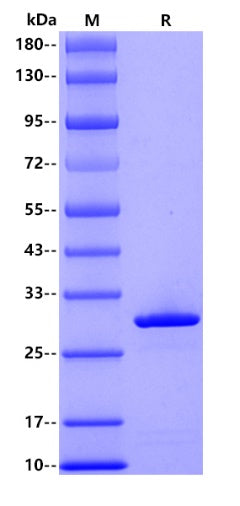
2 μg(R: reducing conditions)
Human 14-3-3 zeta, His tag
Human 14-3-3 zeta, His tag
Price:
Regular price
$195 USD
Regular price
Sale price
$195 USD
Unit price
per
For shipping services or bulk orders, you may request a quotation.
Secure checkout with

View full details
Product Details
Product Details
Product Specification
| Species | Human |
| Synonyms | Protein kinase C inhibitor protein 1 (KCIP-1) |
| Accession | P63104 |
| Amino Acid Sequence | Protein sequence (P63104, Met1-Asn245, with C-10*His)MDKNELVQKAKLAEQAERYDDMAACMKSVTEQGAELSNEERNLLSVAYKNVVGARRSSWRVVSSIEQKTEGAEKKQQMAREYREKIETELRDICNDVLSLLEKFLIPNASQAESKVFYLKMKGDYYRYLAEVAAGDDKKGIVDQSQQAYQEAFEISKKEMQPTHPIRLGLALNFSVFYYEILNSPEKACSLAKTAFDEAIAELDTLSEESYKDSTLIMQLLRDNLTLWTSDTQGDEAEAGEGGENGGGGSHHHHHHHHHH |
| Expression System | E. coli |
| Molecular Weight | Predicted MW: 29.4 kDaObserved MW: 30 kDa |
| Purity | >95% by SDS-PAGE |
| Endotoxin | <1EU/μg |
| Tag | with C-His Tag |
| Physical Appearance | Lyophilized powder |
| Storage Buffer | Lyophilized from a 0.2 μm filtered solution of PBS, pH7.4 with 3% trehalose. |
| Reconstitution | Reconstitute no more than 1 mg/mL according to the size in deionized water after rapid centrifugation. |
| Stability & Storage | 12 months from date of receipt, -20 to -70 °C as supplied. |
Background
14-3-3 protein zeta/delta (14-3-3ζ) is a protein that in humans is encoded by the YWHAZ gene on chromosome 8. The protein is a member of the 14-3-3 protein family and a central hub protein for many signal transduction pathways. 14-3-3ζ functions to protect the cell from environmental stresses, such as chemotherapy-induced death, anoikis, growth factor deprivation, and hypoxia. 14-3-3ζ plays a central role in cell proliferation and, by extension, tumor progression. The protein has been implicated in many cancers, including lung cancer, breast cancer, lymphoma, and head and neck cancer, through pathways such as mTOR, Akt, and glucose receptor trafficking. It has been associated with chemoresistance and is a promising therapeutic target for cancer treatment. It stands to become a prognostic marker for breast cancer, lung cancer, head and neck cancer, and possibly gastric cancer in patients who might require more aggressive treatment. 14-3-3ζ has been implicated in pathogenic infections and neurodegenerative diseases, including Creutzfeldt–Jakob disease, Parkinson’s disease, and Alzheimer’s disease (AD). Furthermore, recent studies have shown the 14-3-3ζ plays a significant clinical role in the suppression of the RA symptoms in experimental animals.
Picture
Picture
SDS-PAGE