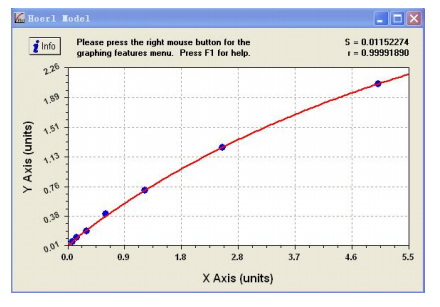
Typical standard test data
Protein A Residue Detection Kit
Protein A Residue Detection Kit
Price:
Regular price
$750 USD
Regular price
Sale price
$750 USD
Unit price
per
For shipping services or bulk orders, you may request a quotation.
Secure checkout with

View full details
Product Details
Product Details
Product Specification
| Usage |
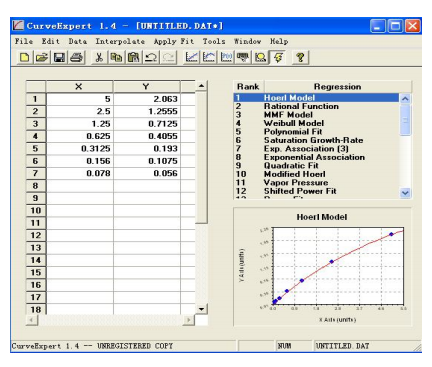
1. Self-prepared materials: 1 、 10-1000uL Pipettes, single and multi-channel 2 、 100mL And 1000mL Beaker of 3 Deionized water 4 , various types of centrifuge tubes 5 , microplate reader (test 450nm ) 6 Data processing and analysis software 2. Reagent preparation: 1 , Please place this kit at room temperature before use ( 20-25℃ )。 2 Wash liquid preparation: 30mL Wash liquid ( 10x ) added to 270mL Deionized water, evenly mixed to obtain 300mL Working washing liquid. If there are crystals in it, please dissolve and mix well before using. 3 Other reagents are used directly without dilution. 3. Sample processing process: 1 If the sample needs to be diluted, use the sample diluent in the kit for dilution, which can be diluted in 96 Orifice plate or EP Conducted in the tube. 2 Ensure that the volume of each well (tube) containing the sample is 100uL 。 3 Additionally added 100uL Standards and controls into the wells. 4 , adding each well 50uL Acidification solution, mix well by blowing, incubate at room temperature 10min (Make the sample proteinA And antibody acidification isolation). 4. Kit operation steps: 1 Standard dilution: 8 Centrifuge tube markers 1#-8# , take 990uL Sample dilution was added to 1# And 2# In the tube, take 500uL Sample dilution was added to 3#-8# In the tube. Take again 10uL Sample standards are added to 1# In the tube, swirl and mix well before taking 10uL Then add to 2# Vortex in the tube and mix well. Then take 2# Tube 500uL Liquid added to 3# Vortex in the tube and mix evenly, then take 3# Tube 500uL Liquid to 4# Vortex in the tube and mix well, so until 8# Tube.  After complete dilution , 2#-8# In centrifuge tube protein A The concentrations of the standards are 5 、 2.5 、 1.25 、 0.625 、 0.3125 、 0.156 、 0.078ng/mL 。 Another tube is marked as 0ng/mL , sample dilution was added. Once the standards and samples are ready, the sample processing procedure is entered. 2 , in the cover protein A The antibody is added to the enzyme label plate 100uL/ Wells of biotin-labeled binding antibody. 3 Re-join 25uL Acidified standards, samples, controls and blanks into appropriate wells and incubated at room temperature 1h 。 4 Spin drying, washing 4 Times later, join 100uL/ Avidin labeling of wells HRP , room temperature incubation 10min 。 5 Spin drying, washing 4 Times later, join 100uL/ Porous TMB Chromogenic solution, color development 10min , join 100uL/ Well stop fluid, then in 450nm The absorbance value is detected at. V. Data processing and result analysis: Utilize software such as Curve Expert Or ELISA Calc ) Establish the detection standard curve through the standard concentration gradient, and put OD The correspondence between the value and the standard concentration is determined by 4 Parametric logistic fitting or cubic polynomial linear fitting into a standard curve, and then the test sample OD The value is brought into the corresponding curve equation to calculate the corresponding sample concentration. VI. Analytical method indicators: 1 Precision: at sample concentration greater than 0.3ng/mL When, the detection coefficient of variation is less than 10% ; Sample concentration is less than 0.3ng/mL When, the detection coefficient of variation is slightly greater than 10% 。 2 It is recommended that when testing specific samples, the method of adding quality control products should be used to investigate the influence of sample matrix effect on the test results. 3 The sensitivity of this kit is 0.05ng/mL 。 4 , hook effect: This kit is a double antibody sandwich one-step method, and the concentration that produces the hook effect is 10ug/mL 。 |
| Theory | This kit adopts the technical method of double antibody sandwich labeled with biotin system. The enzyme label plate is pre-coated with a specific monoclonal antibody of protein A. The sample containing protein A is diluted with a sample diluent, and then the acidification solution is mixed to separate protein A from the antibody product. The sample reacts with the protein A capture antibody pre-coated on the enzyme label plate. A biotin-labeled detection antibody is added to form a sandwich complex. Then wash to remove substances that did not participate in the reaction, add avidin-labeled HRP, incubate for a short time, carry out TMB color development, then add stop solution to stop the color development reaction, detect the absorbance value at 450nm, and the OD value is proportional to the sample content. |
| Description | This protein A Detection ELISA The kit is used to quantitatively detect unnatural proteins such as recombinant alkali resistance A , can only be used for scientific research and production, and cannot be used for the diagnosis and treatment of human or animal diseases. This kit provides an acidification treatment method of the sample, and the protein A From IgG Isolated from the product, at the concentration of humanized monoclonal antibody as high as 2mg/mL In the case of protein A The limit of detection is as low as 78pg/mL Following. Product Components: 1 、 Protein A Standard ( proteinA Protein Standard) Recombinant Alkali-tolerant Protein A in a protein matrix with preservative, 50ug/mL, 1x0.1mL 2 、 Biotinylated Antibody (Biotin-Labeled Antibody) Biotinylated anti-protein A monoclonal antibody in a protein matrix with preservative, 1x13mL 3 、 Sample Diluent (Sample dilution) Tris buffered saline with a protein matrix andpreservative, 1x30mL 4 、 Denaturing Buffer (Acidification Buffer) Citrate buffer with detergent and preservative, 1x20mL 5 、 10x Assay Buffer ( 10x ) Wash buffer phosphate buffer with preservative, 1x30mL 6 、 Streptavidin labeled HRP Avidin-labeled HRP Streptavidin labeled HRP in a protein matrix withpreservative, 1x13mL 7 、 TMB Substrate ( TMB Chromogenic solution) 3,3’,5,5’Tetramethylbenzidine, 1x13mL 8 、 Stop Solution (Stop Solution) 2M sulphuric acid, 1x13mL 9 、 Monoclonal anti-Protein A Coated plate of 96 wells (coating proteinA Antibodies 96 Well plate) 12x8 well strips in a bag with desiccant |
| General Notes | 1. This kit can only be used for scientific research and production, not for in vitro diagnosis. 2. The terminating solution is 2M sulfuric acid, avoid contact with eyes, skin and clothes. Apart from this, the reagents in this kit will not cause any harm to the human body. 3. High or low PH value, detergent, urea, high salt concentration and organic reagents are all influencing factors of ELISA method. PH has a great influence. The PH value of the sample should be controlled at 7.0-7.4. 4. If you have any questions during use, please contact our technical department. |
| Storage Temp. | Stored at 2-8 ℃, valid for 6 months. |
Picture
Picture
Immunohistochemistry
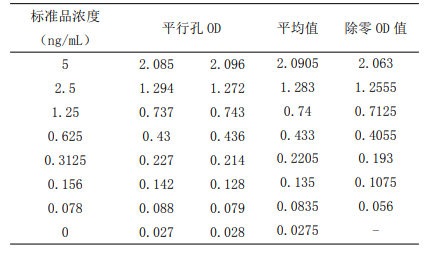
Typical standard test data
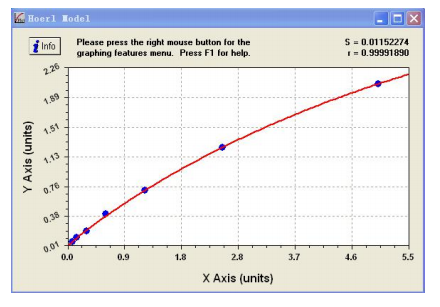
Curve fitting