Alexa Fluor® 647 Human Anti-Human CD40 Antibody (ABBV-323)
Alexa Fluor® 647 Human Anti-Human CD40 Antibody (ABBV-323)

Product Details
Product Details
Product Specification
| Host | Human |
| Antigen | CD40 |
| Synonyms | Tumor necrosis factor receptor superfamily member 5; B-cell surface antigen CD40; Bp50; CD40L receptor; CDw40; TNFRSF5 |
| Location | Cell membrane |
| Accession | P25942 |
| Clone Number | ABBV-323 |
| Antibody Type | Recombinant mAb |
| Isotype | IgG1,κ |
| Application | FCM |
| Reactivity | Hu |
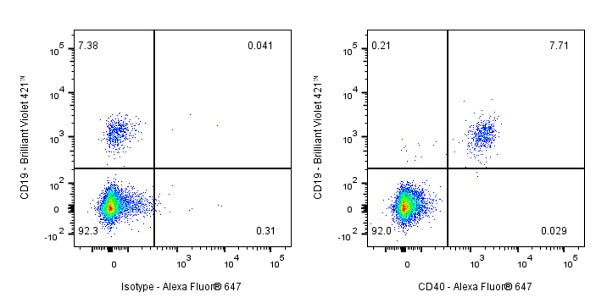
| Positive Sample | Human PBMC |
| Purification | Protein A |
| Concentration | 0.002mg/ml |
| Conjugation | Alexa Fluor® 647 |
| Physical Appearance | Liquid |
| Storage Buffer | PBS, 1% BSA, 0.3% Proclin 300 |
| Stability & Storage | 12 months from date of receipt / reconstitution, 2 to 8 °C as supplied. |
Dilution
| application | dilution | species |
| FCM | 5 μl per million cells in 100μl volume | Hu |
Background
CD40 is a member of the tumor necrosis factor receptor superfamily and is primarily involved in regulating immune responses. It is highly expressed on cells such as B cells, dendritic cells (DCs), and monocytes, and plays a crucial role in linking innate and adaptive immunity. CD40 signaling is a key trigger in the maturation process of monocytes, mainly driving differentiation into M1-type macrophages and DCs. On DC surfaces, CD40 is involved in promoting the production of cytokines and chemokines, inducing the expression of costimulatory molecules, and enhancing antigen cross-presentation. CD40 is also expressed on various types of cells, including fibroblasts, endothelial cells, and certain hematopoietic and epithelial tumor cells. In the context of CAR-T cell therapy, the expression of CD40L on the surface of CAR-T cells has been explored to enhance their anti-tumor functions.
Picture
Picture
FC