Comparison of UA-Glo Cell Viability Reagent and CellTiter-Glo® Luminescent Cell Viability Assay Reagent (PC):
HEK293, HeLa, and HepG2 cells were resuspended in DMEM (10% FBS), and 100 μL of cell suspension containing 50,000 or 5,000 cells was seeded into a 96-well clear-bottom plate. After adding 50 μL of either UA-Glo Cell Viability Reagent or the PC brand reagent, plates were read at 10 minutes post-addition.
UA-Glo® Luminescent Cell Viability Assay
UA-Glo® Luminescent Cell Viability Assay
Price:
Regular price
$45 USD
Regular price
Sale price
$45 USD
Unit price
per
For shipping services or bulk orders, you may request a quotation.
Secure checkout with

View full details
Product Details
Product Details
Product Specification
| Stability & Storage |
Dry ice transport. Store protected from light at −20°C or below; for long-term (>3 months) storage, we recommend −80°C. The shelf life is 12 months. After first use, it is recommended to aliquot the reagent and store it protected from light at −20°C or below; when aliquoting, take care to avoid ATP contamination. The reagent can be frozen and thawed no more than five times.The reagent can be stored at 4°C for 4 days, or at room temperature (22°C) for 1 day without affecting its function, and its signal intensity remains >90% compared to that of the reagent stored at −80°C.
|
Background
The UA-Glo homogeneous ready-to-use cell viability assay kit is designed for quantitatively measuring ATP levels in live cells, thereby indirectly determining the number of viable cells. This reagent features high signal-to-noise ratio, excellent reproducibility, and outstanding stability. Its ready-to-use formulation eliminates the need for separate lysis and detection steps, reducing errors caused by frequent pipetting. The stable glow-type signal makes this product particularly suitable for high-throughput tumor cell proliferation assays and compound screening.
Components
UA-Glo® CTGThe components and specifications of the cell viability assay kit are as follows:
Specification |
Assay96-Number of wells in a plate |
Assay384-Number of wells in a plate |
10 mL |
100 |
500 |
10 x 10 mL |
1,000 |
5,000 |
100 mL |
1,000 |
5,000 |
10 x 100 mL |
10,000 |
50,000 |
Protocol
UA-Glo® CTG cell viability assay kit determines the number of viable cells by detecting ATP levels in living cells through a luciferase reaction. The luciferase reaction is highly sensitive, and parameters such as pH, temperature, and experimental setup can significantly affect the reaction; therefore, direct comparison of absolute sample readings is generally not recommended under most experimental conditions. It is advised to set up the same reference controls on each experimental plate—for example, in tumor cell proliferation assays, use the same toxic reference compound and solvent carrier control—and normalize the sample readings against these controls before data processing and comparison.
1) Seed experimental cells at an appropriate density into 96-well or 384-well white transparent cell culture plates.
2) After performing cell treatment according to experimental requirements, proceed with cell viability detection.
3) Take out the UA-Glo® CTG cell viability assay reagent. After the reagent has completely melted, equilibrate it to room temperature (22℃-25℃), and invert it thoroughly to mix.
4) Take out the experimental cell plate and equilibrate it to room temperature. The luciferase reaction is sensitive to temperature changes. Both the assay reagent and the cell plate must be brought to room temperature, and the test should be conducted at a constant temperature (±1℃).
5) Add to each well of the experimental cell plate an equal volume of UA-Glo® CTG cell viability assay reagent as the culture medium in that well. For example, add 100 µL of the assay reagent to cells in a 96-well plate containing 100 µL of medium, and add 20 µL of the assay reagent to cells in a 384-well plate containing 20 µL of medium.
6) Shake the plate at medium speed for 2 minutes, then place it in the dark and incubate for 10 minutes to stabilize the luminescence signal.
7) On a chemiluminescence instrument (supporting 96-well or 384-well plates) or a multifunctional plate reader, select the "LUM" mode to read the luminescence signal; plate reading can be performed within 10 minutes to 3 hours.For most cells,CTGThe cell viability assay reagent should be used under the detection conditions specified in the instructions, with the environment and detection temperature maintained at22℃approximately, the half-life of the detection signal is>3 hours.
Guidelines
1) Mixing different batches is not recommended.
Picture
Picture
Bioactivity
UA-Glo Cell Viability Assay Reagent Stability Test:
The UA-Glo cell viability assay reagent was tested after storage at room temperature for 8 hours (RT-8hr), at 4°C for 2 days and 4 days, and after five freeze-thaw cycles (T1-T5). HeLa cells were seeded into a 96-well opaque white plate at 2.5 × 10⁴ cells per well, with 100 µL per well, in triplicate. The UA-Glo cell viability reagent was added at 50 µL per well and mixed thoroughly. Fluorescence readings were taken 10 minutes later.
100 μL containing 50,000 HEK293 cells was added to 100 μL of reagent. The left figure shows the RLU reading (10-6 hr), and the right figure represents the signal stability, with 10 minutes set as 1.
100 uL containing 5,000 HEK293 cells were added to 100 uL of reagent. The left figure shows the RLU reading (10-6 hr), and the right figure represents the signal stability, with 10 minutes set as 1.
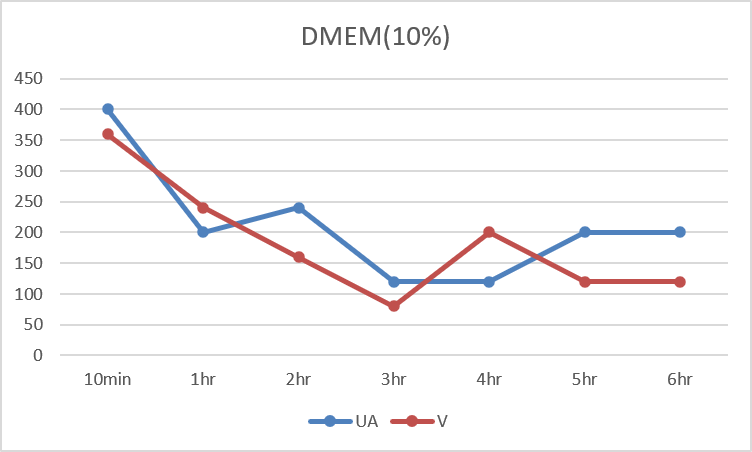
Add 100 uL of DMEM (containing 10% FBS) and 100 uL of the test sample with RLU readings (10-6 hr)