


A: Fluc activity after R1 addition
B: Remaining FLuc activity after R1+R2 addition
C: Rluc activity after R1+(R2+Sub) addition

| Synonyms | Dual-Luciferase Assay Kit |
| Stability & Storage |
Dry ice transportation. Store away from light at -20°C or below, with R2 substrate stored at -80°C. For long-term storage (>2 months), it is recommended to store at -80°C. Refer to the reagent label for the expiration date. After initial use, it is advised to aliquot the reagent and store it away from light at -20°C or below. |
The dual-luciferase reporter gene system is widely used in functional studies of mammalian cells, including cell metabolism, signaling pathways, transcription factors, gene function, and drug screening. In the dual-luciferase reporter system, one luciferase serves as the experimental reporter gene to indicate the activity of the target under investigation, while the other luciferase acts as the control reporter gene, used to normalize the activity of the experimental reporter gene. This minimizes experimental errors caused by factors such as transfection efficiency, cell count, cell lysis efficiency, and sample volume.The UA-Glo dual-luciferase assay kit enables the detection of firefly luciferase and Renilla luciferase expression in the same sample, offering advantages such as high sensitivity, stability, reproducibility, and ease of use.
The UA-Glo Dual-Luciferase Assay Kit consists of R1 reagent, R2 buffer, and R2 substrate. The specifications are as follows. The detectable number of wells for 96-well/384-well plates is calculated based on a culture medium volume of 50/20 µL per well, with the addition of 50/20 µL of R1 reagent and 50/20 µL of R2 reagent.
Specification |
R1 Reagent |
R2 Buffer |
R2 Substrate |
Detectable 96-well Plate Wells |
Detectable 384-well Plate Wells |
10 mL |
10 mL |
10 mL |
100 µL |
200 |
500 |
100 mL |
100 mL |
100 mL |
The luciferase reaction exhibits extremely high sensitivity, andpH, temperature, experimental system settings, and other parameters significantly affect the reaction. Under most experimental conditions, it is not recommended to directly compare the absolute readings of samples. For inter-plate data comparison, appropriate control samples must be included on all plates as inter-plate internal references. Experimental data from each plate should be normalized using the inter-plate internal reference before comparison. The reading time after addingR1andR2reagents to each experimental plate should be kept consistent to ensure equal signal decay rates across plates.
Seed cells at an appropriate density in96-well or384-well white cell culture plates. Transfect with vectors expressing firefly and Renilla luciferases as required, or directly use stable cell lines capable of expressing this dual-luciferase system.
Treat the cells according to experimental requirements and incubate for an appropriate duration.
Remove the experimental cell plate and equilibrate to room temperature (22-25℃). The luciferase reaction is temperature-sensitive. Reagents and the experimental cell plate should be equilibrated to room temperature prior to detection, and a constant temperature should be maintained during the assay(±1℃)
Remove the detection reagents and equilibrate to room temperature.
Reagent Preparation:R1reagent can be used directly.R2substrate is a100x concentrate. Dilute withR2buffer to prepare1x R2reagent.R2reagent should be prepared fresh as needed. After first use, aliquotR1reagent andR2buffer,-20℃ or lower for storage.R2substrate should be stored at-80℃.
Add an equal volume ofR1reagent to the experimental cell plate. For example, add50µL R1to a well containing50 µLcell culture medium in a96-well experimental cell plate. The volume ratio of cell culture medium,R1andR2reagents is1:1:1. Unless validated, it is not recommended to alter the detection reagent ratios.
Shake the plate at medium speed for2min, then place in the dark to continue lysis for10min
Read the luminescence signal on a luminometer. This is the firefly luciferase activity reading.
Add an equal volume ofR1reagent to the wells of the experimental cell plate described above.R2reagent. It is recommended to addR1reagent within2hrof addingR2reagent to obtain optimal results.
Shake the plate at medium speed for2minto mix thoroughly, then place in the dark to continue lysis for10min
Read the luminescence signal on a luminometer. This is the Renilla luciferase activity reading.
Calculate the ratio of the firefly luciferase activity reading to the Renilla luciferase activity reading, and use this ratio for subsequent data processing.
1) Different batches are not recommended for mixed use 2) Without strict validation, it is not recommended to alter the dosage of detection reagents 3) For research use only
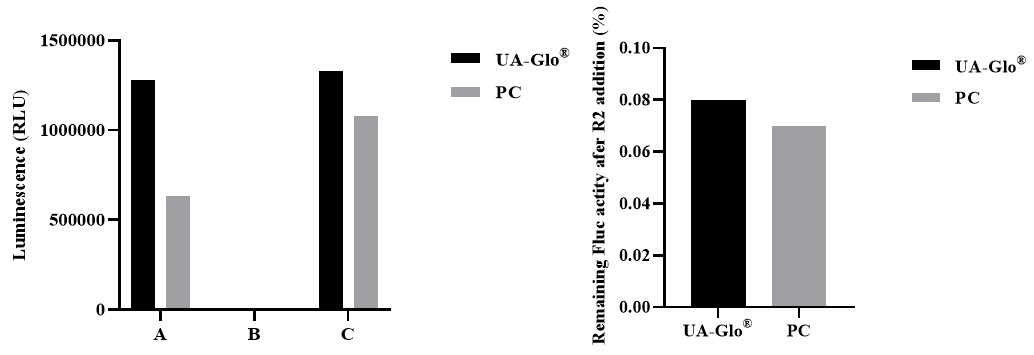
A: Fluc activity after R1 addition
B: Remaining FLuc activity after R1+R2 addition
C: Rluc activity after R1+(R2+Sub) addition
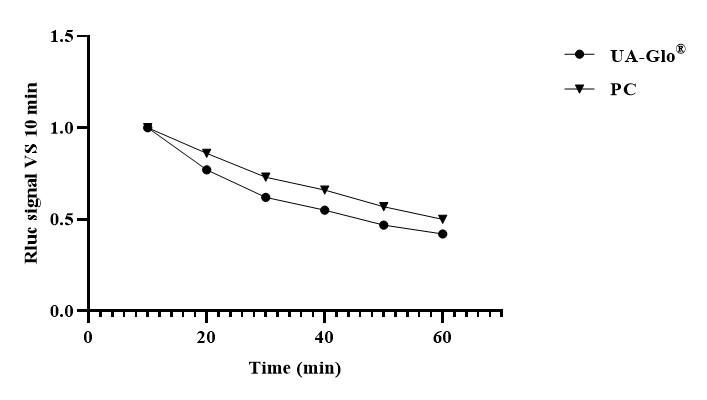
Stability testing


