WB result of SOX4 Recombinant Rabbit mAb
Primary antibody: SOX4 Recombinant Rabbit mAb at 1/1000 dilution
Lane 1: Jurkat whole cell lysate 20 µg
Lane 2: SH-SY5Y whole cell lysate 20 µg
Lane 3: HEK-293 whole cell lysate 20 µg
Secondary antibody: Goat Anti-rabbit IgG, (H+L), HRP conjugated at 1/10000 dilution
Predicted MW: 47 kDa
Observed MW: 70 kDa
SOX4 Recombinant Rabbit mAb (S-2207-103)
SOX4 Recombinant Rabbit mAb (S-2207-103)
Price:
Regular price
$100 USD
Regular price
Sale price
$100 USD
Unit price
per
For shipping services or bulk orders, you may request a quotation.
Secure checkout with

View full details
Product Details
Product Details
Product Specification
| Host | Rabbit |
| Antigen | SOX4 |
| Synonyms | Transcription factor SOX-4 |
| Immunogen | Synthetic Peptide |
| Location | Nucleus |
| Accession | Q06945 |
| Clone Number | S-2207-103 |
| Antibody Type | Recombinant mAb |
| Isotype | IgG |
| Application | WB, ICC |
| Reactivity | Hu, Mk |
| Positive Sample | Jurkat, SH-SY5Y, HEK-293 |
| Purification | Protein A |
| Concentration | 0.5 mg/ml |
| Conjugation | Unconjugated |
| Physical Appearance | Liquid |
| Storage Buffer | PBS, 40% Glycerol, 0.05% BSA, 0.03% Proclin 300 |
| Stability & Storage | 12 months from date of receipt / reconstitution, -20 °C as supplied |
Dilution
| application | dilution | species |
| WB | 1:1000 | Hu, Mk |
| ICC | 1:500 | Hu |
Background
SOX4 (SRY-related HMG-box 4) is a 47-kDa transcription factor that contains a canonical high-mobility-group (HMG) DNA-binding domain and a C-terminal trans-activation domain rich in serine and proline residues; it binds to the minor groove of the consensus motif 5′-AACAAT-3′, thereby bending flanking chromatin and recruiting co-factors such as p300, β-catenin, and POU-domain proteins to activate or repress target genes involved in Wnt, TGF-β, Notch and PI3K/AKT signaling. During embryogenesis SOX4 drives differentiation and survival of neural, cardiac, pancreatic and lymphoid progenitors, while in post-natal life its expression is sharply down-regulated except in selected stem-cell niches and activated lymphocytes. In cancer, SOX4 is frequently re-amplified at 6p22.3 and its over-expression—mediated by miR-129-2 methylation, TCF/LEF or NF-κB signaling—promotes epithelial-to-mesenchymal transition, invasion, angiogenesis and chemo-resistance in breast, prostate, lung, hepatic, colorectal and hematopoietic malignancies through direct trans-activation of MMP9, VEGF, PD-L1, BMI1 and ABCC3, and by stabilizing β-catenin and Snail. Consequently, high SOX4 levels correlate with advanced stage, metastasis and poor prognosis, and CRISPR-deletion or pharmacologic inhibition of SOX4 (e.g., by flavopiridol or HDAC inhibitors) suppresses tumor growth and sensitizes cells to cisplatin or imatinib, validating SOX4 as both a master developmental regulator and an attractive oncotherapeutic target.
Picture
Picture
Western Blot
WB result of SOX4 Recombinant Rabbit mAb
Primary antibody: SOX4 Recombinant Rabbit mAb at 1/1000 dilution
Lane 1: COS-7 whole cell lysate 20 µg
Secondary antibody: Goat Anti-rabbit IgG, (H+L), HRP conjugated at 1/10000 dilution
Predicted MW: 70 kDa
Observed MW: 70 kDa
Immunocytochemistry
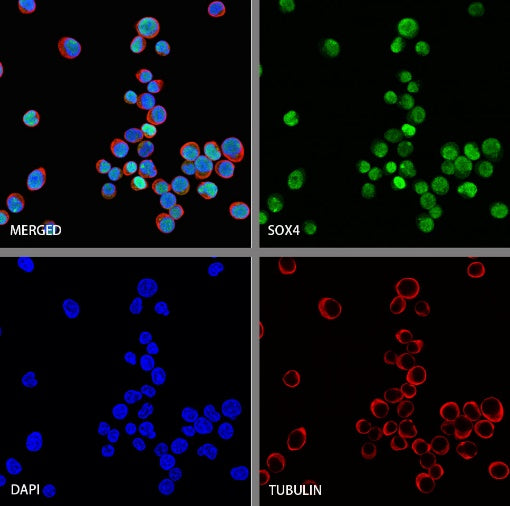
ICC shows positive staining in Jurkat cells. Anti-SOX4 antibody was used at 1/500 dilution (Green) and incubated overnight at 4°C. Goat polyclonal Antibody to Rabbit IgG - H&L (Alexa Fluor® 488) was used as secondary antibody at 1/1000 dilution. The cells were fixed with 4% PFA and permeabilized with 0.1% PBS-Triton X-100. Nuclei were counterstained with DAPI (Blue). Counterstain with tubulin (Red).