WB result of Phospho-c-Jun (Ser73) Recombinant Rabbit mAb
Blocking/Diluting buffer and concentration: 5% NFDM/TBST
Primary antibody: Phospho-c-Jun (Ser73) Recombinant Rabbit mAb at 1/1000 dilution
Lane 1: untreated HeLa whole cell lysate 20 µg
Lane 2: HeLa treated with 25 μg/mL Anisomycin for 30 minutes whole cell lysate 20 µg
Secondary antibody: Goat Anti- rabbit IgG, (H+L), HRP conjugated at 1/10000 dilution
Predicted MW: 36 kDa
Observed MW: 39 kDa
Phospho-c-Jun (Ser73) Recombinant Rabbit mAb (S-3105-71)
Phospho-c-Jun (Ser73) Recombinant Rabbit mAb (S-3105-71)
Price:
Regular price
$100 USD
Regular price
Sale price
$100 USD
Unit price
per
For shipping services or bulk orders, you may request a quotation.
Secure checkout with

View full details
Product Details
Product Details
Product Specification
| Host | Rabbit |
| Antigen | c-Jun |
| Synonyms | Transcription factor Jun; Activator protein 1 (AP1); Proto-oncogene c-Jun; Transcription factor AP-1 subunit Jun; V-jun avian sarcoma virus 17 oncogene homolog; p39; JUN |
| Immunogen | Synthetic Peptide |
| Location | Nucleus |
| Accession | P05412 |
| Clone Number | S-3105-71 |
| Antibody Type | Recombinant mAb |
| Isotype | IgG |
| Application | WB, ICC |
| Reactivity | Hu, Ms, Rt |
| Positive Sample | Anisomycin treated HeLa cells, Anisomycin treated NIH/3T3 cells, Anisomycin treated C6 cells, |
| Purification | Protein A |
| Concentration | 0.5 mg/ml |
| Conjugation | Unconjugated |
| Physical Appearance | Liquid |
| Storage Buffer | PBS, 40% Glycerol, 0.05% BSA, 0.03% Proclin 300 |
| Stability & Storage | 12 months from date of receipt / reconstitution, -20 °C as supplied |
Dilution
| application | dilution | species |
| WB | 1:1000 | Hu, Ms, Rt |
| ICC | 1:500 | Hu |
Background
Phospho-c-Jun (Ser73) refers to the specific post-translational modification where the transcription factor c-Jun is phosphorylated at its serine 73 residue. As a key component of the Activator Protein-1 (AP-1) transcription complex, c-Jun's activity is tightly regulated by the c-Jun N-terminal kinase (JNK) signaling pathway. Upon cellular exposure to stress signals such as UV radiation, cytokine stimulation, or genotoxic stress, JNK becomes activated through phosphorylation and subsequently phosphorylates c-Jun specifically at Ser73. This phosphorylation event is crucial for enhancing c-Jun's transcriptional activity, significantly potentiating the expression of its target genes that govern critical cellular processes including proliferation, differentiation, apoptosis, and inflammatory responses. Consequently, the phosphorylation level at Ser73 serves as a well-established readout for JNK pathway activation, and researchers commonly detect this modification using phospho-specific antibodies through techniques like Western Blotting to assess cellular stress response intensity and related signal transduction events.
Picture
Picture
Western Blot
WB result of Phospho-c-Jun (Ser73) Recombinant Rabbit mAb
Blocking/Diluting buffer and concentration: 5% NFDM/TBST
Primary antibody: Phospho-c-Jun (Ser73) Recombinant Rabbit mAb at 1/1000 dilution
Lane 1: untreated NIH/3T3 whole cell lysate 20 µg
Lane 2: NIH/3T3 treated with 25 μg/mL Anisomycin for 35 minutes whole cell lysate 20 µg
Secondary antibody: Goat Anti- rabbit IgG, (H+L), HRP conjugated at 1/10000 dilution
Predicted MW: 36 kDa
Observed MW: 39 kDa
WB result of Phospho-c-Jun (Ser73) Recombinant Rabbit mAb
Blocking/Diluting buffer and concentration: 5% NFDM/TBST
Primary antibody: Phospho-c-Jun (Ser73) Recombinant Rabbit mAb at 1/1000 dilution
Lane 1: untreated C6 whole cell lysate 20 µg
Lane 2: C6 treated with 25 μg/mL Anisomycin for 30 minutes whole cell lysate 20 µg
Secondary antibody: Goat Anti- rabbit IgG, (H+L), HRP conjugated at 1/10000 dilution
Predicted MW: 36 kDa
Observed MW: 39 kDa
Immunocytochemistry
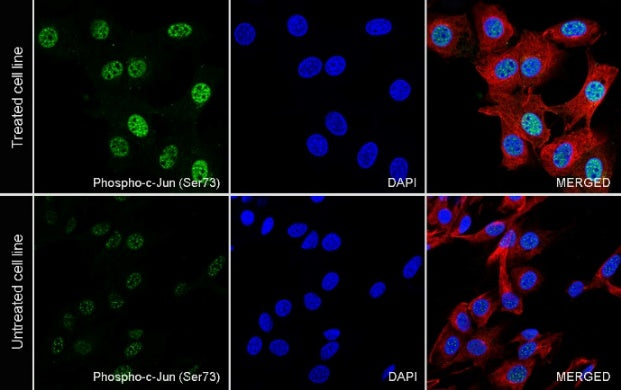
ICC analysis of NIH/3T3 cells treated with Anisomycin (25μg/ml, 30min) (top panel) and untreated NIH/3T3 cells (below panel). Anti- Phospho-c-Jun (Ser73) antibody was used at 1/500 dilution (Green) and incubated overnight at 4°C. Goat polyclonal Antibody to Rabbit IgG - H&L (Alexa Fluor® 488) was used as secondary antibody at 1/1000 dilution. The cells were fixed with 4% PFA and permeabilized with 0.1% PBS-Triton X-100. Nuclei were counterstained with DAPI (Blue). Counterstain with tubulin (Red).