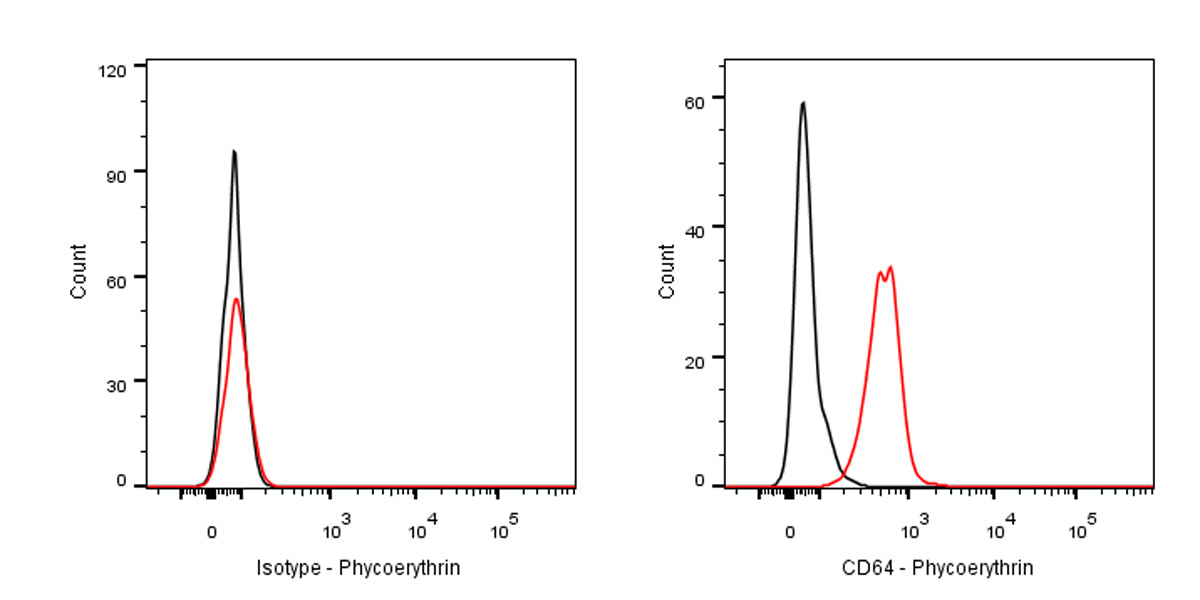
Flow cytometric analysis of Mouse CD64 expression on RAW 264.7 cells. Cells from the RAW 264.7 (Mouse Abelson murine leukemia virus-induced tumor macrophage, Right) or C2C12 (Mouse myoblasts myoblast, Left) was stained with either PE Mouse IgG1, κ Isotype Control (Black line histogram) or SDT PE Mouse Anti-Mouse CD64 Antibody (Red line histogram) at 5 μl/test. Flow cytometry and data analysis were performed using BD FACSymphony™ A1 and FlowJo™ software.
PE Mouse Anti-Mouse CD64 Antibody (X54-5/7.1)
PE Mouse Anti-Mouse CD64 Antibody (X54-5/7.1)
Price:
Regular price
$165 USD
Regular price
Sale price
$165 USD
Unit price
per
For shipping services or bulk orders, you may request a quotation.
Secure checkout with

View full details
Product Details
Product Details
Product Specification
| Host | Mouse |
| Antigen | CD64 |
| Synonyms | High affinity immunoglobulin gamma Fc receptor I; IgG Fc receptor I; Fc-gamma RI (FcRI); Fcg1; Fcgr1 |
| Location | Cell membrane |
| Accession | P26151 |
| Clone Number | X54-5/7.1 |
| Antibody Type | Mouse mAb |
| Isotype | IgG1,k |
| Application | FCM |
| Reactivity | Ms |
| Positive Sample | RAW 264.7 |
| Purification | Protein G |
| Concentration | 0.2 mg/ml |
| Conjugation | PE |
| Physical Appearance | Liquid |
| Storage Buffer | PBS, 1% BSA, 0.3% Proclin 300 |
| Stability & Storage | 12 months from date of receipt / reconstitution, 2 to 8 °C as supplied |
Dilution
| application | dilution | species |
| FCM | 5μl per million cells in 100μl volume | Ms |
Background
CD64, also known as Fc-gamma receptor I (FcγRI), is a 72-kDa type I transmembrane glycoprotein encoded by the FCGR1A gene on chromosome 1. It belongs to the immunoglobulin superfamily and is composed of three extracellular Ig-like C2-type domains, a single transmembrane region, and a short cytoplasmic tail that associates with the Fc receptor γ-chain containing an ITAM motif to mediate intracellular signaling. CD64 is constitutively expressed on monocytes, macrophages, and dendritic cells, and can be rapidly up-regulated on neutrophils by pro-inflammatory stimuli such as IFN-γ, LPS, or G-CSF. It functions as a high-affinity receptor for the Fc portion of IgG, particularly IgG1 and IgG3, enabling key immune processes including phagocytosis, antigen presentation, antibody-dependent cellular cytotoxicity (ADCC), and the release of reactive oxygen species and cytokines. Its expression is tightly linked to innate immune activation, making CD64 a sensitive biomarker for bacterial infections and inflammatory disorders such as sepsis and rheumatoid arthritis.
Picture
Picture
FC