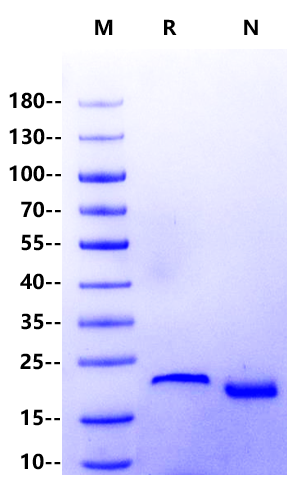
1μg (R: reducing condition, N:non-reducing condition).
KRAS(G12D) His Tag Protein, Human
KRAS(G12D) His Tag Protein, Human
Price:
Regular price
$195 USD
Regular price
Sale price
$195 USD
Unit price
per
For shipping services or bulk orders, you may request a quotation.
Secure checkout with

View full details
Product Details
Product Details
Product Specification
| Species | Human |
| Synonyms | K-Ras 2, Ki-Ras, c-K-ras, c-Ki-ras, GTPase KRas, KRAS2, RASK2 |
| Accession | P01116-2 |
| Amino Acid Sequence | Thr2-Cys185(G12D)with His Tag at the C-Terminus |
| Expression System | E.coli |
| Molecular Weight | 20-25kDa (Reducing) |
| Purity | >95% by SDS-PAGE |
| Conjugation | Unconjugated |
| Tag | His Tag |
| Physical Appearance | Liquid |
| Storage Buffer | 20 mM Tris, 150 mM NaCl, 1 mM DTT, PH7.4 ,10% glycerol |
| Reconstitution | Reconstitute at 0.1-1 mg/ml according to the size in ultrapure water after rapid centrifugation. |
| Stability & Storage | Stable for 12 months upon stored at -80℃ from the date of receipt. And avoid repeated freeze-thaws cycles. |
| Reference | 1. Gremer L, Merbitz-Zahradnik T, Dvorsky R, Cirstea IC, Kratz CP, Zenker M, Wittinghofer A, Ahmadian MR. Germline KRAS mutations cause aberrant biochemical and physical properties leading to developmental disorders. Hum Mutat. 2011 Jan;32(1):33-43. |
Background
The KRAS protein (Kirsten rat sarcoma viral oncogene homolog) is a small GTPase protein whose structure comprises a G-domain (responsible for GTP/GDP binding) and a hypervariable region. The G12D mutation refers to the substitution of glycine at position 12 (Gly12) with aspartic acid (Asp), which prevents GAP (GTPase-activating protein) from promoting GTP hydrolysis, thereby locking KRAS in a persistently GTP-bound "active" state. This leads to constitutive activation of downstream signaling pathways including RAF-MEK-ERK and PI3K-AKT, driving cellular proliferation, survival, and metabolic reprogramming. Clinically, KRAS G12D represents one of the most prevalent oncogenic mutations in pancreatic cancer (~40%), colorectal cancer, and lung cancer, and has historically been considered "undruggable." However, recent breakthroughs include the development of non-covalent inhibitors (binding the Switch II pocket via salt bridge formation), elucidation of synergistic tumorigenic mechanisms between PTEN loss and G12D, demonstration of G12D-induced immunosuppressive microenvironment conferring resistance to PD-1/PD-L1 inhibitors, and discovery of G12D-specific stem cell reprogramming in lung adenocarcinoma, offering novel directions for precision-targeted therapies and combination immunotherapeutic strategies.
Protocol
Experimental Methods
Experimental Principle: The GTPase Glo™ assay evaluates KRAS activity by measuring the amount of GTP remaining after GTP hydrolysis in the KRAS reaction.
Experimental Materials
1.KRAS(G12D) His Tag Protein, Human
2.GTPase Glo™ Assay (Promega, Catalog # V7681T)
3.Solid white multi-well plate (384-well plate) (Corning, Catalog #3572)
4.Plate Reader (PerkinElmer)
Experimental Steps
1.Prepare a 2X GTP solution containing 10 µM GTP and 2 mM DTT using GTPase/GAP Buffer.
2.Dilute KRAS with GTPase/GAP Buffer to concentrations of 100 µg/mL, 80 µg/mL, and 60 µg/mL, then add 5 µL to each well of a 384-well plate.
3.Add 5 µL of the 2X GTP solution prepared in Step 1 to each well to initiate the reaction. Use 5 µL of GTPase/GAP Buffer mixed with the 2X GTP solution as a blank control. The total reaction volume is 10 µL.
4.Incubate the reaction at room temperature (22–25°C) for 30 minutes.
5.Gently invert and mix the thawed GTPase Glo™ Reagent, 500X; do not vortex. Depending on your needs, adjust the volumes of the following components proportionally to prepare the desired volume of reconstituted GTPase Glo™.
| Sample Name | Amount |
| GTPase Glo ™ Reagent, 500X | 2 μL |
| ADP, 10 mM | 0.5 μL |
| GTPase Glo™ Buffer | 998 μL |
| Total volume | 1 mL |
6.Add 10 µL of the reconstituted GTPase-Glo™ Reagent to the reaction mixture that has completed the reaction, mix briefly, and then incubate with shaking at room temperature (22–25°C) for 30 minutes.
7.Add 20 µL of the detection reagent, and incubate the microplate at room temperature (22–25°C) for 5–10 minutes.
8.Read the results in endpoint mode at an emission wavelength of 555 nm (luminescence).
9.Calculate the specific activity.
| Specific Activity (pmol/min/μg) = | (1 - Sample OD / Blank OD) * 50 pmol |
| Incubation time (min) × amount of enzyme (μg) |
Sample OD value: OD value of remaining ATP
Blank OD value: OD value after adding GTP
50 pmol: Amount of GTP added
Incubation time: 30 minutes
Enzyme amounts: 0.5 μg, 0.4 μg, and 0.3 μg
Picture
Picture
SDS-PAGE