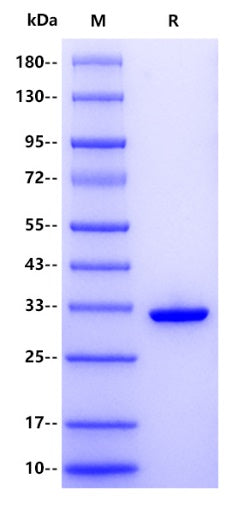
2μg(R: reducing conditions)
Human YWHAE/14-3-3 epsilon Protein, His Tag
Human YWHAE/14-3-3 epsilon Protein, His Tag
Price:
Regular price
$100 USD
Regular price
Sale price
$100 USD
Unit price
per
For shipping services or bulk orders, you may request a quotation.
Secure checkout with

View full details
Product Details
Product Details
Product Specification
| Species | Human |
| Synonyms | 14-3-3 protein epsilon, 14-3-3E |
| Accession | P62258 |
| Amino Acid Sequence | Protein sequence (P62258, Met1-Gln255, with C-His Tag) MDDREDLVYQAKLAEQAERYDEMVESMKKVAGMDVELTVEERNLLSVAYKNVIGARRASWRIISSIEQKEENKGGEDKLKMIREYRQMVETELKLICCDILDVLDKHLIPAANTGESKVFYYKMKGDYHRYLAEFATGNDRKEAAENSLVAYKAASDIAMTELPPTHPIRLGLALNFSVFYYEILNSPDRACRLAKAAFDDAIAELDTLSEESYKDSTLIMQLLRDNLTLWTSDMQGDGEEQNKEALQDVEDENQ |
| Expression System | E. coli |
| Molecular Weight | Predicted MW: 30.9 kDaObserved MW: 32 kDa |
| Purity | >95% by SDS-PAGE |
| Endotoxin | <1EU/μg |
| Conjugation | Unconjugated |
| Tag | with C-His Tag |
| Physical Appearance | Lyophilized powder |
| Storage Buffer | Lyophilized from a 0.2 μm filtered solution of PBS, pH7.4 with 3% trehalose. |
| Reconstitution | Reconstitute no more than 1 mg/mL according to the size in deionized water after rapid centrifugation. |
| Stability & Storage | 12 months from date of receipt, -20 to -70 °C as supplied. |
Background
YWHAE, also known as 14-3-3ε, is a member of the highly conserved 14-3-3 protein family. These proteins function as key regulatory molecules by binding to phosphorylated serine and threonine residues on a vast array of client proteins. Through these interactions, YWHAE modulates critical cellular processes including signal transduction, cell cycle control, apoptosis, and metabolism. It acts as a molecular scaffold, influencing the activity, localization, and stability of its binding partners. Its gene location within the 17p13.3 chromosomal region implicates it in human diseases; deletions encompassing YWHAE are associated with Miller-Dieker syndrome, a severe neuronal migration disorder, highlighting its essential role in brain development. YWHAE is dysregulated in various cancers, underscoring its importance in cellular proliferation and survival pathways.
Picture
Picture
SDS-PAGE