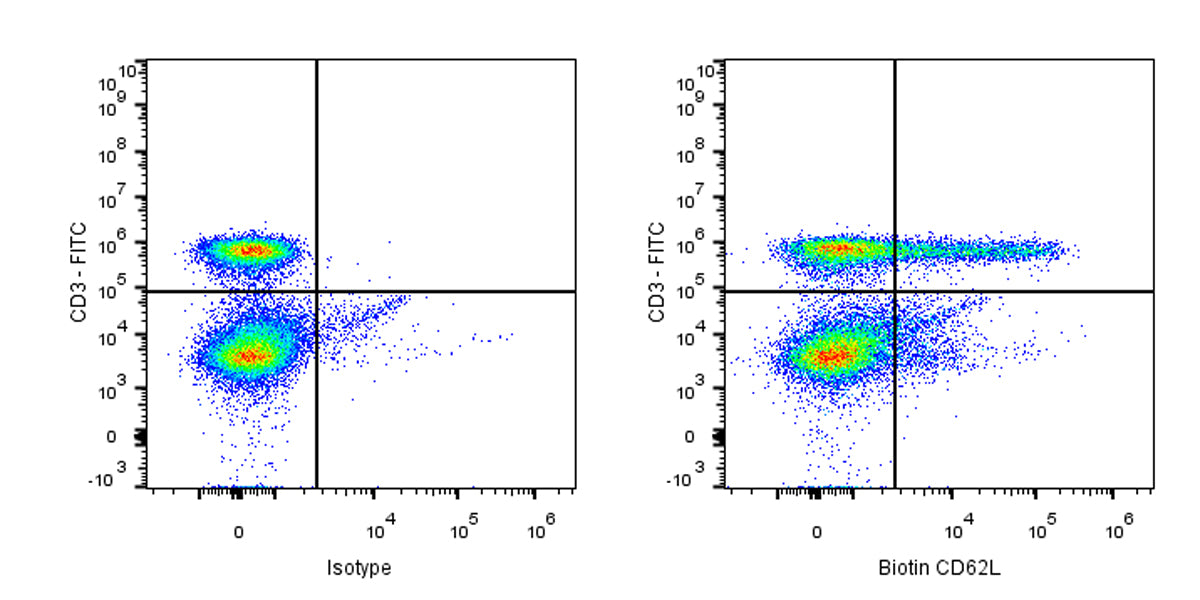
Flow cytometric analysis of Rat CD62L expression on SD Rat splenocytes. SD Rat splenocytes were stained with FITC Mouse Anti-Rat CD3 Antibody and either Biotin Mouse IgG1, κ Isotype Control (Left panel) or SDT Biotin Mouse Anti-Rat CD62L Antibody (Right panel) at 1.25μl/test followed by Sav-PE. Flow cytometry and data analysis were performed using BD FACSymphony™ A1 and FlowJo™ software.
Biotin Mouse Anti-Rat CD62L Antibody (OX-85)
Biotin Mouse Anti-Rat CD62L Antibody (OX-85)
Price:
Regular price
$135 USD
Regular price
Sale price
$135 USD
Unit price
per
For shipping services or bulk orders, you may request a quotation.
Secure checkout with

View full details
Product Details
Product Details
Product Specification
| Host | Mouse |
| Antigen | CD62L |
| Synonyms | L-selectin; CD62 antigen-like family member L; Leukocyte adhesion molecule 1 (LAM-1); Leukocyte-endothelial cell adhesion molecule 1 (LECAM1); Lymph node homing receptor; Lymphocyte antigen 22 (Ly-22); Lymphocyte surface MEL-14 antigen; Lnhr; Ly-22; Sell |
| Location | Cell membrane |
| Accession | P30836 |
| Clone Number | OX-85 |
| Antibody Type | Mouse mAb |
| Isotype | IgG1,k |
| Application | FCM |
| Reactivity | Rt |
| Positive Sample | SD Rat splenocytes |
| Purification | Protein G |
| Concentration | 0.2 mg/ml |
| Conjugation | Biotin |
| Physical Appearance | Liquid |
| Storage Buffer | PBS pH7.4, 0.03% Proclin 300 |
| Stability & Storage | 12 months from date of receipt / reconstitution, 2 to 8 °C as supplied |
Dilution
| application | dilution | species |
| FCM | 1.25μl per million cells in 100μl volume | Rt |
Background
CD62L, also known as L-selectin, is a type of adhesion molecule belonging to the selectin family and is primarily expressed on the surface of leukocytes, including T cells, B cells, and natural killer cells. It plays a crucial role in leukocyte homing and immune cell localization, facilitating the migration of T and B cells from the bloodstream into lymphoid tissues. In the immune response, CD62L mediates the initial adhesion and rolling of leukocytes on endothelial cells, promoting their movement to inflamed sites. Additionally, it serves as a phenotypic marker for central memory T cells (Tcm), which have high CD62L expression and can rapidly respond to antigen re-exposure. CD62L is also involved in the regulation of immune cell distribution and has potential applications in cancer immunotherapy, such as enhancing T cell infiltration into the tumor microenvironment.
Picture
Picture
FC