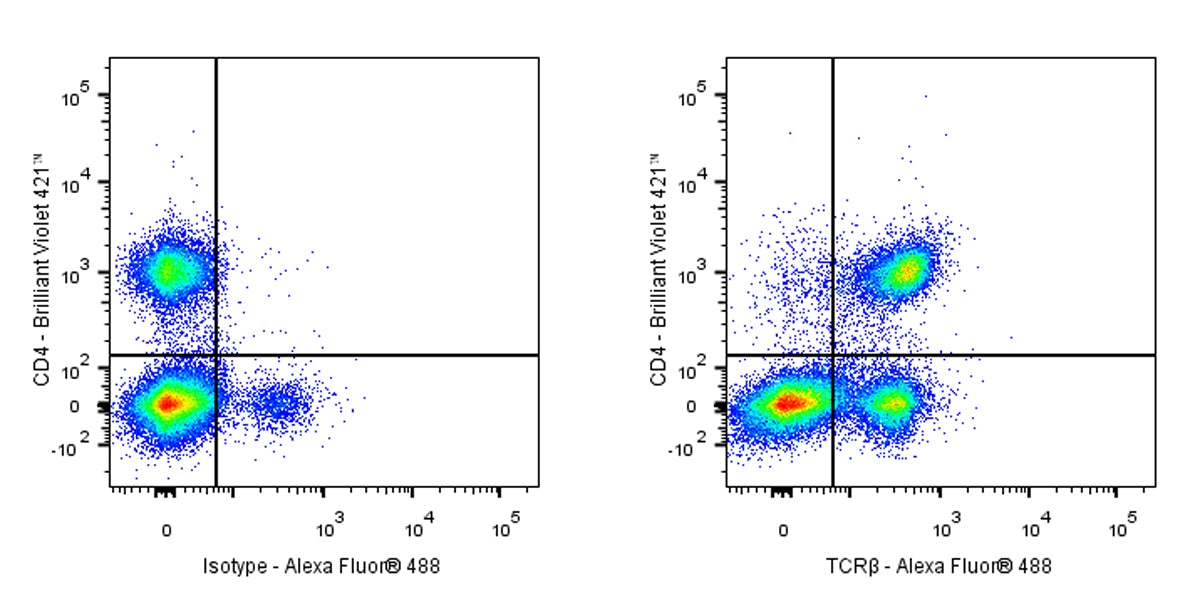
Flow cytometric analysis of BALB/c mouse splenocytes labelling Mouse TCR β antibody at 1/200 dilution (1 μg) / (Right panel) compared with a Armenian hamster IgG Isotype Control / (Left panel). Goat Anti- Armenian hamster IgG Alexa Fluor® 488 was used as the secondary antibody. Then cells were stained with CD4 - Brilliant Violet 421™ Antibody separately.
Armenian hamster Anti-Mouse TCR β Antibody (S-3829)
Armenian hamster Anti-Mouse TCR β Antibody (S-3829)
Price:
Regular price
$100 USD
Regular price
Sale price
$100 USD
Unit price
per
For shipping services or bulk orders, you may request a quotation.
Secure checkout with

View full details
Product Details
Product Details
Product Specification
| Host | Armenian hamster |
| Antigen | TCR β |
| Synonyms | T-cell receptor beta-1 chain C region |
| Location | Membrane |
| Accession | P01852 |
| Clone Number | S-3829 |
| Antibody Type | Recombinant mAb |
| Isotype | IgG |
| Application | FCM |
| Reactivity | Ms |
| Positive Sample | BALB/c mouse splenocytes |
| Purification | Protein G |
| Concentration | 2 mg/ml |
| Conjugation | Unconjugated |
| Physical Appearance | Liquid |
| Storage Buffer | PBS pH7.4 |
| Stability & Storage | 12 months from date of receipt / reconstitution, 2 to 8 °C as supplied |
Dilution
| application | dilution | species |
| FCM | 1:200 | Ms |
Background
The TCR β protein is a key component of the T-cell receptor (TCR), belonging to the immunoglobulin superfamily, and is primarily expressed on the surface of T cells. It is encoded by gene segments—variable (V), diverse (D), joining (J), and constant (C)—through V(D)J recombination, forming a highly diverse antigen-binding domain that recognizes antigen peptides presented by major histocompatibility complex (MHC) molecules. The TCR β chain noncovalently associates with the α chain to form a heterodimer, which constitutes the core structure of the TCR and plays a critical role in T-cell development, activation, and adaptive immune responses. Its intracellular segment is relatively short and must associate with the CD3 signaling complex to transmit antigen recognition signals into the cell, thereby initiating T-cell immune effector functions.
Picture
Picture
FC