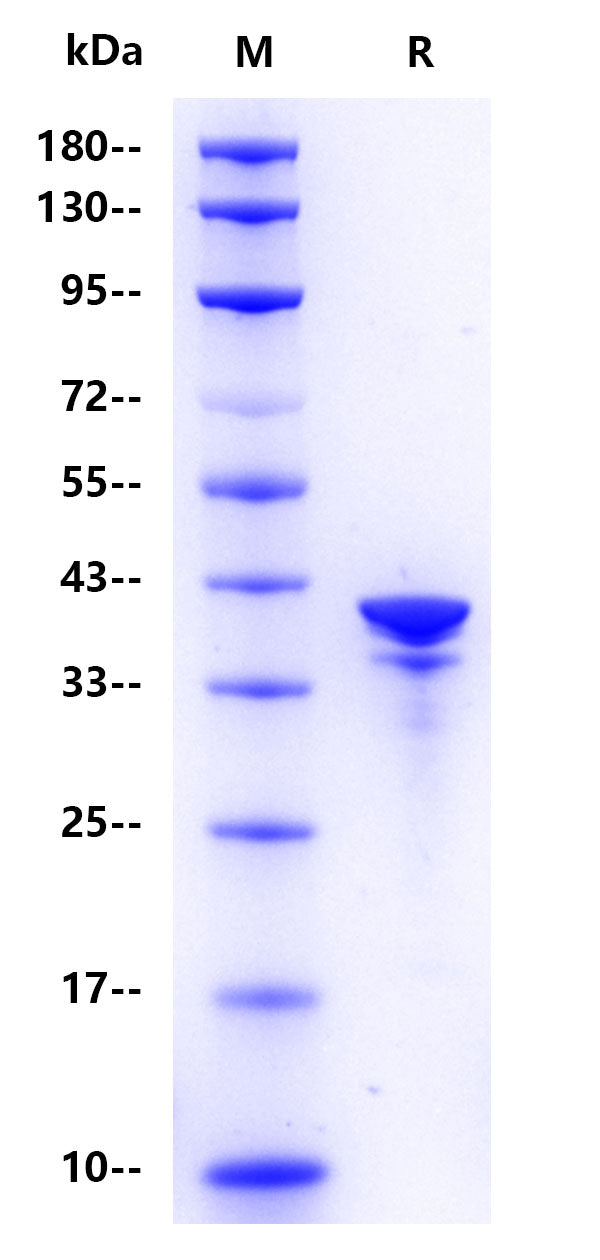
2μg(R: reducing conditions)
Annexin A1 His Tag Protein, Human
Annexin A1 His Tag Protein, Human
Price:
Regular price
$195 USD
Regular price
Sale price
$195 USD
Unit price
per
For shipping services or bulk orders, you may request a quotation.
Secure checkout with

View full details
Product Details
Product Details
Product Specification
| Species | Human |
| Synonyms | Annexin I, Annexin-1, Calpactin II, Calpactin-2, Chromobindin-9 |
| Accession | P04083 |
| Amino Acid Sequence | Ala2-Asn346 with C-10*His |
| Expression System | E.coli |
| Molecular Weight | Theoretical: 40.4kDa Actual: 40kDa |
| Purity | >95% by SDS-PAGE |
| Endotoxin | <1EU/μg |
| Conjugation | Unconjugated |
| Tag | His Tag |
| Physical Appearance | Lyophilized powder |
| Reconstitution | Reconstitute no more than 1 mg/mL according to the size in deionized water after rapid centrifugation. |
| Stability & Storage | 12 months from date of receipt, -20 to -70 °C as supplied. |
Background
Annexin A1 belongs to the annexin family of Ca2+-dependent phospholipid-binding proteins. Annexin A1 has important opposing properties during innate and adaptive immune responses: it inhibits innate immune cells and promotes T-cell activation. The activation of T cells results in the release of annexin A1 and the expression of its receptor. This pathway seems to fine-tune the strength of TCR signalling. Higher expression of annexin A1 during pathological conditions could increase the strength of TCR signalling through the mitogen-activated protein kinase signalling pathway, thereby causing a state of hyperactivation of T cells. Annexin A1 has also been of interest for use as a potential anticancer drug. Upon induction by modified NSAIDS and other potent anti-inflammatory drugs, annexin A1 inhibits the NF-κB signal transduction pathway, which is exploited by cancerous cells to proliferate and avoid apoptosis. ANXA1 inhibits the activation of NF-κB by binding to the p65 subunit.
Picture
Picture
SDS-PAGE