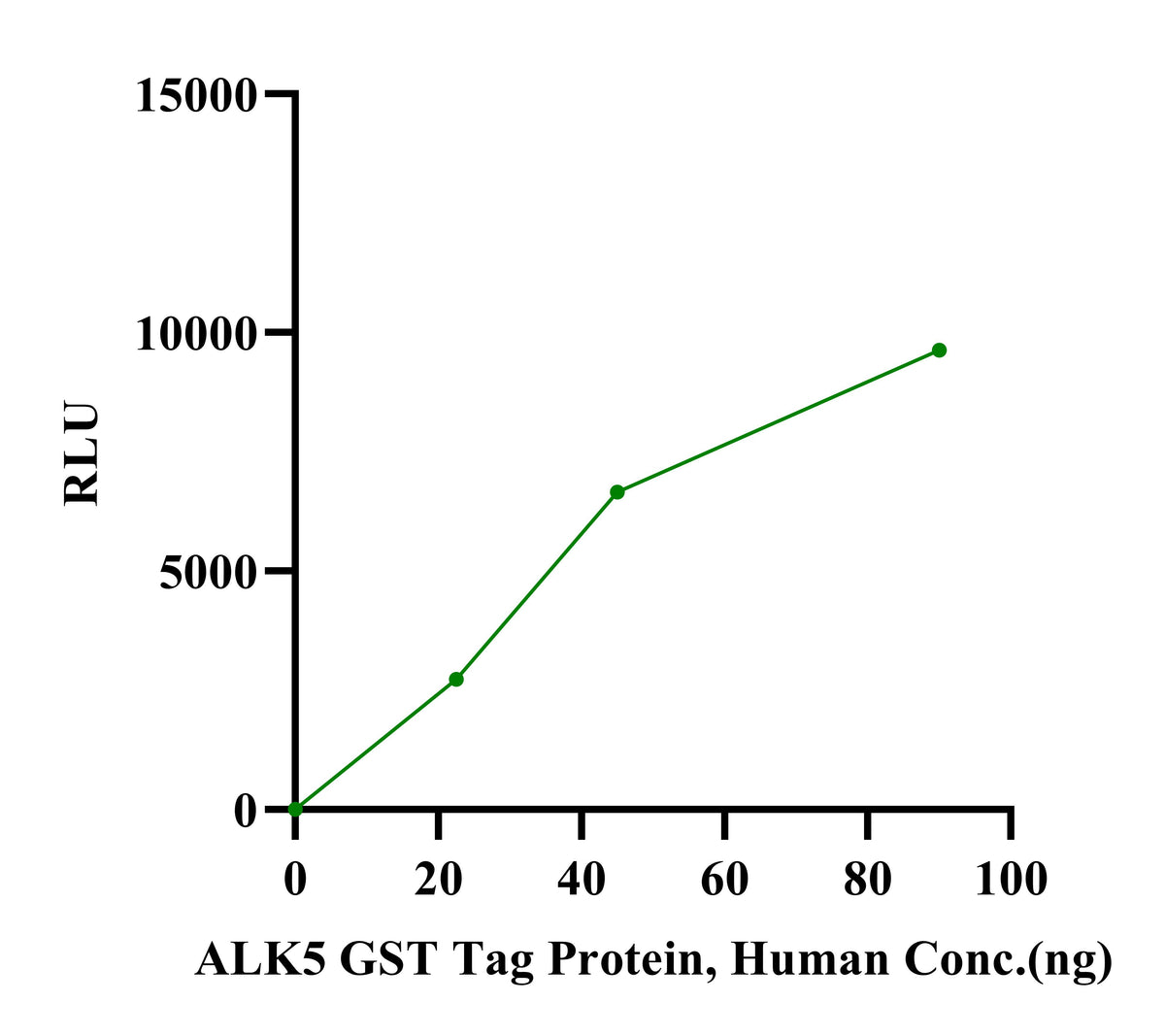
The specific activity of ALK5 GST Tag Protein was determined to be >20 pmol/min/ug as per activity assay protocol.
ALK5 GST Tag Protein, Human
ALK5 GST Tag Protein, Human
Price:
Regular price
$200 USD
Regular price
Sale price
$200 USD
Unit price
per
For shipping services or bulk orders, you may request a quotation.
Secure checkout with

View full details
Product Details
Product Details
Product Specification
| Species | Human |
| Synonyms | AAT5, ACVRLK4, ALK-5, ALK5, SKR4, TGFβR-1, TGFR1 |
| Accession | P36897 |
| Amino Acid Sequence | Thr200-Met503 with GST Tag at the N-Terminus |
| Expression System | Baculovirus-InsectCells |
| Molecular Weight | 55-70kDa (Reducing) |
| Purity | >95% by SDS-PAGE & HPLC |
| Conjugation | Unconjugated |
| Tag | GST Tag |
| Physical Appearance | Liquid |
| Storage Buffer | 50mM Tris, 150mM NaCl, PH7.5, 1mM DTT, 10%Glycerol |
| Stability & Storage | Stable for 12 months upon stored at -80℃ from the date of receipt. And avoid repeated freeze-thaws cycles. |
| Reference | 1. Larsson, J., et al. (2001). Abnormal angiogenesis but intact hematopoietic potential in TGF-beta type I receptor-deficient mice. Development, 128(10), 1863-1873 |
Background
ALK5 (Activin Receptor-Like Kinase 5), officially designated TGFBR1 (Transforming Growth Factor Beta Receptor 1), is the primary type I serine/threonine kinase receptor for TGF-β cytokines. It is encoded by the gene located on chromosome 9q22.33 and is ubiquitously expressed.
Mechanism of Action: TGF-β ligands first bind with high affinity to the type II receptor (TGFBR2). This complex then recruits and phosphorylates ALK5 at its GS domain. Activated ALK5 phosphorylates SMAD2 and SMAD3, which complex with SMAD4 and translocate to the nucleus to regulate transcription of genes involved in cell cycle arrest, extracellular matrix production, epithelial-mesenchymal transition (EMT), and differentiation. Beyond canonical SMAD signaling, ALK5 also activates non-SMAD pathways.
Physiological & Pathological Roles: ALK5 is a master regulator of homeostasis and development. It is essential for embryonic development, as murine knockout is embryonic lethal. In adults, it functions as a tumor suppressor in many epithelial tissues by inhibiting proliferation; loss of its negative regulation contributes to cancer. Conversely, in advanced cancers, ALK5 signaling can promote metastasis via EMT. Germline mutations in TGFBR1 cause Loeys-Dietz syndrome (LDS), a connective tissue disorder characterized by aortic aneurysms. Somatic mutations (e.g., A230V) in the kinase domain are found in endometrial cancer and result in partial loss-of-function and reduced inhibitor sensitivity.
Protocol
Assay protocol
Principle: The ALK5 assay is performed using the ADP-GloTM Kinase Assay kit which quantifies the amount of ADP produced by the ALK5 reaction. The ADP-GloTM Reagent is added to terminate the kinase reaction and to deplete the remaining ATP, and then the Kinase Detection Reagent is added to convert ADP to ATP and to measure the newly synthesized ATP using luciferase/luciferin reaction.
Materials
1.Kinase assay buffer(5X): 200 mM Tris-HCl, pH 7.4, 100 mM MgCl2 and 0.5 mg/mL BSA, 250 μM DTT
2.Kinase assay buffer(1X): 40 mM Tris-HCl, pH 7.4, 20 mM MgCl2, 0.1 mg/mL BSA, 50 μM DTT
3.ALK5 GST Tag Protein, Human
4.ADP-Glo Kinase Assay (Promega, Catalog # V6930)
5.Substrate: TGFBR1 peptide (Sinobiological, Catalog # T36-58)
6.Solid white multi-well plate (384-well plate) (Corning, Catalog #3572)
7.Plate Reader (PerkinElmer)
Produce
1.Prepare a substrate/ATP mixture as follows (25 μM example).
Sample Name |
Amount (μL) |
10 mM ATP Solution |
1 |
Kinase Assay Buffer III (5x) |
79 |
Substrate at 1 mg/mL |
80 |
2. Dilute the ALK5 to 30 µg/mL, 15 µg/mL and 7.5 µg/mL in Kinase Assay Buffer (1x) and dispense 3 μL into each well of a 384-well plate.
3. Initiate the reaction by adding 2 μL of the detection system prepared in Step 1 to each well. Include a detection system with 3 μL Kinase Assay Buffer (1x) as Blank. The reaction volume is 5 μL.
4. Incubate the reaction at room temperature (22–25℃) for 40 minutes.
5.Add 5 μL of ADP-Glo Reagent to the completed reaction, mix briefly and incubate for 40 minutes at room temperature (22–25 ℃).
6.Add 10 μL of Detection Reagent and incubate the plate for 30 minutes at room temperature (22–25 ℃).
7.Read at luminescence, respectively in endpoint mode.
8.Calculate specific activity.
• Standard Curve
1.Dilute the ATP and ADP to 25 μM in Kinase Assay Buffer (1x).
2.Mix 25 μΜ ATP and 25 μM ADP to form an ATP+ADP solution provided below and dispense 5 μL into each well of a 384-well plate.
Well Number |
1 |
2 |
3 |
4 |
5 |
6 |
7 |
8 |
9 |
10 |
11 |
12 |
25μM ADP (μL) |
100 |
80 |
60 |
40 |
20 |
10 |
5 |
4 |
3 |
2 |
1 |
0 |
25μM ATP (μL) |
0 |
20 |
40 |
60 |
80 |
90 |
95 |
96 |
97 |
98 |
99 |
100 |
3.Add 5 μL of ADP-Glo Reagent to the completed reaction, mix briefly and incubate for 40 minutes at room temperature (22–25 ℃).
4.Add 10 μL of Detection Reagent and incubate the plate for 30 minutes at room temperature (22–25 ℃).
5.Read at luminescence, respectively in endpoint mode.
6.Detect optical signals and establish conversion curves.
Specific Activity (pmol/min/μg) = |
ATP (pmol)-Blank |
Incubation time(min) ×amount of enzyme (μg) |
Picture
Picture
Bioactivity
SDS-PAGE
2μg (R: reducing condition, N: non-reducing condition).
SEC-HPLC
The purity of ALK5 GST Tag Protein, Human is more than 95% determined by SEC-HPLC.