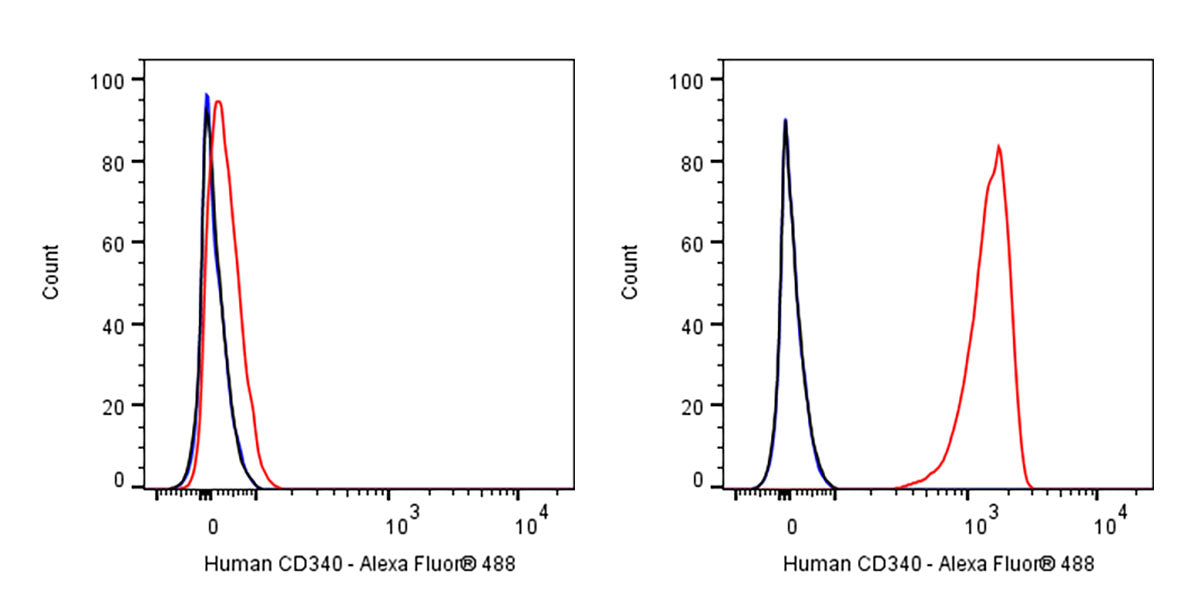
Flow cytometric analysis of Human CD340 expression on SK-BR-3 cells. Cells from the SK-BR-3 (Human breast adenocarcinoma epithelial cell, Right) or MCF7 (Human breast adenocarcinoma epithelial cell, Left) was stained with either Alexa Fluor® 488 Mouse IgG1, κ Isotype Control (Black line histogram) or SDT Alexa Fluor® 488 Mouse Anti-Human CD340 antibody (Red line histogram) at 5 μl/test, cells without incubation with primary antibody and secondary antibody (Blue line histogram) was used as unlabelled control. Flow cytometry and data analysis were performed using BD FACSymphony™ A1 and FlowJo™ software.
Alexa Fluor® 488 Mouse Anti-Human CD340 Antibody (S-3018)
Alexa Fluor® 488 Mouse Anti-Human CD340 Antibody (S-3018)
Price:
Regular price
$185 USD
Regular price
Sale price
$185 USD
Unit price
per
For shipping services or bulk orders, you may request a quotation.
Secure checkout with

View full details
Product Details
Product Details
Product Specification
| Host | Mouse |
| Antigen | CD340 |
| Synonyms | Receptor tyrosine-protein kinase erbB-2; Metastatic lymph node gene 19 protein (MLN 19); Proto-oncogene Neu; Proto-oncogene c-ErbB-2; Tyrosine kinase-type cell surface receptor HER2; p185erbB2; HER2; MLN19; NEU; NGL; ERBB2 |
| Location | Cell membrane |
| Accession | P04626 |
| Clone Number | S-3018 |
| Antibody Type | Mouse mAb |
| Isotype | IgG1,k |
| Application | FCM |
| Reactivity | Hu |
| Positive Sample | SK-BR-3 |
| Purification | Protein G |
| Concentration | 0.2 mg/ml |
| Conjugation | Alexa Fluor® 488 |
| Physical Appearance | Liquid |
| Storage Buffer | PBS, 1% BSA, 0.3% Proclin 300 |
| Stability & Storage | 12 months from date of receipt / reconstitution, 2 to 8 °C as supplied |
Dilution
| application | dilution | species |
| FCM | 5μl per million cells in 100μl volume | Hu |
Background
CD340, also termed HER2/ErbB2, is a 1,255-amino-acid, 185 kDa glycosylated type-I trans-membrane receptor tyrosine kinase that lacks its own ligand-binding domain yet serves as the dimerization partner of choice for the other epidermal growth-factor receptors; upon hetero-dimerization it triggers potent downstream signaling cascades (MAPK, PI3K–Akt, PLC-γ, STAT) that drive proliferation, survival and microtubule stabilization, is frequently amplified or over-expressed on the surface of breast, ovarian and other epithelial tumours, and is therefore a key therapeutic target for monoclonal antibodies such as trastuzumab and pertuzumab.
Picture
Picture
FC