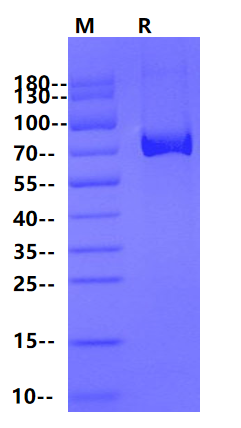
2μg (R: reducing condition, N:non-reducing condition).
ACHE/Acetylcholinesterase His Tag Protein, Human
ACHE/Acetylcholinesterase His Tag Protein, Human
Price:
Regular price
$415 USD
Regular price
Sale price
$415 USD
Unit price
per
For shipping services or bulk orders, you may request a quotation.
Secure checkout with

View full details
Product Details
Product Details
Product Specification
| Species | Human |
| Synonyms | ARACHE,apoptosis-related acetylcholinesterase,N-ACHE |
| Accession | P22303-1 |
| Amino Acid Sequence | Glu32-Leu614 with His Tag at the C-Terminus |
| Expression System | HEK293 |
| Molecular Weight | 65-80kDa (Reducing) |
| Purity | >90% by SDS-PAGE |
| Conjugation | Unconjugated |
| Tag | His Tag |
| Physical Appearance | Lyophilized powder |
| Storage Buffer | PBS, PH7.4, 5% trehalose |
| Reconstitution | Reconstitute at 0.1-1 mg/ml according to the size in ultrapure water after rapid centrifugation. |
| Stability & Storage | · 12 months from date of receipt, lyophilized powder stored at -20 to -80℃. |
| Reference | 1.Rawat K, Tewari D, Bisht A, Chandra S, Tiruneh YK, Hassan HM, Al-Emam A, Sindi ER, Al-Dies AM. Identification of AChE targeted therapeutic compounds for Alzheimer's disease: an in-silico study with DFT integration. Sci Rep. 2024 Dec 5;14(1):30356. |
Background
Acetylcholinesterase (AChE), also known as acetylhydrolase, is a crucial serine hydrolase that efficiently terminates signal transmission at neuromuscular junctions and cholinergic synapses by rapidly hydrolyzing acetylcholine (ACh) in the synaptic cleft. Beyond its fundamental role in neurotransmitter regulation, AChE has been found to participate in neuronal apoptosis and other cellular processes, suggesting a broader involvement in programmed cell death. In neurodegenerative diseases such as Alzheimer's disease, acetylcholine deficiency is closely associated with cognitive decline, making AChE an important therapeutic target. Currently, acetylcholinesterase inhibitors (AChEIs) are widely used in clinical practice for the targeted treatment of Alzheimer's disease and other forms of dementia.
Protocol
Experimental Method
Principle: Detect the ability of ACHE protein to cleave Acetylthiocholine.
Materials
Assay buffer: 0.1 M Sodium Phosphate, 0.05% (w/v) Brij-35, pH 7.5
- ACHE/Acetylcholinesterase His Tag Protein, Human (SPA1701)
Substrate: Acetylthiocholine (ATC) (A5626)
5’,5’-Dithiobis (2-nitrobenzoic acid) (DTNB) (D8130)
96 Well Clear Plate (701311)
Plate reader (PerkinElmer, 405 nm)
Procedure
Dilute ACHE protein to 0.02 μg/mL in assay buffer.
Dilute substrate to 200 μM in assay buffer containing 100 μM DTNB.
Add 50 μL of diluted ACHE protein to the clear plate. Include a control group with assay buffer instead of ACHE protein.
Add 50 μL of substrate/DTNB mixture to initiate the reaction.
Read the signal at 405 nm in kinetic mode for 10 minutes.
Calculate specific activity:
Specific Activity (pmol/min/µg) = |
Adjusted Vmax* (OD/min) x well volume (L) x 109 nmol/mol |
|
ext. coeff** (M--1cm--1) x path corr.*** (cm) x amount of enzyme (μg) |
*
Substrate blank correction
**Extinction coefficient 13260 M⁻¹cm⁻¹
***Path length correction 0.32 cm
Picture
Picture
SDS-PAGE