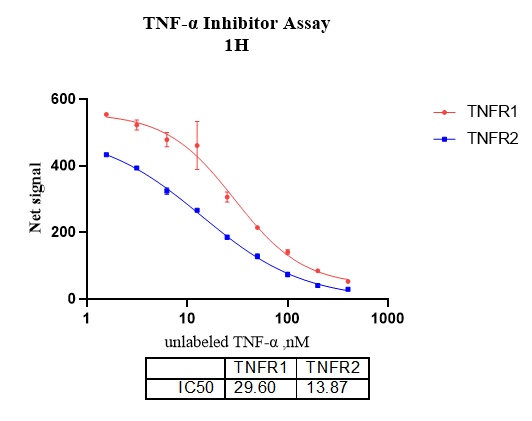
1. TNF-α & TNFR2 Binding Assay
UniOne® TR-FRET Human TNF-α/TNFR2 Binding Kit
UniOne® TR-FRET Human TNF-α/TNFR2 Binding Kit
Price:
Regular price
$2,180 USD
Regular price
Sale price
$2,180 USD
Unit price
per
For shipping services or bulk orders, you may request a quotation.
Secure checkout with

View full details
Product Details
Product Details
Product Specification
| Host | Human |
| Stability & Storage | -80℃ |
Background
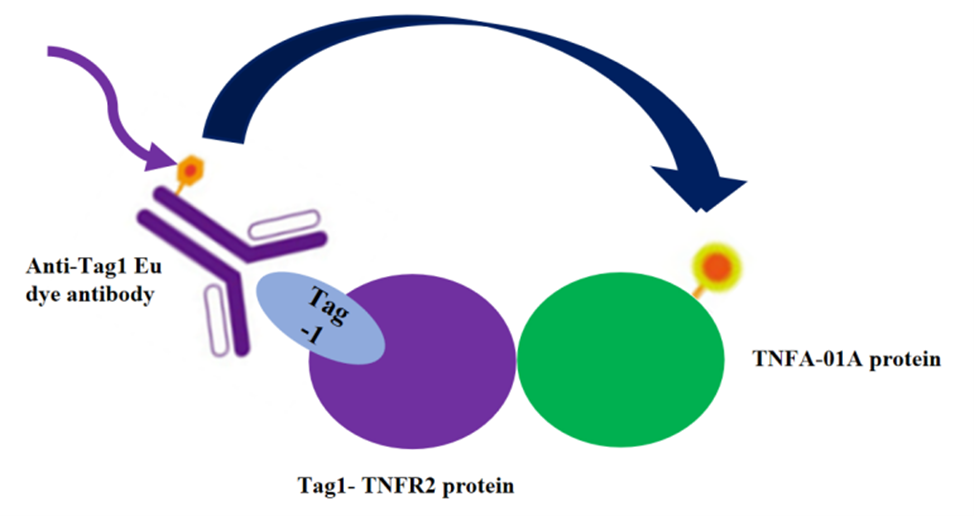
This kit employsHomogeneous Time-Resolved Fluorescence (TR-FRET) technology to measure the interactionbetween TNF-α and TNFR2. The method enables simple and rapid high-throughputscreening of inhibitors and antibody blockers.
As shown in thefigure, the TNF-α/TNFR2 interaction is detected using an Eu-labeled anti-Tag1antibody (TR-FRET donor) and an Acceptor-labeled TNF-α protein (TR-FRETacceptor). Binding of TNF-α to TNFR2 brings the donor antibody into proximitywith the acceptor protein. Excitation of the donor antibody triggersFluorescence Resonance Energy Transfer (FRET) to the acceptor, resulting inspecific emission at 665 nm. This specific signal is proportional to the levelof TNF-α/TNFR2 interaction. This homogeneous assay is simple to perform andrequires no wash steps.
Components
Component |
Concentration |
500 TESTS |
2500 TESTS |
10000 TESTS |
Storage Temperature |
|---|---|---|---|---|---|
TNFΑ-01A protein |
50× |
50 μL |
250 μL |
500 μL |
-80°C |
Tag1-TNFR2 protein |
100× |
40 μL |
200 μL |
800 μL |
-80°C |
Anti-Tag1 Eu-dye antibody |
50× |
50 μL |
250 μL |
1000 μL |
-80°C |
Detection buffer |
10× |
2 mL |
10 mL |
40 mL |
-80°C |
* Avoid repeated freeze-thaw cycles. Aliquot after first thaw and store according to conditions indicated. Shelf life is one year.
Protocol
1Reagent Preparation
Thaw all reagents to room temperature before use (equilibrate at room temperature for at least30min).384-well low-volume plate reaction volume is20μL (reagent volumes for the reaction system are shown in the table). Calculate the required volume for the experiment before preparation and prepare as needed; the following preparation is for reference only, using500reactions as an example.
1.1 Preparation of Buffer (1×)
2mL Detection buffer (10×)add18mLsterile water, mix well and set aside;
Table2. Reagent Preparation and Volumes
Reagent Name |
Preparation |
Volume (μL) |
Test Sample |
Dilute the test sample to the desired concentration using1×Detection buffer according to the reaction system. IfDMSOis used, ensure theDMSOconcentration is consistent across all detection wells. |
2 |
TNFΑ-01A protein |
Take50μL TNFΑ-01A proteinstock solution,1×Detection bufferdilute to2.5mL ,mix well and set aside. | 5 |
Tag1- TNFR2 protein |
Take40μL Tag1- TNFR2 proteinstock solution,1×Detection bufferdilute to4mL ,mix well and set aside. | 8 |
Anti-Tag1 Eu dye antibody |
Take50μL Anti-Tag1 Eu dye antibody, using1×Detection bufferdilute to2500μL, mix well and set aside. | 5 |
1.2 Serial Dilution of Test Samples
Prepare test samples using1×Detection buffer. If the sample stock is inDMSO, it is recommended to maintain a consistentDMSO concentration in the system,(the detection buffer does not containDMSO; please addDMSOto the1×Detection bufferaccording to the dilution of the standard or test sample), with a maximum concentration not exceeding2%.
2 Sample Addition and Controls
2.1 Addition order for experimental wells:2μL test sample,8μL Tag1- TNFR2 proteinworking solution,5μL TNFΑ-01A protein protein,5μL Anti-Tag1 Eu dye antibody, sequentially added into the384-well low-volume plate.
2.2 Minimum control well:10μL 1× Detection buffer (containingDMSO),5μL TNFΑ-01A protein,5μL Anti-Tag1 Eu dye antibody.
2.3 Maximum control well:2μL 1× Detection buffer (containingDMSO),8μL Tag1- TNFR2 protein,5μL TNFΑ-01A protein,5μL Anti-Tag1 Eu dye antibody.
2.4 Eu only:15μL 1× buffer plus5μLdilutedAnti-Tag1 Eu dye antibody.
Table4. Sample Addition and Controls
|
Minimum Control |
Maximum Control |
Sample |
Eu Only |
Step 1 |
2μL 1× Detection buffer (containingDMSO) |
2μL 1× Detection buffer (containingDMSO) |
2μL Serially diluted test sample |
15uL 1× Detection buffer |
|
8μL 1× Detection buffer (containingDMSO) |
8μL Tag1- TNFR2 protein |
|||
Step 2 |
5μL TNFΑ-01A protein |
|||
5μL Anti-Tag1 Eu dye antibody | ||||
Step 3 |
Seal the plate with a sealing film, and incubate at room temperature for2h |
|||
*For negative controls and quality control, it is recommended to usea solution with the same matrix as the test sample to replace1×Detection buffer.
*Ensure consistentDMSOor other matrix concentrations across all detection wells.
3.Detection
Detect using a microplate reader compatible withTR-FRET (excitation wavelength at320nm, emission wavelengths at620nm and665nm).
[Result Calculation]
1. Calculate signal value:665nmfluorescence signal divided by620nmfluorescence signal, then multiplied by10000, i.e.,
Signal Value= (665/620)*10000
2. Calculate the δ value based on the signal value:
δ Value= (Std-NC)/NC*100
3.CalculateCV (%)
CV (%)= Standard Deviation/Mean Ratio×100%
[Data Example]
The following data cannot replace data obtained from actual experiments and is provided for illustration only. Results may vary depending on theTR-FRETcompatible instrument.
Picture
Picture
Bioactivity
1. TNF-α & TNFR2 Binding Assay
2. Anti- TNF-α Monoclonal Antibody(Starter,S0B0553)Titration
3. Unlabeled TNF-α Protein (UA, UA040005) Titration