Standard Curve
Example of Monkey FGF-19 standard curve in Assay Diluent GC8. Plotted are the background-subtracted data.
This standard curve is provided for demonstration only.
Monkey FGF-19 OneStep ELISA Kit
Monkey FGF-19 OneStep ELISA Kit
Price:
Regular price
$870 USD
Regular price
Sale price
$870 USD
Unit price
per
For shipping services or bulk orders, you may request a quotation.
Secure checkout with

View full details
Product Details
Product Details
Product Specification
| Antigen | FGF-19 |
| Immunogen | Recombinant Protein |
| Antibody Type | Recombinant mAb |
| Reactivity | Mk |
| Purification | Protein A |
| Stability & Storage | 12 months from date of receipt / reconstitution, 2 to 8°C as supplied. |
Kit
| Precision | Intra-assay: 3.7%; Inter-assay: 5.1% |
| Sample type | Serum; EDTA Plasma, Heparin Plasma, Citrate Plasma; Cell Culture Supernatant |
| Assay type | Sandwich (quantitative) |
| Sensitivity | 2.09 pg/mL |
| Range | 7.8 pg/mL – 500 pg/mL |
| Recovery | Serum: 98% EDTA Plasma: 94% Citrate plasma: 104% Heparin Plasma: 109% Cell Culture Supernatant: 96% |
| Assay time | 60 minutes |
| Species reactivity | Mk; Hu |
Background
Monkey FGF-19 (fibroblast growth factor 19) is an endocrine hormone predominantly produced by ileal enterocytes in response to bile acid uptake via the farnesoid X receptor (FXR) pathway. It shares high sequence homology with its human counterpart and exerts its biological effects through binding to the FGFR4/β-Klotho receptor complex, primarily in hepatocytes. Once activated, this signaling cascade potently represses hepatic bile acid synthesis by downregulating the key enzyme CYP7A1. Beyond bile acid metabolism, monkey FGF-19 also modulates postprandial glycemic control by enhancing glycogenesis and suppressing gluconeogenesis in the liver. Additionally, it influences energy homeostasis and lipid metabolism, reflecting its role as a multifunctional endocrine factor. Due to the close physiological resemblance between monkeys and humans, cynomolgus and rhesus macaques serve as valuable preclinical models for studying FGF-19-based therapies. In these models, FGF-19 administration has demonstrated beneficial effects on reducing hepatic steatosis and improving insulin sensitivity. Therefore, monkey FGF-19 is an essential translational tool for evaluating drug candidates targeting metabolic diseases such as nonalcoholic steatohepatitis (NASH) and type 2 diabetes.
Picture
Picture
ELISA
Spike Recovery
The recovery of Monkey FGF-19 was evaluated in activated samples spiked with concentrations spanning the entire assay range.
Dilution Linearity
The concentrations of Monkey FGF-19 were measured and interpolated from the target standard curves and corrected for sample dilution.
The leftmost bar in the graph shows biological samples diluted in Assay Diluent to 50% concentration. "undiluted" was defined as 50% biological sample. The subsequent bars represent two-fold serial dilutions of this reference. The mean target concentration was determined to be 344.4 pg/mL in Monkey FGF-19.
Dilution Linearity
The concentrations of Monkey FGF-19 were measured and interpolated from the target standard curves and corrected for sample dilution.
The leftmost bar in the graph shows biological samples diluted in Assay Diluent to 50% concentration. "undiluted" was defined as 50% biological sample. The subsequent bars represent two-fold serial dilutions of this reference. The mean target concentration was determined to be 105.3 pg/mL in Monkey FGF-19.
Dilution Linearity
The concentrations of Monkey FGF-19 were measured and interpolated from the target standard curves and corrected for sample dilution.
The leftmost bar in the graph shows biological samples diluted in Assay Diluent to 50% concentration. "undiluted" was defined as 50% biological sample. The subsequent bars represent two-fold serial dilutions of this reference. The mean target concentration was determined to be 277.8 pg/mL in Monkey FGF-19.
Dilution Linearity
The concentrations of Monkey FGF-19 were measured and interpolated from the target standard curves and corrected for sample dilution.
The leftmost bar in the graph shows biological samples diluted in Assay Diluent to 50% concentration. "undiluted" was defined as 50% biological sample. The subsequent bars represent two-fold serial dilutions of this reference. The mean target concentration was determined to be 167.2 pg/mL in Monkey FGF-19.
Spike-and-dilution Linearity
To evaluate assay linearity, four samples were spiked with high levels of Monkey FGF-19 in different matrices and serially diluted with the corresponding Calibrator Diluent to fall within the assay's dynamic range.
Spike-and-dilution Linearity
To evaluate assay linearity, sample were spiked with high levels of Monkey FGF-19 in different matrices and serially diluted with the corresponding Calibrator Diluent to fall within the assay's dynamic range.
Intra-Assay Precision (Precision within an assay)
Three samples of known concentration were tested fifteen times on one plate to assess intra-assay precision.
Inter-Assay Precision (Precision between assays).
Three samples of known concentration were tested in separate assays to assess inter-assay precision. Assays were performed with at least three lots of components.
Determination of Minimum Detectable Dose (MDD)
The MDD was determined using three independent lots of assay components. For each lot, 19 replicate measurements of the diluent (zero calibrator) were performed. The mean (AVERAGE) and standard deviation (STDEV) of the 19 replicates were calculated. The MDD for each lot was then calculated according to the following formula:
MDD = 2 × STDEV + AVERAGE
HOOK Effect Threshold
The upper limit of the HOOK effect was established at 100× the highest calibrator concentration (equivalent to a 2-log10 increase). No HOOK effect was observed below this threshold, confirming that samples within this concentration range yield reliable quantitative results without signal depression.
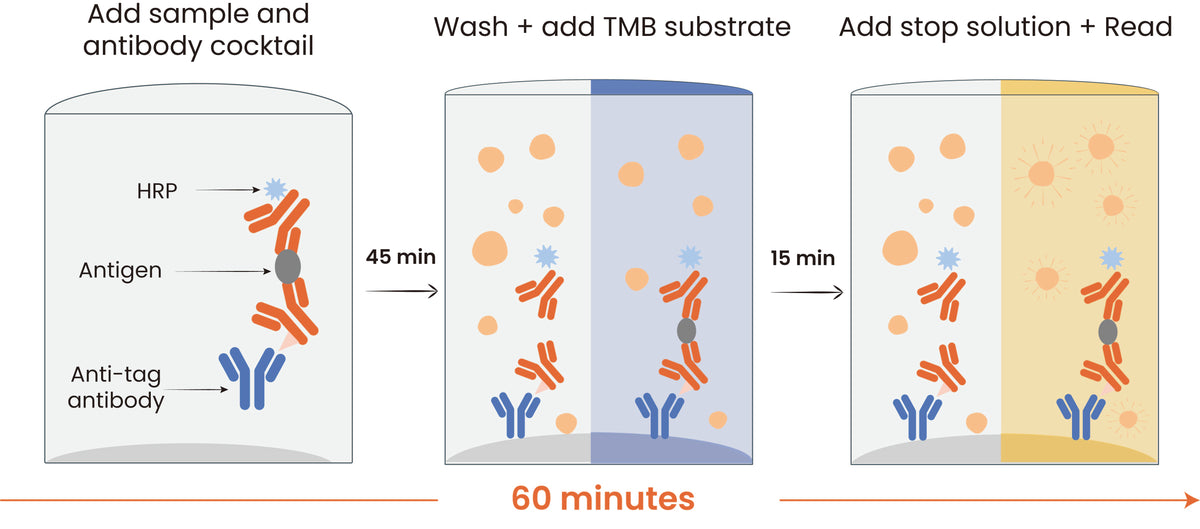
Protocol Diagram