Standard curve
Example of Nipah virus (NiV) Glycoprotein G standard curve in Assay Diluent G1.
Nipah virus (NiV) Glycoprotein G OneStep ELISA Kit
Nipah virus (NiV) Glycoprotein G OneStep ELISA Kit
Price:
Regular price
$500 USD
Regular price
Sale price
$500 USD
Unit price
per
For shipping services or bulk orders, you may request a quotation.
Secure checkout with

View full details
Product Details
Product Details
Product Specification
| Antigen | Nipah virus (NiV) Glycoprotein G |
| Immunogen | Recombinant Protein |
| Antibody Type | Recombinant mAb |
| Reactivity | Others |
| Purification | Protein A |
| Stability & Storage | 12 months from date of receipt / reconstitution, 2 to 8°C as supplied. |
Kit
| Precision | Intra-assay: 2.8%; Inter-assay: 3.2% |
| Sample type | Cell Culture Supernatant; Serum; EDTA Plasma, Heparin Plasma, Citrate Plasma |
| Assay type | Sandwich (quantitative) |
| Sensitivity | 0.179 ng/mL |
| Range | 0.781 ng/mL – 50 ng/mL |
| Recovery | Cell culture supernatant: 107% Serum: 102% EDTA Plasma: 115% Heparin Plasma: 109% Citrate Plasma: 102% |
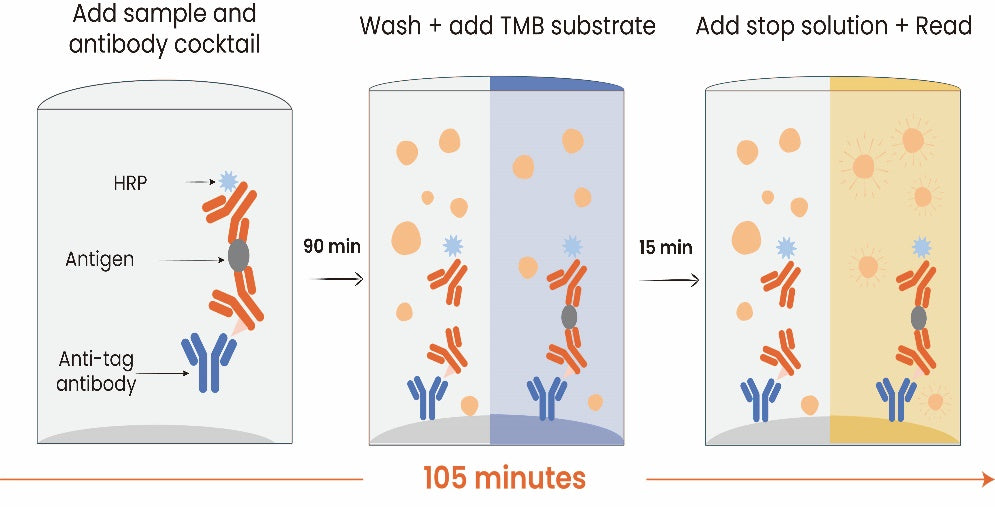
| Assay time | 105 minutes |
| Species reactivity | Others |
Background
The Nipah virus (NiV) glycoprotein G, also known as the receptor-binding protein (RBP), is a crucial Type II transmembrane protein that forms a tetramer on the viral envelope and initiates host cell infection by binding to the highly conserved cellular receptors ephrin-B2 and ephrin-B3, an interaction that has been structurally characterized to reveal a protruding ephrin loop inserted into the central cavity of the G protein's β-propeller fold. Composed of a cytoplasmic tail, a transmembrane domain, a stalk region, a neck domain, a linker, and a C-terminal globular head domain that contains the receptor-binding interface, the G protein undergoes conformational changes upon receptor engagement to trigger the fusion (F) protein, thereby facilitating viral and host cell membrane merger.
Picture
Picture
ELISA
Protocol Diagram