
Human LILRB4 ELISA Kit
Human LILRB4 ELISA Kit

Product Details
Product Details
Product Specification
| Usage |
Sample Processing and Requirements 1. 2. 3. 4. Note: Hemolysis of the specimen will affect the final test results, so hemolyzed specimens are not suitable for this test. Reagent Preparation Procedure 2. 3. 4. 5. 6. 7. Calculation of Experimental Results: Using the OD value of the measured standard as the horizontal axis and the concentration of the standard as the vertical axis, draw a standard curve on graph paper or using relevant software. 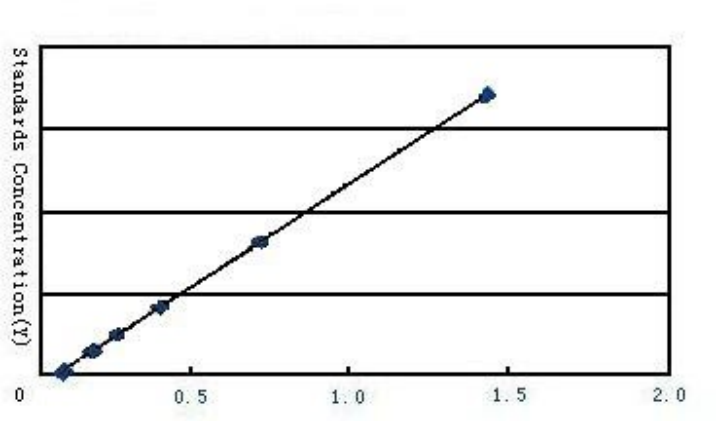 Standard Curve |
||||||||||||||||||||||||||||||
| Species Reactivity | Human | ||||||||||||||||||||||||||||||
| Theory | The kit utilizes a double-antibody, one-step sandwich enzyme-linked immunosorbent assay (ELISA). Samples, standards, and HRP-labeled detection antibodies are sequentially added to microwells pre-coated with a capture antibody against human leukocyte immunoglobulin-like receptor subfamily B, member 4 (LILRB4). The sample is incubated and thoroughly washed. The color is developed using the substrate TMB, which converts to blue under the catalysis of peroxidase and to yellow under the action of acid. The intensity of the color is positively correlated with the amount of human leukocyte immunoglobulin-like receptor subfamily B, member 4 (LILRB4) in the sample. The absorbance (OD) is measured at 450 nm using a microplate reader to calculate the sample concentration. | ||||||||||||||||||||||||||||||
| Synonym | CD85k; LILR-B4; HM18; ILT3; LIR-5; Immunoglobulin-like transcript 3; Leukocyte immunoglobulin-like receptor 5; | ||||||||||||||||||||||||||||||
| Detection Type | Used for in vitro quantitative detection of the content of human leukocyte immunoglobulin-like receptor subfamily B member 4 (LILRB4) in serum, plasma, tissue homogenate and related liquid samples. | ||||||||||||||||||||||||||||||
| Composition |
|
||||||||||||||||||||||||||||||
| General Notes |
1. Strictly adhere to the specified incubation time and temperature to ensure accurate results. All reagents must be at room temperature (20-25°C) before use. Refrigerate reagents immediately after use. 2. Improper plate washing can lead to inaccurate results. Ensure that the liquid in the wells is as dry as possible before adding substrate. Do not allow the microwells to dry out during incubation. 3. Remove any residual liquid and fingerprints from the bottom of the plate, otherwise it will affect the OD value. 4. The substrate developer solution should be colorless or very light in color. Substrate solution that has turned blue should not be used. 5. Avoid cross-contamination of reagents and specimens to prevent erroneous results. 6. Avoid direct exposure to strong light during storage and incubation. 7. Allow the sealed bag to equilibrate to room temperature before opening to prevent water droplets from condensing on the cold plate strips. 8. No reaction reagents should come into contact with bleaching solvents or the strong fumes emitted by bleaching solvents. Any bleaching component will destroy the biological activity of the reagents in the kit. 9. Do not use expired products. 10. If there is a possibility of disease transmission, all samples should be managed properly and the samples and detection devices should be handled according to the prescribed procedures. |
||||||||||||||||||||||||||||||
| Storage Temp. | Unopened test kit, stored at 2-8°C, has a shelf life of 6 months. | ||||||||||||||||||||||||||||||
| Test Range | 0.25 ng/mL – 8 ng/mL; Sensitivity: Minimum detection concentration is less than 0.1 ng/mL. |