Standard curve
Example of Human Insulin standard curve in Assay Diluent DA8.
Human Insulin Serum & Plasma OneStep ELISA Kit
Human Insulin Serum & Plasma OneStep ELISA Kit
Price:
Regular price
$500 USD
Regular price
Sale price
$500 USD
Unit price
per
For shipping services or bulk orders, you may request a quotation.
Secure checkout with

View full details
Product Details
Product Details
Product Specification
| Antigen | Insulin |
| Immunogen | Recombinant Protein |
| Antibody Type | Recombinant mAb |
| Reactivity | Hu, Mk |
| Purification | Protein A |
| Stability & Storage | 12 months from date of receipt / reconstitution, 2 to 8'C as supplied. |
Kit
| Precision | Intra-assay: 2.0%; Inter-assay: 2.6% |
| Sample type | Serum; Plasma-EDTA, Plasma-Citrate |
| Assay type | Sandwich (quantitative) |
| Sensitivity | 0.130 ng/mL (22.36 pmol/L) |
| Range | 0.469 ng/mL – 30 ng/mL (80.63 pmol/L – 5160 pmol/L) |
| Recovery | Serum: 112% Plasma- EDTA: 107% Plasma-Citrate: 91% |
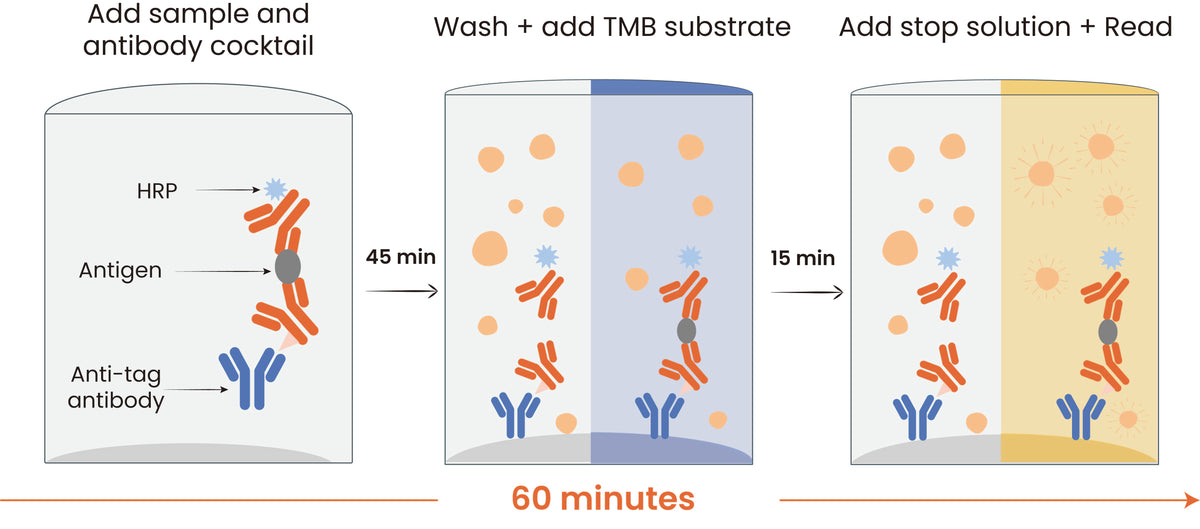
| Assay time | 60 minutes |
| Species reactivity | Hu; MK |
Background
Human insulin is a peptide hormone secreted by the beta cells of the pancreatic islets of Langerhans, playing a fundamental role in regulating glucose homeostasis. It functions as a key anabolic signal by facilitating the cellular uptake of glucose, particularly in muscle and adipose tissue, and promoting its conversion into glycogen for storage in the liver. Insulin also inhibits processes such as gluconeogenesis and lipolysis, thereby lowering blood glucose levels. Structurally, it consists of two polypeptide chains, an A chain and a B chain, linked together by disulfide bonds, which are derived from the proteolytic cleavage of a single precursor molecule called proinsulin. A deficiency in insulin production or action leads to hyperglycemia and the development of diabetes mellitus. Consequently, exogenous insulin administration is a life-saving therapy for individuals with Type 1 diabetes and is also used in advanced Type 2 diabetes. Modern therapeutic advancements have led to various insulin analogs engineered for specific pharmacokinetic profiles, such as rapid-acting or long-acting formulations, allowing for more precise glycemic control.
Picture
Picture
ELISA
Standard curve
Example of Human Insulin standard curve in Assay Diluent DA8. (The conversion factor from ng/mL to pmol/L is 172, based on the conversion concentration unit of insulin with a molecular weight of 5807.67 Da.)
Linearity
The concentrations of Human Insulin were measured and interpolated from the target standard curves and corrected for sample dilution.
Sample is undiluted samples are as follows: Human serum was undilution. The interpolated dilution factor corrected values are plotted. The mean target concentration was determined to be 4.53 ng/mL (779.2 pmol/L) in Human serum.
Sample is undiluted samples are as follows: Human plasma-EDTA was undilution. The interpolated dilution factor corrected values are plotted. The mean target concentration was determined to be 7.14 ng/mL (1227.9 pmol/L) in Human plasma-EDTA.
Sample is undiluted samples are as follows: Human plasma-Citrate was undilution. The interpolated dilution factor corrected values are plotted. The mean target concentration was determined to be 1.44 ng/mL (248.1 pmol/L) in Human plasma-Citrate.
To assess the linearity of the assay, sample was spiked with high concentrations of Human Insulin in various matrices and diluted with the appropriate Calibrator Diluent to produce samples with values within the dynamic range of the assay.
To assess the linearity of the assay, sample was spiked with high concentrations of Human Insulin in various matrices and diluted with the appropriate Calibrator Diluent to produce samples with values within the dynamic range of the assay.
To assess the linearity of the assay, sample was spiked with high concentrations of Human Insulin in various matrices and diluted with the appropriate Calibrator Diluent to produce samples with values within the dynamic range of the assay.
Specificity
Test the specificity of different serum.
Protocol Diagram