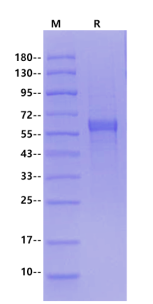
2μg (R: reducing condition).
Furin/PCSK3 His Tag Protein, Human
Furin/PCSK3 His Tag Protein, Human
Price:
Regular price
$570 USD
Regular price
Sale price
$570 USD
Unit price
per
For shipping services or bulk orders, you may request a quotation.
Secure checkout with

View full details
Product Details
Product Details
Product Specification
| Species | Human |
| Synonyms | FUR,PCSK3,SPC1,PACE |
| Accession | P09958-1 |
| Amino Acid Sequence | Gln27-Ala574 with His Tag at the C-Terminus |
| Expression System | HEK293 |
| Molecular Weight | 55-72kDa (Reducing) |
| Purity | >90% by SDS-PAGE |
| Conjugation | Unconjugated |
| Tag | His Tag |
| Physical Appearance | Lyophilized powder |
| Storage Buffer | PBS, PH7.4, 5% trehalose |
| Reconstitution | Reconstitute at 0.1-1 mg/ml according to the size in ultrapure water after rapid centrifugation. |
| Stability & Storage | · 12 months from date of receipt, lyophilized powder stored at -20 to -80℃. |
| Reference | 1.Anderson ED, Molloy SS, Jean F, Fei H, Shimamura S, Thomas G. The ordered and compartment-specfific autoproteolytic removal of the furin intramolecular chaperone is required for enzyme activation. J Biol Chem. 2002 Apr 12;277(15):12879-90. |
Background
Furin, also known as Paired Basic Amino Acid Cleaving Enzyme (PACE), is a key member of the subtilisin-like proprotein convertase family. Functioning as a calcium-dependent serine protease, its structure includes an N-terminal signal peptide, a prodomain, a catalytic domain, a P-domain responsible for maintaining enzymatic activity and calcium/pH sensitivity, a transmembrane region, and a cytoplasmic tail. Primarily localized within the Golgi apparatus/endosomal system, it activates a wide range of proprotein substrates—such as growth factors, receptors, extracellular matrix proteins, and pathogen proteins (e.g., envelope proteins of HIV and influenza virus)—by specifically cleaving after the Arg-X-(Arg/Lys)-Arg sequence motif. It plays a critical role in embryogenesis, peripheral immune tolerance, and cellular homeostasis. Dysregulation of its function is closely linked to tumor progression, neurodegenerative diseases, and various pathogen infections, making it a significant therapeutic target in clinical applications.
Protocol
Assay protocol
Principle: Measured by its ability to cleave the fluorogenic peptide substrate, Pyr-Arg-Thr-Lys-Arg-AMC.
Materials
Assay buffer: 25 mM Tris, 1 mM CaCl2, pH 9.0
Furin/PCSK3 His Tag Protein, Human (UA011272)
Substrate: Pyr-Arg-Thr-Lys-Arg-AMC (abs45133051)
96 ELISA Removable Plate, Black, High binding (GENEVER, Catalog # GMO2-96H)
Plate Reader (PerkinElmer, excitation 380 nm and emission 460 nm)
Produce
Dilute Human Furin Protein to 2 µg/mL/4 µg/mL/8 µg/mL in Assay Buffer.
Dilute Substrate to 100 µM in Assay Buffer.
Load into a black well plate 50 µL of 2 µg/mL/4 µg/mL/8 µg/mL of Human Furin Protein, and start the reaction by adding 50 µL of 100 µM Substrate. Include a Substrate Blank containing 50 µL of Assay Buffer and 50 µL of 100 µM Substrate.
Read at excitation and emission wavelengths of 380 nm and 460 nm, respectively in kinetic mode for 10 minutes.
Calculate specific activity:
*Adjusted for Substrate Blank
**Derived using calibration standard 7-amino-4-Methyl Coumarin
Conversion Factor (pmol/RFU)
Produce
Buffer: Assay buffer
Calibration standard: standard 7-amino-4-Methyl Coumarin (Enzo, Catalog # BML-KI107-0001).
Add 100 µL Dilute Calibration standard, Standard curve 1500/750/375/188/94/47/24/12/6/3 pmol per well or blank (Assay buffer) per well.
Read at excitation and emission wavelengths of 380 nm and 460 nm, respectively in endpoint mode.
Linear Regression of 7-amino-4-Methyl Coumarin (pmol) (y)—RFU-Blank(x).
Note
Storage Conditions: After reconstitution, aliquot and store at -80°C. Please do not
repeated freeze-thaw cycles.
Picture
Picture
SDS-PAGE