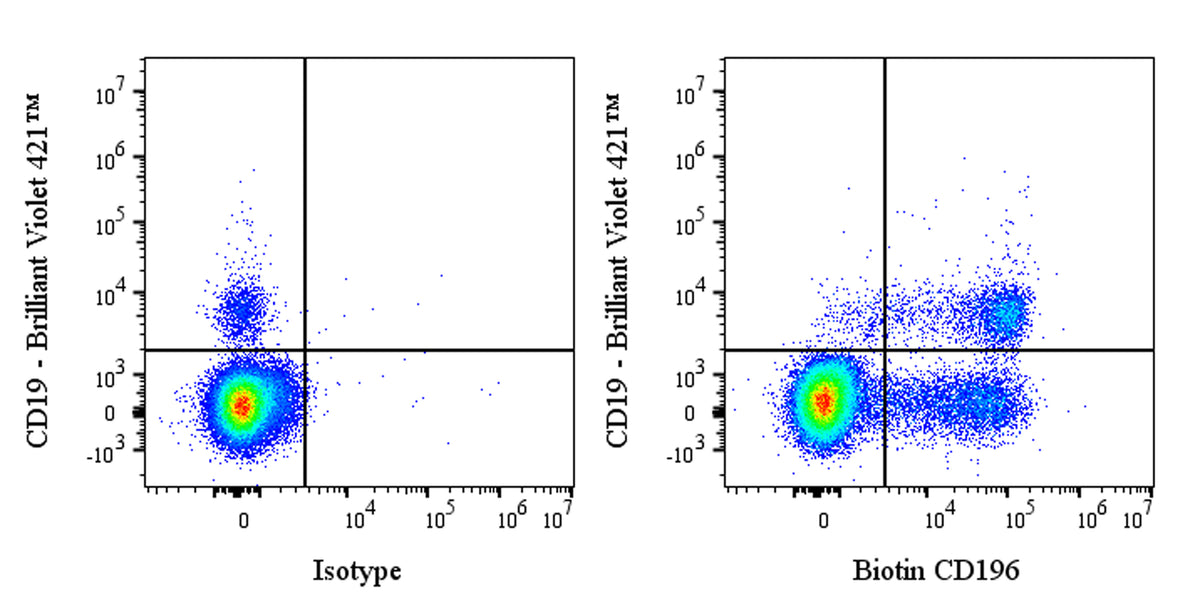
Flow cytometric analysis of human CD196 expression on human PBMC (human peripheral blood mononuclear cells). Human PBMC were stained with Brilliant Violet 421™ Mouse Anti-Human CD19 Antibody and either Biotin Mouse IgG1, κ Isotype Control (left panel) or SDT Biotin Mouse Anti-Human CD196 Antibody (right panel) at 5μl/test followed by Sav-PE. Flow cytometry and data analysis were performed using BD FACSymphony™ A1 and FlowJo™ software.
Biotin Mouse Anti-Human CD196 Antibody (S-R645)
Biotin Mouse Anti-Human CD196 Antibody (S-R645)
Price:
Regular price
$100 USD
Regular price
Sale price
$100 USD
Unit price
per
For shipping services or bulk orders, you may request a quotation.
Secure checkout with

View full details
Product Details
Product Details
Product Specification
| Host | Mouse |
| Antigen | CD196 |
| Synonyms | C-C chemokine receptor type 6; C-C CKR-6; CC-CKR-6; CCR-6; Chemokine receptor-like 3 (CKR-L3); DRY6; G-protein coupled receptor 29; GPR-CY4 (GPRCY4); LARC receptor; CKRL3; CMKBR6; GPR29; STRL22; CCR6 |
| Location | Cell membrane |
| Accession | P51684 |
| Clone Number | S-R645 |
| Antibody Type | Mouse mAb |
| Isotype | IgG1,k |
| Application | FCM |
| Reactivity | Hu |
| Positive Sample | human PBMC |
| Purification | Protein G |
| Concentration | 0.2 mg/ml |
| Conjugation | Biotin |
| Physical Appearance | Liquid |
| Storage Buffer | PBS pH7.4, 0.03% Proclin 300 |
| Stability & Storage | 12 months from date of receipt / reconstitution, 2 to 8 °C as supplied |
Dilution
| application | dilution | species |
| FCM | 5μl per million cells in 100μl volume | Hu |
Background
CD196, also known as CCR6 (C-C chemokine receptor type 6), is a G protein-coupled receptor primarily expressed on specific subsets of immune cells including memory T cells (particularly Th17 and regulatory T cells), immature dendritic cells, and B cells, where it serves as the exclusive receptor for the chemokine CCL20 (also called MIP-3α). This signaling axis plays a pivotal role in directing the migration of these leukocytes to inflammatory sites and secondary lymphoid organs, especially those rich in CCL20 such as the skin, lung, and mucosal tissues of the gut, thereby facilitating critical immune surveillance and the organization of adaptive immune responses. Beyond its physiological function in homeostasis and inflammation, CD196 is significantly implicated in various pathological conditions, acting as a key marker for Th17-mediated autoimmune diseases like rheumatoid arthritis, psoriasis, and multiple sclerosis, while also being exploited by certain cancers and HIV strains for cell entry or metastatic spread, making it a promising therapeutic target for modulating immune trafficking in chronic inflammatory disorders and oncology.
Picture
Picture
FC