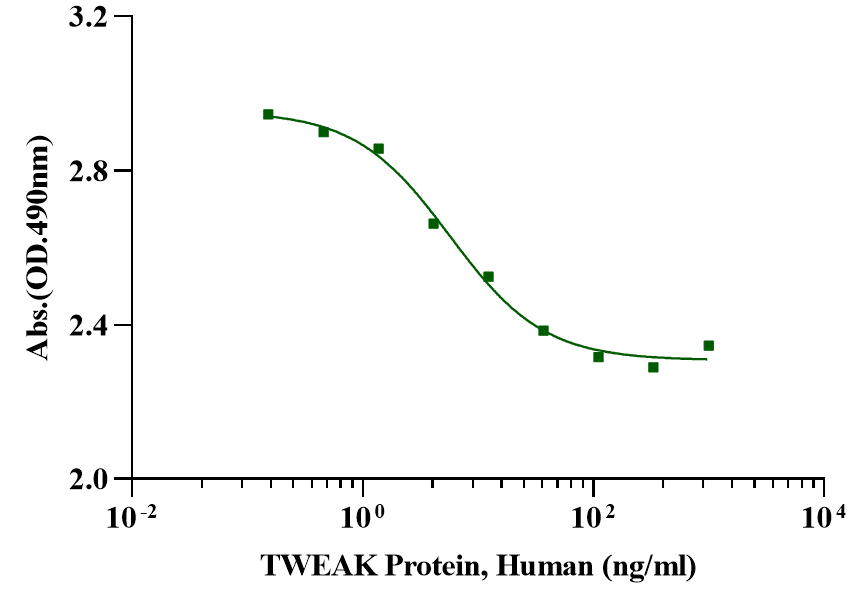
Measured in a cell proliferation assay using HT-29 human colon adenocarcinoma cells, the IC50 for this effect is 1.5-8.8 ng/ml.
TWEAK Protein, Human
TWEAK Protein, Human
Price:
Regular price
$1,785 USD
Regular price
Sale price
$1,785 USD
Unit price
per
For shipping services or bulk orders, you may request a quotation.
Secure checkout with

View full details
Product Details
Product Details
Product Specification
| Species | Human |
| Synonyms | Tumor necrosis factor ligand superfamily member 12, APO3 ligand, TNF-related weak inducer of apoptosis (TWEAK) |
| Accession | O43508 |
| Amino Acid Sequence | Ser94-His249 |
| Expression System | HEK293 |
| Molecular Weight | 18-20 kDa (Reducing) |
| Purity | >95% by SDS-PAGE, >90% by HPLC. |
| Endotoxin | <0.1EU/μg |
| Conjugation | Unconjugated |
| Tag | No Tag |
| Physical Appearance | Lyophilized Powder |
| Storage Buffer | PBS, pH7.4 |
| Reconstitution | Reconstitute at 0.1-1 mg/ml according to the size in ultrapure water after rapid centrifugation. |
| Stability & Storage | ·12 months from date of receipt, lyophilized powder stored at -20 to -80℃. |
| Reference | Tumour Biol. 2017 Jun;39(6):1010428317714624. |
Background
Tumor necrosis factor-like weak inducer of apoptosis (TWEAK), also known as TNFSF12, is a member of the TNF ligand superfamily initially characterized in 1997. TWEAK is synthesized as a type II transmembrane protein and can be proteolytically cleaved by furin into a soluble cytokine. It exerts its biological functions primarily by binding to its receptor, fibroblast growth factor-inducible 14 (Fn14), which contains a TRAF-binding motif that activates downstream signaling cascades including NF-κB, MAPK, PI3K-Akt, and Notch pathways. While Fn14 is the critical signaling receptor, CD163 can also bind soluble TWEAK as a scavenger receptor. The TWEAK/Fn14 axis regulates diverse cellular processes including proliferation, differentiation, migration, angiogenesis, inflammation, and apoptosis, with Fn14 expression being markedly upregulated during tissue injury, inflammation, and regeneration.
Picture
Picture
Bioactivity
SDS-PAGE
2μg (R: reducing condition, N: non-reducing condition).
RP-HPLC
>90% as determined by RP-HPLC.