Standard Curve
Example of Rat TNF-α standard curve in Assay Diluent HR2. Plotted are the background-subtracted data.
This standard curve is provided for demonstration only.
Rat TNF-α Serum & Plasma OneStep ELISA Kit
Rat TNF-α Serum & Plasma OneStep ELISA Kit
Price:
Regular price
$200 USD
Regular price
Sale price
$200 USD
Unit price
per
For shipping services or bulk orders, you may request a quotation.
Secure checkout with

View full details
Product Details
Product Details
Product Specification
| Antigen | TNF-α |
| Immunogen | Recombinant Protein |
| Antibody Type | Recombinant mAb |
| Reactivity | Rt |
| Purification | Protein A |
| Stability & Storage | 12 months from date of receipt / reconstitution, 2 to 8°C as supplied. |
Kit
| Precision | Intra-assay: 1.6%; Inter-assay: 2.6% |
| Sample type | Serum; Citrate plasma |
| Assay type | Sandwich (quantitative) |
| Sensitivity | 7.686 pg/mL |
| Range | 31.25 pg/mL – 2000 pg/mL |
| Recovery | Serum (SD): 107% Citrate plasma (SD): 106% |
| Assay time | 60 minutes |
| Species reactivity | Rt |
| CROSS REACTIVITY | Ms |
Background
Rat TNF-α (Tumor Necrosis Factor-alpha) is a multifunctional pro-inflammatory cytokine centrally involved in immune regulation, inflammation, and cell survival, primarily produced by activated macrophages as well as other cell types such as T lymphocytes and fibroblasts; synthesized as a 26 kDa transmembrane precursor and cleaved by TACE into a soluble 17 kDa active homotrimer, it exerts its effects by binding to TNFR1 and TNFR2 receptors on nearly all nucleated cells, thereby activating NF-κB and MAPK signaling pathways to drive diverse outcomes including inflammation, apoptosis, proliferation, and tissue remodeling, and its dual role as both a host defense mediator and a pathological inflammation driver makes it a critical therapeutic target and key biomarker extensively studied in rat models of autoimmune diseases, septic shock, cancer, and chronic inflammatory conditions like rheumatoid arthritis and inflammatory bowel disease.
Picture
Picture
ELISA
Spike Recovery
The recovery of Rat TNF-α was evaluated in activated samples spiked with concentrations spanning the entire assay range.
Spike-and-dilution Linearity
To evaluate assay linearity, two samples were spiked with high levels of Rat TNF-α in different matrices and serially diluted with the corresponding Calibrator Diluent to fall within the assay's dynamic range.
Intra-Assay Precision (Precision within an assay)
Three samples of known concentration were tested fifteen times on one plate to assess intra-assay precision.
Inter-Assay Precision (Precision between assays).
Three samples of known concentration were tested in separate assays to assess inter-assay precision. Assays were performed with at least three lots of components.
Determination of Minimum Detectable Dose (MDD)
The MDD was determined using three independent lots of assay components. For each lot, 19 replicate measurements of the diluent (zero calibrator) were performed. The mean (AVERAGE) and standard deviation (STDEV) of the 19 replicates were calculated. The MDD for each lot was then calculated according to the following formula:
MDD = 2 × STDEV + AVERAGE
Cross-reactivity
The cross-reactivity between Mouse TNF-α、Human TNF-α and Monkey TNF-α was assessed by testing both proteins in the same assay system. Serial dilutions of each protein were measured, and the dose-response curves were compared. No significant cross-reactivity was observed when Human TNF-α and Monkey TNF-α was tested in the Rat TNF-α assay, as the signals remained within the background range of the assay.
HOOK Effect Threshold
The upper limit of the HOOK effect was established at 100× the highest calibrator concentration (equivalent to a 2-log10 increase). No HOOK effect was observed below this threshold, confirming that samples within this concentration range yield reliable quantitative results without signal depression.
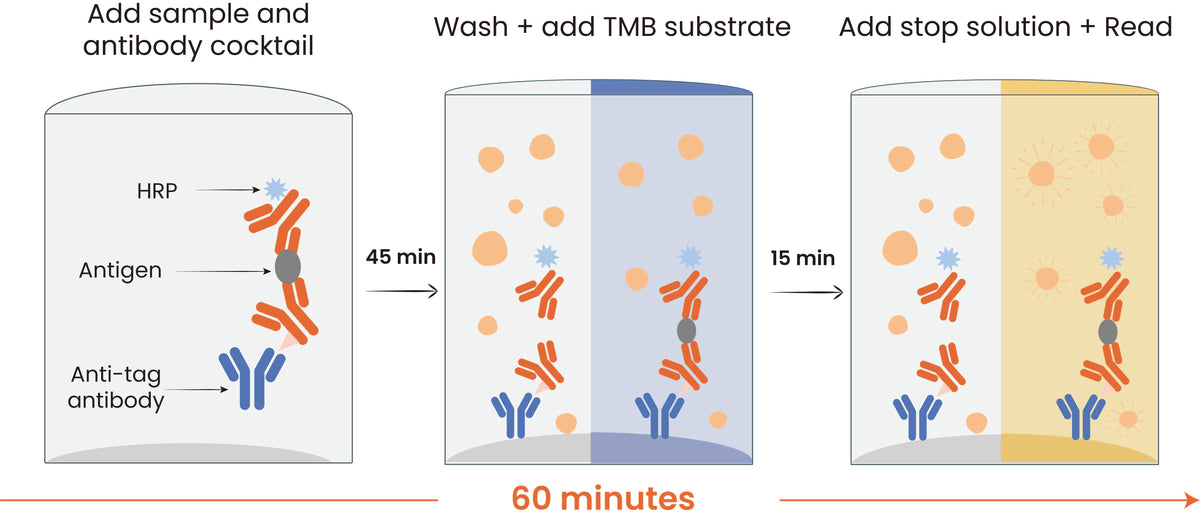
Protocol Diagram