Mouse IL-1β ELISA Kit
Mouse IL-1β ELISA Kit
Price:
Regular price
$450 USD
Regular price
Sale price
$450 USD
Unit price
per
For shipping services or bulk orders, you may request a quotation.
Secure checkout with

View full details
Product Details
Product Details
Product Specification
| Usage |
Need to bring your own test equipment 1. Microplate reader (can measure the absorption value of 450nm detection wavelength and 540nm or 570nm correction wavelength) 2. High precision liquid dispenser and disposable suction head 3. Distilled water or deionized water 4. Washing bottle (spray bottle), multi-channel plate washer or automatic plate washer 5. 500mL cylinder One, preparation before the experiment 1. Sample collection and storage ① Cell culture supernatant: particles should be removed by centrifugation; Test the samples immediately. If the sample is not tested in time after collection, it is recommended that the sample be divided according to the dosage and stored in the refrigerator at -20 ° C to avoid repeated freezing and thawing. Samples may need to be diluted (1×) Dilute. ② Serum: Samples were collected using a serum separation tube (SST) and samples were left at room temperature for 30 minutes. The samples were centrifuged at 1000g for 15 min. Serum was immediately removed and tested immediately. If the sample is not tested in time after collection, it is recommended to repack according to a single dosage and freeze in ≤ -20℃ refrigerator to avoid repeated freezing and thawing. Samples may need to be diluted (1×) Dilute. ③ Plasma: Plasma was collected using EDTA, heparin, or citric acid as an anticoagulant, centrifuged at 1000g for 15 min within 30 min of collection, and tested immediately. If the samples are not detected in time after collection, it is recommended to separate the samples according to the single dosage and freeze them in &le. -20℃ refrigerator to avoid repeated freezing and thawing. Samples may need to be diluted (1×) Dilute. 2 Reagent preparation (Place all reagents and samples at room temperature for 15 minutes before use. It is recommended that all experimental samples and standards do double hole detection ) 1× Preparation of washing solution: concentrated washing solution in the kit is 20× Mother liquor, diluted to 1× with distilled water before use; Working liquid. Example: Take 10mL concentrated washing solution +190mL distilled water to 200mL, the actual operation can be calculated first, then make up. ②1× Dilution with buffer preparation: concentrate dilution in the kit with buffer 10× Mother liquor, diluted to 1× with distilled water before use; Working solution. example: Take 3mL of concentrated dilution with buffer +27mL of distilled water to a constant volume of 30mL. In practical operation, the required dilution buffer can be calculated according to the dilution multiple of the sample, and then the preparation can be made. ③ Detection of antibody: the dry powder was centrifuged to the bottom of the tube, and 110uL dilution buffer (1×) was used. Dissolve and let stand at room temperature for 5 minutes to obtain 100× Mother liquor; Dilute to 1× before use; Working solution. Calculate the desired volume by using 100uL per well. example: 10 Wells were used, then take 10uL of 100 times the working concentration of the test antibody, using dilution buffer (1×) Constant volume to 1mL, get 1mL of 1× The working concentration of the detected antibody. ④SA-HRP: SA-HRP is 40× Mother liquor, use dilution buffer before use (1×) Dilute to make 1× Working solution, 100uL required per well. example: used 10 holes, then take 25uL of 40× Mother liquor +975uL dilution buffer (1×) Constant volume to 1mL to obtain 1× of 1mL; The working concentration of the detected antibody. ⑤ Chromogenic agent: according to 100uL per well, calculate the amount needed for this test, take out the corresponding volume of chromogenic agent, avoid light; The removed chromogenic agent is only used on the same day. ⑥ Standards: lyophilized standards with dilution buffer (1×) Redissolve, redissolve volume 1000uL, to obtain a concentration of 1000pg/mL standard mother liquor. Gently shake for at least 5 minutes, it is fully dissolved. Add 300uL dilution buffer (1×) to each dilution tube. . The standard mother liquor is diluted according to the picture below, and each tube must be fully mixed before pipetting to the next tube. The standard mother liquor without dilution can be used as the highest point of the standard curve (1000pg/mL), and the dilution buffer (1×) Can be used as the zero point of the standard curve (0pg/mL). 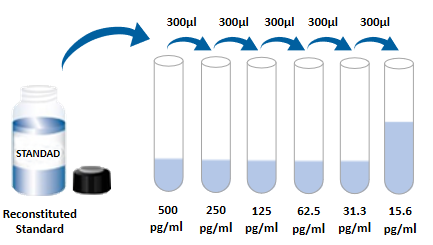 2, operation steps 2, operation steps1. Ready for all the needed reagent and standard; 2 Remove the microplate from the sealed bag that has been balanced to room temperature, and put the unused slat back into the aluminum foil bag and re-seal it; 3. Add 300uL washing solution to the microplate, let it soak for 30 seconds, discard the washing solution and pat the microplate dry on absorbent paper, please use immediately do not let the microplate dry; 4. Add different concentrations of standard, experimental samples or quality control into the corresponding Wells, 100uL for each well. The Wells were sealed with plate adhesive and incubated at room temperature for 2 hours. 5 Suck the liquid out of the plate and wash the plate using a bottle washer, a multi-channel plate washer, or an automatic plate washer. Add 300uL of washing liquid to each well, and then suck the washing liquid out of the plate. Repeat 3 times. Every time you wash the plate, try to absorb the residual liquid to help you get a good test result. At the end of the last plate wash, please blot all the liquid in the plate or invert the plate and pat all the residual liquid in the absorbent paper; 6. Add 100uL detection antibody to each microwell. Seal the reaction Wells with sealer tape and incubate for 2 hours at room temperature; 7. Repeat the plate washing operation of step 5; 8. Add 100 ULSA-HRP to each microwell and incubate for 20 minutes at room temperature. Be careful to avoid light; 9. Repeat step 5 to wash the plate; 10. Add 100uL of color development solution to each microwell, incubate at room temperature for 5-30 minutes, pay attention to avoid light; 11. Add 50uL of termination solution to each microwell, and the color of the solution in the well will change from blue to yellow. If the color of the solution turns green or the color change is inconsistent, tap the microplate to mix the solution evenly; 12. Within 30 minutes after the termination solution is added, the absorbance value at 450nm is measured using a microplate reader and 540nm or 570nm is set as the correction wavelength. If the dual wavelength correction is not used, the accuracy of the results may be affected; 13 Calculation results: The corrected absorbance values (OD450-OD540/OD570), the compound reading were averaged for each standard and sample, and then the average zero standard OD value was subtracted. Standard curves were created by 4-parameter logic (4-PL) curve fitting using computer software. Alternatively, a curve can be generated by plotting the logarithm of the concentration of the standard against the logarithm of the corresponding OD value, and the best fit line can be determined by regression analysis. This process produces an adequate but less accurate fit to the data. If the sample is diluted, the concentration should be multiplied by the dilution.  3. Kit parameters 1. Recovery: Different levels of Mouse IL-1&beta were incorporated into the cell culture medium samples; And measure its recovery. The recovery ranges from 69 to 102%, with an average recovery of 77%. 2. Sensitivity: Mouse IL-1β The minimum detectable dose (MDD) is generally less than 3.8 pg/mL. The lowest detectable dose was calculated as the corresponding concentration based on the mean of the zero-point absorbance values of 20 standard curves plus two standard deviations. 3. Calibration: The ELISA kit was purified recombinant Mouse IL-1&beta expressed in E. coli. Corrected by protein. 4. Linearity: four different samples were mixed with high concentrations of Mouse IL-1β , and then with diluent (1×) Measure linearity by dilating the sample to within the detection range.
5. Specificity: The ELISA could detect native and recombinant Mouse IL-1&beta. Protein. Combine the following factors with diluent (1×) Configure to a concentration of 50ng/mL to detect with Mouse IL-1β Cross reaction with mouse IL-1 & beta. 50ng/mL of interfering factor was incorporated into the intermediate range of recombinant Mouse IL-1β To detect the effect on Mouse IL-1β The interference. No significant cross-reaction or interference was observed.
4, common problem resolution 1. The white board (no color), after the completion of color
2. Flower plate (blank, negative and positive controls were normal, but the OD value of sample Wells was significantly higher)
|
|||||||||||||||||||||||||||||||||||||||||||||||||||||||||||||||||||||||||
| Theory | Double antibody sandwich enzyme-linked immunosorbent assay was used in this kit. Specific anti-mouse IL-1β antibody was precoated on a high-affinity microplate. The standard substance, the test sample and the biotinylated detection antibody were added into the microplate Wells. After incubation, the IL-1β present in the sample combined with the solid-phase antibody and the detection antibody to form immune complexes. After washing to remove the unbound material, the horseradish peroxidase-labeled Streptavidin-HRP was added. After washing, the chromogenic substrate was added and the color was developed in the dark. The reaction was terminated by adding the termination solution, and the absorbance value was measured at 450nm wavelength (reference correction wavelength 540nm or 570nm). | |||||||||||||||||||||||||||||||||||||||||||||||||||||||||||||||||||||||||
| Composition |
|
|||||||||||||||||||||||||||||||||||||||||||||||||||||||||||||||||||||||||
| Background | The interleukin-1 (IL-1) protein family contains the classical members IL-1α, Il-1β and IL-1ra, as well as IL-18, IL-33 and IL-1F5-10. IL-1α and IL-1β bind to the same cell surface receptor and share biological functions. "With the exception of skin keratinocytes, some epithelial cells, and certain cells of the central nervous system, unstimulated cells from healthy mice do not produce IL-1." "However, in response to inflammatory agents, infections, or microbial endotoxins, IL-1 is produced in large quantities by macrophages and a variety of other cells." IL-1β plays a key role in the physiological processes of immune response and inflammation, bone remodeling, fever, glucose metabolism, growth hormone /IGF-1. "Abnormal or sustained production of IL-1 has been associated with a range of pathological conditions, including sepsis, rheumatoid arthritis, inflammatory bowel disease, acute and chronic myeloid leukemia, insulin-dependent diabetes mellitus, atherosclerosis, nerve injury, and aging-related diseases." IL-1α and IL-1β have structurally related peptides that share approximately 25% identity at the amino acid level. They were synthesized as the size of 31 kDa precursor, and then cracking into mature protein, molecular weight is about 17.5 kDa. Caspase 1 / ICEI cracking IL - 1 beta precursor is a key step in the inflammatory response. Neither IL-1α nor IL-1β contain typical hydrophobic signal peptides, but there is evidence that these factors can be secreted through nonclassical pathways. Part of raw IL - 1 alpha can appear on the cell membrane, and may have biological activities. Unlike precursor IL - 1 alpha, beta IL - 1 precursor compared with mature body almost do not have biological activities. Both unprocessed and mature IL-1β can be exported from the cell. IL - 1 alpha and beta IL - 1 with IL - 1 ra combination immunoglobulin superfamily receptors play a role. "Cells expressing the 80-kda transmembrane type I receptor (IL-1RI) include T cells, fibroblasts, keratinocytes, endothelial cells, synovial fluid lining cells, chondrocytes, and hepatocytes." "Cells expressing the 68kDa transmembrane type II receptor (IL-1RII) include B cells, neutrophils, and bone marrow cells." "The two IL-1 receptors share approximately 28% identity in their extracellular domains, but a significant difference is found in their intracellular domains: the type II receptor has an intracellular domain of only 29 amino acids, whereas the type I receptor has an intracellular domain of 217 amino acids." IL-1RII does not produce a signal for IL-1 and may act as a decoy receptor to attenuate IL-1 function. IL-1 receptor accessory protein (IL-1RAcP) is associated with IL-1RI and required for IL-1RI signal transduction. IL-1ra is a secretory molecule that acts as a competitive inhibitor of IL-1. Soluble IL-1RI and IL-1RII can be detected in human plasma, joint synovial fluid, and conditioned media of a variety of human cell lines. In addition, IL-1binding proteins similar to soluble IL-1RII are capable of being encoded by cowpox and vaccinia virus. |
|||||||||||||||||||||||||||||||||||||||||||||||||||||||||||||||||||||||||
| General Notes | 1. Please use the kit within the validity period. 2. Components of different kits and different batch kits should not be mixed. 3. If the sample value is greater than the highest value of the standard curve, the sample should be diluted with (1×) The samples were diluted and retested. If the cell culture supernatant sample needs to be diluted, except for the last step, diluent (1×) is used. "In addition to dilution, cell culture medium may be used for other intermediate dilutions." 4. The difference of the test results can be caused by a variety of factors, including the operation of the experimenter, the use of the pipettor, the washing technique, the reaction time or temperature, the storage of the kit, etc. 5. The termination solution in the kit is acidic. Please protect your glasses, hands, face and clothes when using it. 6. For scientific research only, not for in vitro diagnosis. |
|||||||||||||||||||||||||||||||||||||||||||||||||||||||||||||||||||||||||
| Storage Temp. | Unopened kit, 2-8° C Storage | |||||||||||||||||||||||||||||||||||||||||||||||||||||||||||||||||||||||||
| Test Range | 15.6pg/mL-1000pg/mL |
Picture
Picture
Immunohistochemistry