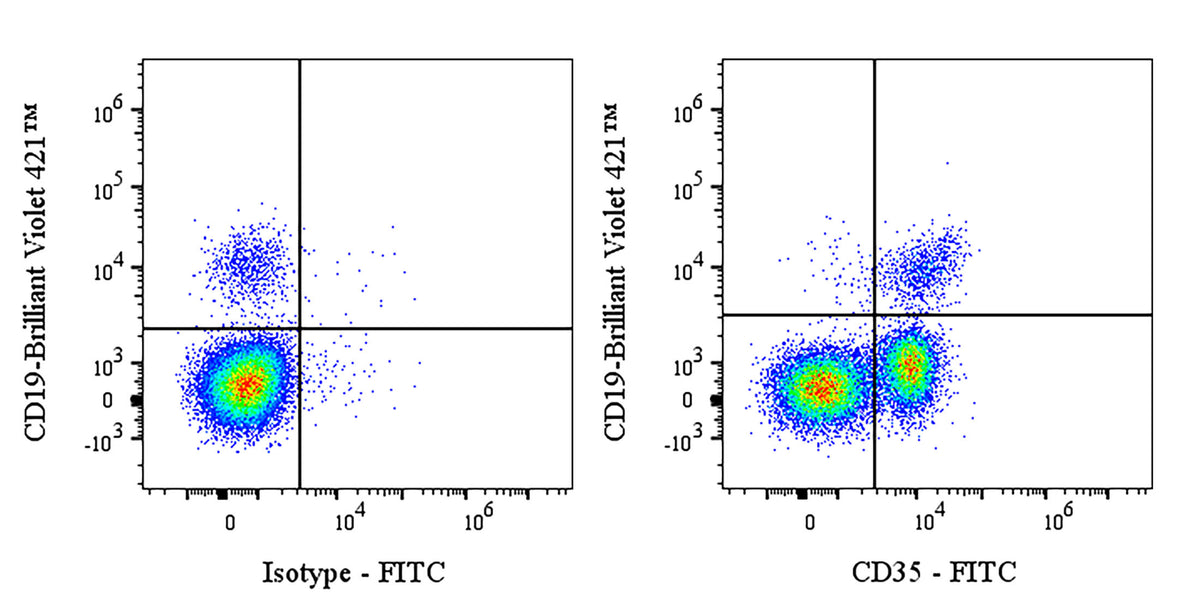
Flow cytometric analysis of Human CD35 expression on human peripheral blood cells. Human peripheral blood cells were stained with Brilliant Violet 421™ Mouse Anti-Human CD19 Antibody and either FITC Rabbit IgG Isotype Control (left panel) or SDT FITC Rabbit Anti-Human CD35 Antibody (right panel) at 5 μg/test. Total viable cells, as determined by Fixable Viability Dye 583 (S0B88803), were used for analysis. Flow cytometry and data analysis were performed using Agilent NovoCyte Quanteon and FlowJo™ software.
FITC Rabbit Anti-Human CD35 Antibody (S-1294-26)
FITC Rabbit Anti-Human CD35 Antibody (S-1294-26)
Price:
Regular price
$120 USD
Regular price
Sale price
$120 USD
Unit price
per
For shipping services or bulk orders, you may request a quotation.
Secure checkout with

View full details
Product Details
Product Details
Product Specification
| Host | Rabbit |
| Antigen | CD35 |
| Synonyms | Complement receptor type 1; C3BR; CR1 |
| Immunogen | Recombinant Protein |
| Location | Membrane |
| Accession | P17927 |
| Clone Number | S-1294-26 |
| Antibody Type | Recombinant mAb |
| Isotype | IgG |
| Application | FCM |
| Reactivity | Hu |
| Positive Sample | Human Peripheral Blood cells |
| Purification | Protein A |
| Concentration | 0.2 mg/ml |
| Conjugation | FITC |
| Physical Appearance | Liquid |
| Storage Buffer | PBS, 40% Glycerol, 0.05% BSA, 0.03% Proclin 300 |
| Stability & Storage | 12 months from date of receipt / reconstitution, -20 °C as supplied |
Dilution
| application | dilution | species |
| FCM | 5μl per million cells in 100μl volume | Hu |
Background
CD35, also known as Complement Receptor 1 (CR1), is a large single-chain transmembrane glycoprotein belonging to the regulators of complement activation (RCA) family, primarily expressed on the surface of erythrocytes, leukocytes, glomerular podocytes, and dendritic cells. Structurally characterized by multiple short consensus repeats (SCRs) that bind complement fragments C3b and C4b, CD35 plays a pivotal dual role in the immune system: it acts as a cofactor for Factor I-mediated cleavage of C3b and C4b, thereby inhibiting the formation of C3 convertases and protecting host tissues from excessive complement damage, while simultaneously facilitating the clearance of immune complexes by transporting them via erythrocytes to the liver and spleen for removal by macrophages. Beyond its regulatory function in the complement cascade, CD35 serves as a receptor for various pathogens, including Plasmodium falciparum-infected red blood cells and certain viruses, and has been implicated in the pathogenesis of autoimmune diseases like systemic lupus erythematosus (SLE) due to its critical involvement in maintaining immune homeostasis and preventing the deposition of immune complexes in tissues.
Picture
Picture
FC