2μg(R: reducing condition, N: non-reducing condition).
Biotinylated TSLPR Fc&Avi Tag Protein, Human
Biotinylated TSLPR Fc&Avi Tag Protein, Human
Price:
Regular price
$430 USD
Regular price
Sale price
$430 USD
Unit price
per
For shipping services or bulk orders, you may request a quotation.
Secure checkout with

View full details
Product Details
Product Details
Product Specification
| Species | Human |
| Synonyms | Cytokine receptor-like factor 2, CRLF2, CRL2, ILXR |
| Accession | Q9HC73-1 |
| Amino Acid Sequence | Gly25-Lys231 with hIgG1 Fc&Avi Tag at C-Terminus |
| Expression System | HEK293 |
| Molecular Weight | 60-75kDa (Reducing) |
| Purity | > 95% by SDS-PAGE&HPLC |
| Endotoxin | <0.1EU/μg |
| Conjugation | Biotin |
| Tag | Avi Tag, Human IgG1 Fc |
| Physical Appearance | Lyophilized Powder |
| Storage Buffer | PBS, pH7.4, 5% trehalose |
| Reconstitution | Reconstitute at 0.1-1 mg/ml according to the size in ultrapure water after rapid centrifugation. |
| Stability & Storage |
· 12 months from date of receipt, lyophilized powder stored at -20 to -80℃. · 3 months, -20 to -80℃ under sterile conditions after reconstitution. · 1 week, 2 to 8℃ under sterile conditions after reconstitution. · Please avoid repeated freeze-thaw cycles. |
| Reference | 1.Pandey A, Ozaki K, Baumann H, Levin SD, Puel A, Farr AG, Ziegler SF, Leonard WJ, Lodish HF. Cloning of a receptor subunit required for signaling by thymic stromal lymphopoietin. Nat Immunol. 2000 Jul;1(1):59-64. |
Background
TSLPR, or thymic stromal lymphopoietin receptor, also known as cytokine receptor-like factor 2 (CRLF2), belongs to the type I cytokine receptor family and structurally comprises an extracellular domain (containing the WSXWS motif), a single transmembrane domain, and an intracellular domain (harboring Box1/Box2 motifs); it lacks intrinsic kinase activity and must form a heterodimeric complex with the interleukin-7 receptor alpha chain (IL-7Rα) to transduce signals. Functionally, TSLPR serves as the specific receptor subunit for TSLP, and upon TSLP binding, the complex activates multiple downstream signaling pathways, predominantly the JAK-STAT (primarily STAT5), PI3K-AKT, and MAPK cascades, thereby driving Th2-type immune responses, promoting B-cell development, and maintaining immune homeostasis under physiological conditions, whereas under pathological states it becomes a core pathogenic mediator in allergic diseases such as asthma, atopic dermatitis, and chronic rhinosinusitis with nasal polyps; moreover, TSLPR overexpression (mostly resulting from CRLF2 gene translocations or mutations) has been established as a major driver of high-risk B-cell acute lymphoblastic leukemia (B-ALL), significantly increasing relapse risk by enhancing leukemic cell proliferation, survival, and chemoresistance. Clinically, therapeutic strategies targeting the TSLP/TSLPR signaling axis have achieved milestone breakthroughs—the anti-TSLP monoclonal antibody Tezepelumab has been approved for severe asthma, while the novel anti-TSLPR antibody ASP7266 has demonstrated therapeutic potential for allergic diseases in preclinical studies; concurrently, peripheral blood TSLP/TSLPR expression levels as non-invasive biomarkers for diseases such as chronic rhinosinusitis, together with TSLPR overexpression as a predictive indicator for high-risk stratification in B-ALL, are driving the translational application of this signaling axis from fundamental immunoregulation toward precision therapy for allergic diseases and prognostic evaluation in hematological malignancies.
Picture
Picture
SDS-PAGE
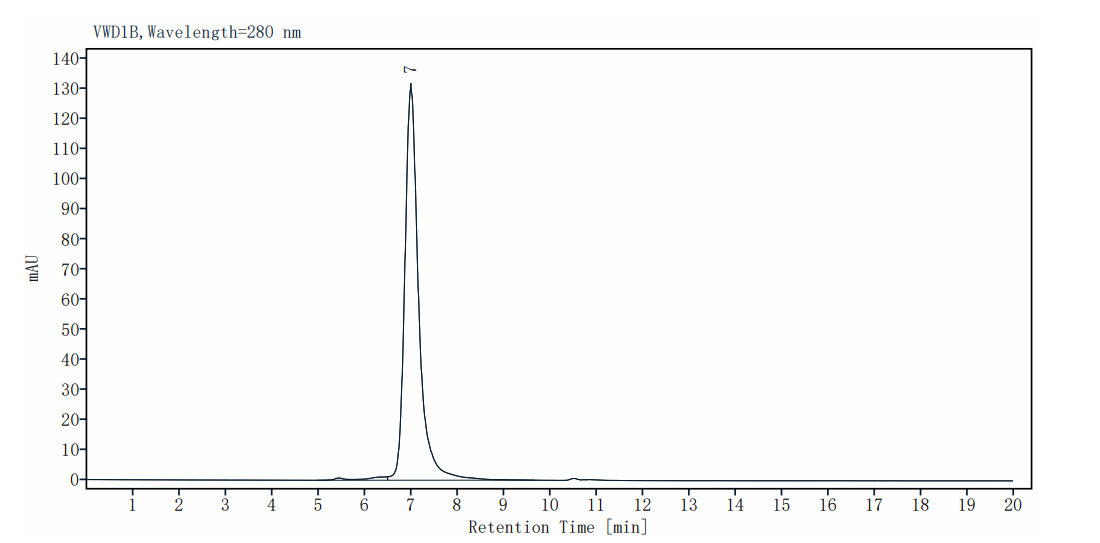
SEC-HPLC
The purity of Biotinylated TSLPR Fc&Avi Tag Protein, Human is more than 95 % as determined by SEC-HPLC.
ELISA
Immobilized Human TSLP Protein (R127A, R130A), His Tag at 5.0μg/mL (100μL/well) can bind Biotinylated TSLPR Fc&Avi Tag Protein, Human (Cat. No. UA016020) with EC50 of 1.36-1.66ng/mL.