WB result of L-Lactyl Lysine Recombinant Rabbit mAb
Primary antibody: L-Lactyl Lysine Recombinant Rabbit mAb at 1/1000 dilution
Lane 1: untreated HeLa whole cell lysate 20 µg
Lane 2: HeLa treated with 100 mM Lactate sodium for 24 hours whole cell lysate 20 µg
Secondary antibody: Goat Anti- rabbit IgG, (H+L), HRP conjugated at 1/10000 dilution
Predicted MW: Multiple
Observed MW: Multiple
L-Lactyl Lysine Rabbit mAb
L-Lactyl Lysine Rabbit mAb
Price:
Regular price
$250 USD
Regular price
Sale price
$250 USD
Unit price
per
For shipping services or bulk orders, you may request a quotation.
Secure checkout with

View full details
Product Details
Product Details
Product Specification
| Host | Rabbit |
| Synonyms | L-Kla, Kla, L-lactylation, L-lactoylation |
| Antibody Type | Recombinant mAb Mix |
| Isotype | IgG |
| Application | WB, IHC-P, ICC |
| Reactivity | Species Independent |
| Positive Sample | HeLa (treated with 100 mM Lactate sodium for 24 hours) |
| Purification | Protein A |
| Concentration | 1 mg/ml |
| Conjugation | Unconjugated |
| Physical Appearance | Liquid |
| Storage Buffer | PBS, 40% Glycerol, 0.05% BSA, 0.03% Proclin 300 |
| Stability & Storage | 12 months from date of receipt / reconstitution, -20 °C as supplied |
Dilution
| application | dilution | species |
| Dot Blot | 1:1000 | |
| WB | 1:1000-1:2000 | Species Independent |
| IHC-P | 1:2000-1:5000 | Species Independent |
| ICC | 1:2000-1:5000 | Species Independent |
Background
Lysine lactylation is an emerging post-translational modification that occurs in cellular metabolism, specifically referring to the accumulation of lactic acid modifying lysine residues on histones. Lysine lactylation modifies the chromatin structure, thereby affecting gene expression. Research has found that lactylation sites are widely distributed in gene promoter regions, closely associated with gene transcriptional activation. Lysine lactylation also participates in energy metabolism processes, potentially related to the dynamic balance regulation of histone lysine acetylation.
Picture
Picture
Western Blot
Dot Blot
Dot blot result of L-Lactyl Lysine Rabbit mAb
Lane 1: Modified peptide library (Acetyl lysine)
Lane 2: Unmodified peptide library control
Lane 3: Modified peptide library (D-lactyl lysine)
Lane 4: Modified peptide library (β-hydroxybutyryl lysine)
Lane 5: Modified peptide library (Fumaryl lysine)
Lane 6: Modified peptide library (Crotonyl lysine)
Lane 7: Modified peptide library (Succinyl lysine)
Lane 8: Modified peptide library (L-lactyl lysine)
Lane 9: Modified peptide library (Propionyl lysine)
Lane 10: Modified peptide library (Actyl lysine)
Primary antibody: L-Lactyl Lysine Rabbit mAb at 1/1000 dilution
Secondary antibody: Goat Anti-rabbit IgG, (H+L), HRP conjugated at 1/10000 dilution
Immunohistochemistry
IHC shows positive staining in paraffin-embedded human cervical squamous cell carcinoma. Anti- L-Lactyl Lysine antibody was used at 1/2000 dilution, followed by a HRP Polymer for Mouse & Rabbit IgG (ready to use). Counterstained with hematoxylin. Heat mediated antigen retrieval with Tris/EDTA buffer pH9.0 was performed before commencing with IHC staining protocol.
IHC shows positive staining in paraffin-embedded human colon cancer. Anti- L-Lactyl Lysine antibody was used at 1/2000 dilution, followed by a HRP Polymer for Mouse & Rabbit IgG (ready to use). Counterstained with hematoxylin. Heat mediated antigen retrieval with Tris/EDTA buffer pH9.0 was performed before commencing with IHC staining protocol.
IHC shows positive staining in paraffin-embedded human colon. Anti- L-Lactyl Lysine antibody was used at 1/2000 dilution, followed by a HRP Polymer for Mouse & Rabbit IgG (ready to use). Counterstained with hematoxylin. Heat mediated antigen retrieval with Tris/EDTA buffer pH9.0 was performed before commencing with IHC staining protocol.
Immunocytochemistry
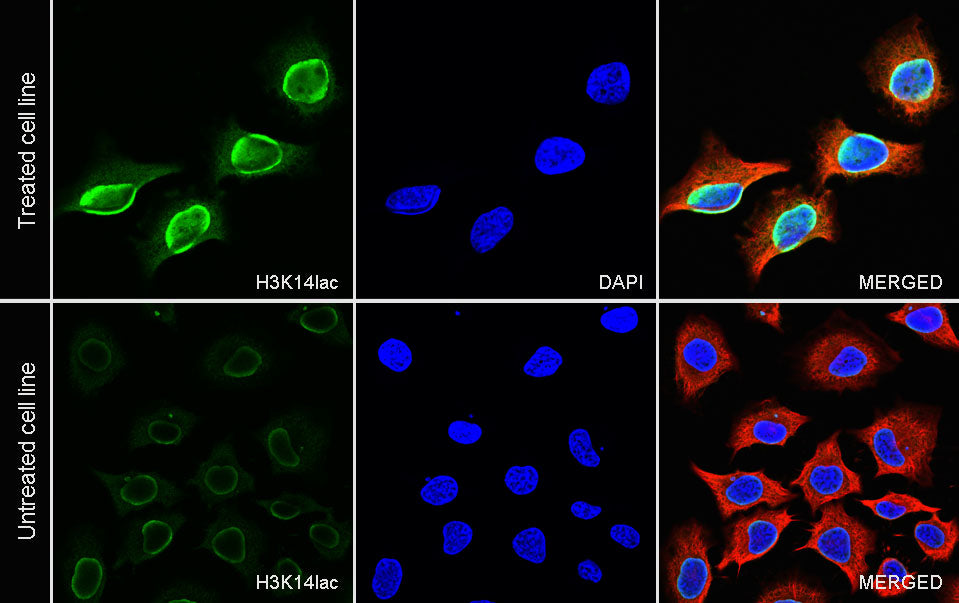
ICC analysis of HeLa cells treated with Lactate sodium (100 mM, 24 hours) (top panel) and untreated HeLa cells (below panel). Anti- L-Lactyl Lysine antibody was used at 1/2500 dilution (Green) and incubated overnight at 4°C. Goat polyclonal Antibody to Rabbit IgG - H&L (Alexa Fluor® 488) was used as secondary antibody at 1/1000 dilution. The cells were fixed with 100% ice-cold methanol and permeabilized with 0.1% PBS-Triton X-100. Nuclei were counterstained with DAPI (Blue). Counterstain with tubulin (Red).