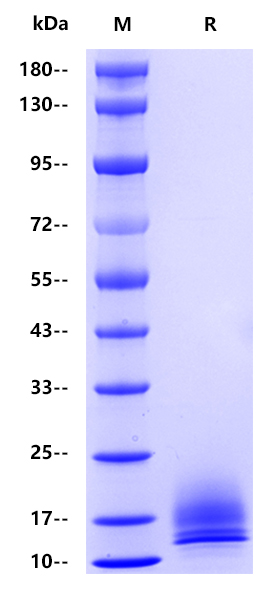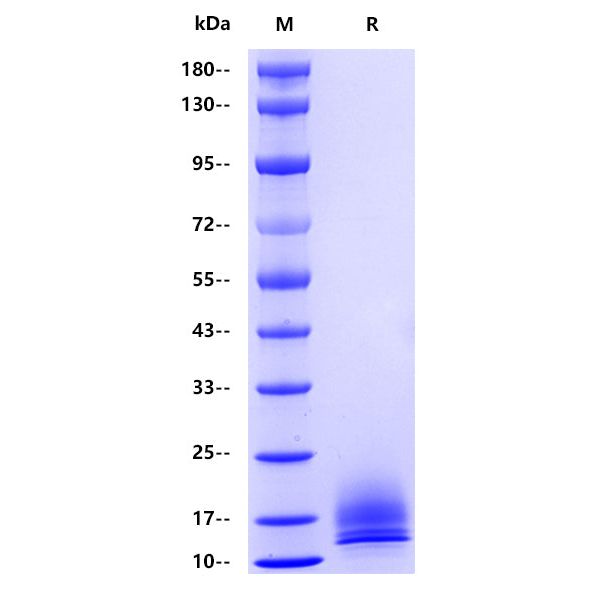

2μg(R: reducing conditions)
Human NY-BR-1, His tag
Human NY-BR-1, His tag
Price:
Regular price
$100 USD
Regular price
Sale price
$100 USD
Unit price
per
For shipping services or bulk orders, you may request a quotation.
Secure checkout with

View full details
Product Details
Product Details
Product Specification
| Species | Human |
| Synonyms | ANKRD30A |
| Accession | Q9BXX3 |
| Amino Acid Sequence | Protein sequence(Q9BXX3, Arg851-Leu928, with C-10*His) RMKVSIPTKALELMDMQTFKAEPPEKPSAFEPAIEMQKSVPNKALELKNEQTLRADQMFPSESKQKKVEENSWDSESLGGGGSHHHHHHHHHH |
| Expression System | HEK293 |
| Molecular Weight | Theoretical:10.6kDa Actual:13-20kDa |
| Purity | >95% by SDS-PAGE |
| Endotoxin | <1EU/μg |
| Tag | His Tag |
| Physical Appearance | Lyophilized Powder |
| Storage Buffer | Lyophilized from a 0.2 μm filtered solution of 0.2M PBS, 1mM EDTA, pH7.4. |
| Reconstitution | Reconstitute no more than 1 mg/mL according to the size in deionized water after rapid centrifugation. |
| Stability & Storage | 12 months from date of receipt, -20 to -70 °C as supplied. 6 months, -20 to -70 °C under sterile conditions after reconstitution. 1 week, 2 to 8 °C under sterile conditions after reconstitution. Please avoid repeated freeze-thaw cycles. |
Background
ANKRD30A has been previously identified as NY-BR-1 or antigen B726P. It was identified based on spontaneous humoural immune responses in breast cancer patients (Jäger et al. 2001, 2002). The protein is regarded as a putative transcription factor, as it contains a bipartite nuclear localization signal motif and a bZIP site (DNA-binding site followed by leucine zipper motif). Additional structural features include five tandem ankyrin repeats, implying a role for ANKRD30A in protein–protein interactions. In view of its highly restricted expression pattern, ANKRD30A may be considered as a breast differentiation antigen that could represent a suitable target for immunotherapy. Indeed, it was found in 80% of breast cancer specimens, while tumours of other histological types were ANKRD30A-negative. It was also identified in normal breast, normal testis, was inconsistent in prostate, and not found in other tissues.
Picture
Picture
SDS-PAGE