

Unione ®️ TR-FRET Human PD1/PD-L1 Binding Kit
Unione ®️ TR-FRET Human PD1/PD-L1 Binding Kit

Product Details
Product Details
Product Specification
| Host | Human |
| Stability & Storage | -80℃ |
Background
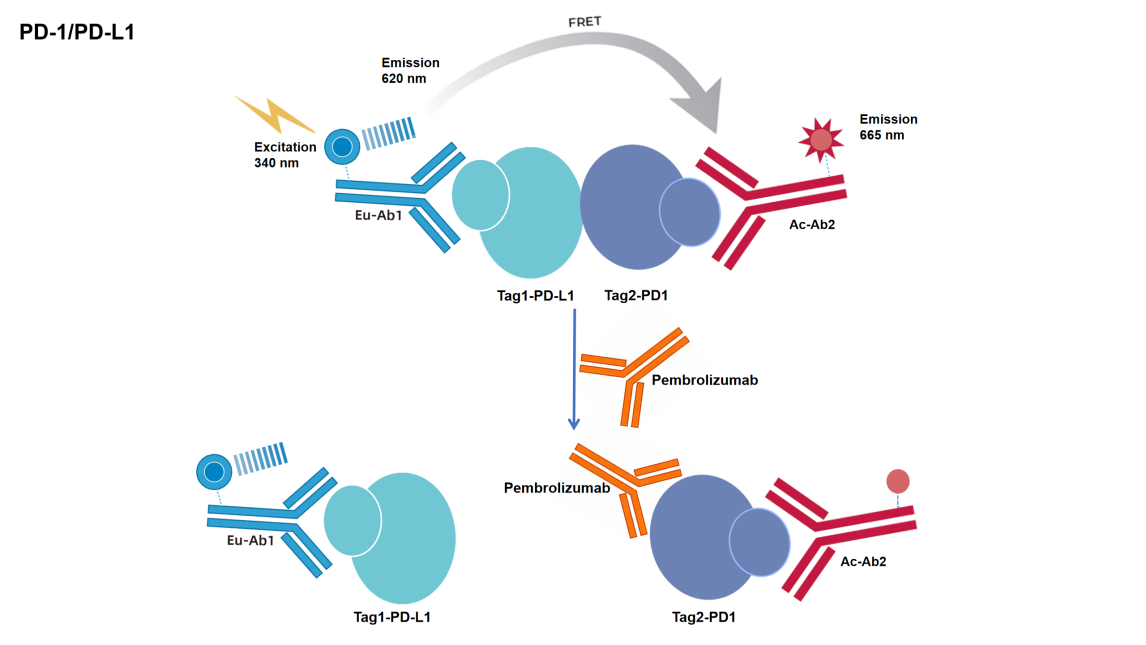
The assay kit utilizes homogeneous time-resolved fluorescence (TR-FRET) technology to measure the interaction between PD1 and PD-L1. This method enables simple, rapid, and high-throughput screening of inhibitors and antibody blockers.
As shown in the figure, the interaction between PD1 and PD-L1 is detected using an Eu-labeled anti-Tag1 antibody (TR-FRET donor) and an Ac-labeled anti-Tag2 antibody (TR-FRET acceptor). The binding of PD1 and PD-L1 brings the donor and acceptor antibodies into proximity, allowing the excitation of the donor antibody to trigger fluorescence resonance energy transfer (FRET) to the acceptor antibody, resulting in a specific emission signal at 665 nm. Pembrolizumab, as a positive control, blocks the interaction between PD1 and PD-L1, preventing FRET signal generation. The stronger the blocking effect of the screened drug on the PD1/PD-L1 interaction, the lower the signal. The specific signal is proportional to the extent of the PD1/PD-L1 interaction. This homogeneous assay is simple to perform and requires no washing steps.
Components
Component |
Concentration |
100T |
500T |
2500T |
10000T |
Storage Temperature |
Pembrolizumab |
5μM |
5μL |
10μL |
50μL |
200μL |
-80℃ |
Tag1-PD-L1 protein |
100× |
5μL |
20μL |
100μL |
400μL |
-80℃ |
Tag2- PD1 protein |
100× |
5μL |
20μL |
100μL |
400μL |
-80℃ |
Anti-Tag1 Eu antibody |
50× |
10μL |
50μL |
250μL |
1000μL |
-80℃ |
Anti-Tag2 Ac antibody |
12.5× |
40μL |
200μL |
1000μL |
4000μL |
-80℃ |
Detection buffer |
10× |
400μL |
2mL |
10mL |
40mL |
-80℃ |
Note: Aliquot immediately upon first thaw and store at the recommended temperature. Avoid storage after dilution and repeated freeze-thaw cycles.