

Unione ®️ TR-FRET Human BTK/CRBN PROTAC Binding Kit
Unione ®️ TR-FRET Human BTK/CRBN PROTAC Binding Kit

Product Details
Product Details
Product Specification
| Host | Human |
| Stability & Storage | -80℃ |
Background
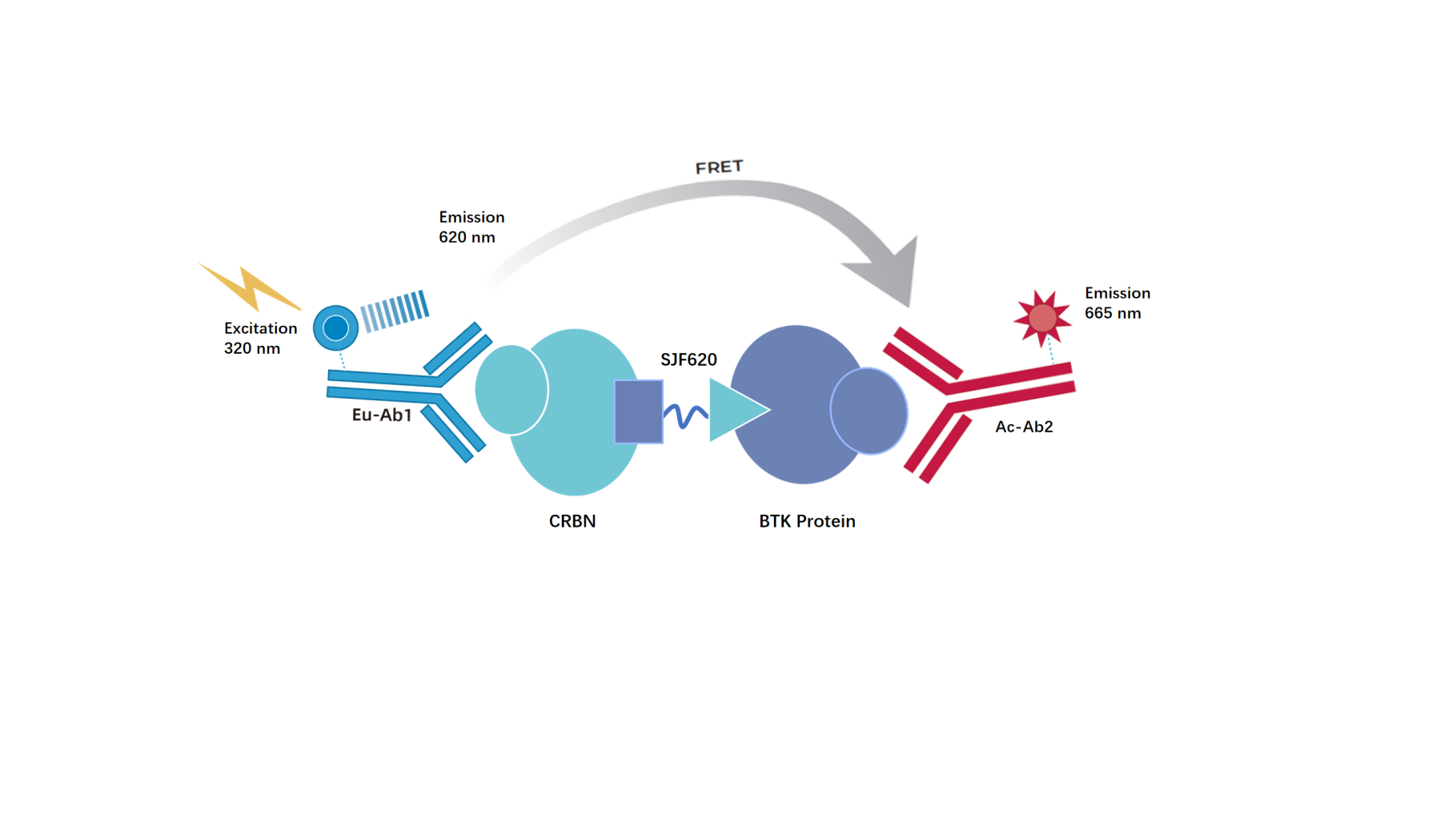
The assay kit utilizes homogeneous time-resolved fluorescence (TR-FRET) technology to measure the interaction between the DDB1/CRBN complex and BTK mediated by molecular glue SJF620 and test compounds. This method enables a high-throughput format for simple and rapid detection of small molecules that can mediate the interaction between the DDB1/CRBN complex and BTK.
As shown, the interaction between DDB1/CRBN and BTK is detected using a Eu-labeled anti-Tag1 antibody (TR-FRET donor) and an Accepter-labeled anti-Tag2 antibody (TR-FRET acceptor). Since molecular glue SJF620 mediates the interaction between DDB1/CRBN and BTK, the donor antibody and acceptor antibody come into proximity, allowing the excitation of the donor antibody to trigger fluorescence resonance energy transfer (FRET) to the acceptor antibody, resulting in a specific emission signal at 665 nm. This specific signal is proportional to the extent of interaction mediated by SJF620 between DDB1/CRBN and BTK. The homogeneous assay is simple to perform and requires no washing steps.
Components
Component |
Concentration |
100T |
500T |
2500T |
10000T |
Storage Temperature |
Tag1-DDB1/CRBN protein |
50× |
8μL |
40μL |
200μL |
800μL |
-80℃ |
Tag2- BTK protein |
20× |
20μL |
100μL |
500μL |
2mL |
-80℃ |
SJF620 |
1mM |
5μL |
10μL |
50μL |
200μL |
-80℃ |
Anti-Tag1 Eu antibody |
50× |
10μL |
50μL |
250μL |
1mL |
-80℃ |
Anti-Tag2 Ac antibody |
12.5× |
40μL |
200μL |
1mL |
4mL |
-80℃ |
Detection buffer |
10× |
400μL |
2mL |
10mL |
40mL |
-80℃ |
Protocol
[Experimental Procedure and Operation]
1.Reagent Preparation
1.1 Melt all reagents at room temperature before use (equilibrate at room temperature for at least 30 min). The reaction volume for the 384-well shallow well plate is 20μL (reagent volumes for the reaction system are shown in the table). Calculate the required volume for the experiment prior to preparation and prepare as needed; the following preparation is for reference only, using 500 tests as an example.
Table 1. Reagent Preparation
Reagent Name |
Preparation |
Volume per Detection Well (μL) |
Detection buffer |
Take 2 mL 10× Detection buffer 1 and add 18 mL deionized water, dilute to 1×, mix well and set aside. |
- |
SJF620 |
According to the reaction system, dilute the compound to the desired concentration using 1× Detection buffer. Ensure consistent DMSO concentration across all detection wells. |
2 |
Tag1-DDB1/CRBN protein |
Take 40μL Tag1-DDB1/CRBN protein stock solution, dilute to 2 mL with 1× Detection buffer, mix well and set aside for later use. |
4 |
Tag2- BTK protein |
Take 100μL Tag2- BTK protein stock solution, dilute to 2 mL with 1× Detection buffer, mix well and set aside for later use. |
4 |
Antibody Mix |
Take 50μL Anti-Tag1 Eu antibody stock solution, add 2.45 mL of 1× Detection buffer, mix well; take 200μL Anti-Tag2 Ac antibody stock solution, add 2.3 mL of 1× Detection buffer, mix well; mix the two solutions 1:1 to prepare Antibody Mix. |
10 |
1.2 Gradient Dilution of Test Samples
Using SJF620 as an example, the diluent is 1× Detection buffer. To minimize matrix effect interference, it is recommended to dilute with a solution matching the sample matrix; adjust the test samples according to actual concentrations.
Table2. Positive Control Drug Gradient Dilution (Adjust according to actual conditions)
SJF620 Final Concentration (nM) |
SJF620 Prepared Concentration (nM) |
Preparation Method |
|
1 |
10000.00 |
100000.00 |
2μL 1 mM Stock Solution+18μL 1× Detection buffer |
2 |
2500.00 |
25000.00 |
5μL ①+15μL 1× Detection buffer |
3 |
625.00 |
6250.00 |
5μL ②+15μL 1× Detection buffer |
4 |
156.25 |
1562.50 |
5μL ③+15μL 1× Detection buffer |
5 |
39.06 |
390.63 |
5μL ④+15μL 1× Detection buffer |
6 |
9.77 |
97.66 |
5μL ⑤+15μL 1× Detection buffer |
7 |
2.44 |
24.41 |
5μL ⑥+15μL 1× Detection buffer |
8 |
0.61 |
6.10 |
5μL ⑦+15μL 1× Detection buffer |
9 |
0.15 |
1.53 |
5μL⑧+15μL 1× Detection buffer |
10 |
0.04 |
0.38 |
5μL ⑨+15μL 1× Detection buffer |
Blank |
0 |
0 |
15μL 1× Detection buffer |
2.Sample Addition and Controls
Positive Control Standard Curve |
Test Samples |
Blank |
NC |
|
2μL Gradient Diluted SJF620 |
2μL Gradient Diluted Test Samples |
2μL 1× Detection buffer |
10μL 1× Detection buffer+10μL Antibody Mix |
4μL Tag1- CRBN protein | |||
4μL Tag2-BTK protein | |||
10μL Antibody Mix | |||
Seal the plate wells with a sealing film,incubate at room temperature for 2 hours; | |||
2.1 Test Samples: 2μL gradient diluted test samples, 4μL Tag1-DDB1/CRBN protein working solution, 4μL Tag2-BTK protein working solution, 10μL mixed Antibody Mix (Tag2-BTK protein can be mixed with Antibody Mix in proportion before addition), added sequentially into the 384-well shallow well plate.
2.2 Positive Control Standard Curve: 2μL gradient diluted SJF620, 4μL Tag1-DDB1/CRBN protein working solution, 4μL Tag2-BTK protein working solution, 10μL Antibody Mix.
2.3 Blank: 2μL 1× Detection buffer replaces test samples;
2.4 Negative Control Wells (NC): 10μL 1× Detection buffer plus 10μL Antibody Mix.
After adding all samples, centrifuge, cover with a sealing film, and incubate at room temperature for 2 hours.
3.Detection
Detect using a microplate reader compatible with TR-FRET. Excitation wavelength is 320/340nm, and emission wavelengths detected are 620nm and 665nm.
[Result Calculation]
1) Calculate Signal Value (Ratio): Divide the 665nm fluorescence signal by the 620nm fluorescence signal, then multiply by 10000.
Ratio = (665/620) ×10000
2) Calculate Net signal based on signal values:
Net signal = (Std-NC)/NC×100
3) Calculate CV (%):
CV (%) = Standard Deviation/Mean Ratio × 100%
[Data Example]
The following data cannot replace data obtained from experiments and is for illustration only. Results may vary depending on the microplate reader used.
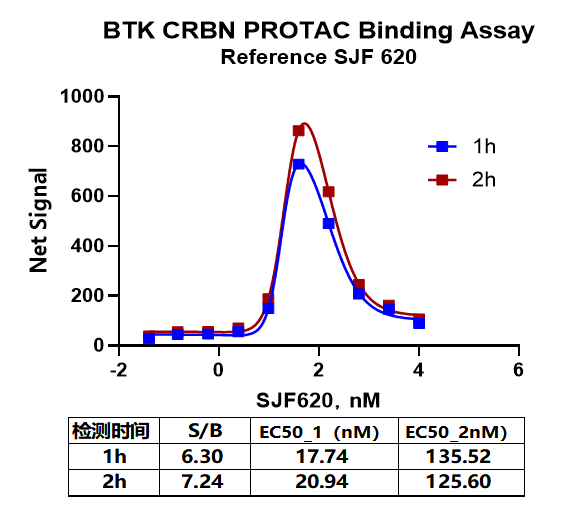
Note: Recommended microplate (384-well plate, white, shallow well)