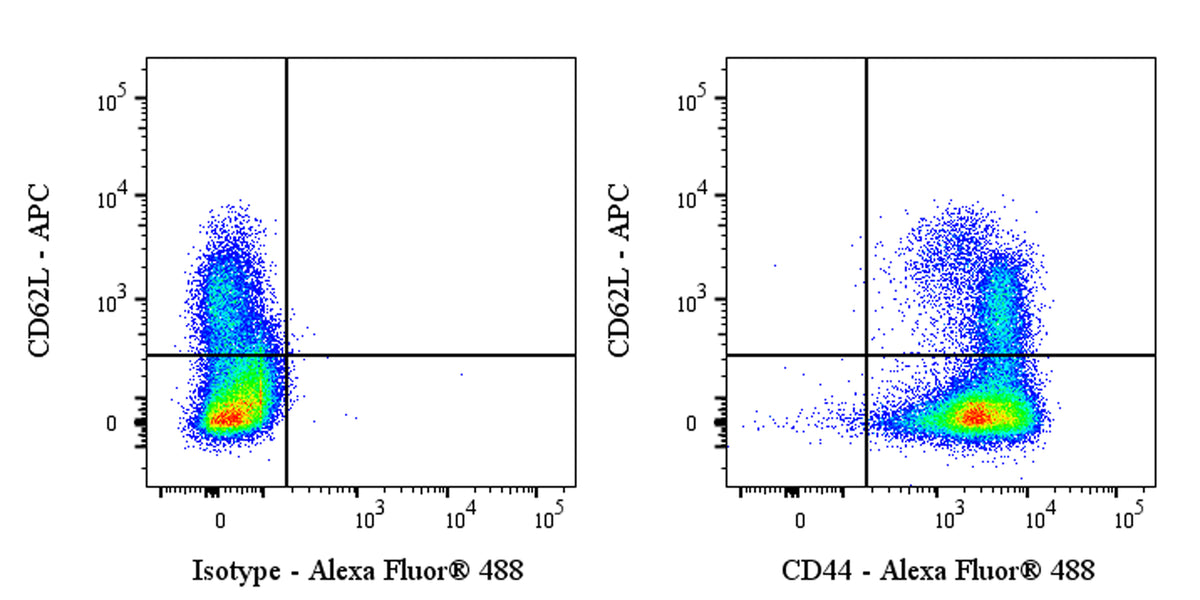
Flow cytometric analysis of human PBMC (human peripheral blood mononuclear cells) labelling CD44 antibody at 1/400 dilution (0.5 μg) / (right panel) compared with a Rat IgG2b, κ Isotype Control / (left panel). Goat Anti-Rat IgG Alexa Fluor® 488 was used as the secondary antibody. Then cells were stained with CD62L - Allophycocyanin antibody separately. Flow cytometry and data analysis were performed using BD FACSymphony™ A1 and FlowJo™ software.
Rat Anti-Mouse/Human CD44 Antibody (IM7)
Rat Anti-Mouse/Human CD44 Antibody (IM7)
Price:
Regular price
$100 USD
Regular price
Sale price
$100 USD
Unit price
per
For shipping services or bulk orders, you may request a quotation.
Secure checkout with

View full details
Product Details
Product Details
Product Specification
| Host | Rat |
| Antigen | CD44 |
| Synonyms | CDw44; Epican; Extracellular matrix receptor III (ECMR-III); GP90 lymphocyte homing/adhesion receptor; HUTCH-I; Heparan sulfate proteoglycan; Hermes antigen; Hyaluronate receptor; Phagocytic glycoprotein 1 (PGP-1); Phagocytic glycoprotein I (PGP-I); LHR; MDU2; MDU3; MIC4 |
| Location | Cell membrane |
| Accession | P16070、 P15379 |
| Clone Number | IM7 |
| Antibody Type | Rat mAb |
| Isotype | IgG2b,k |
| Application | FCM |
| Reactivity | Hu, Ms |
| Positive Sample | Human PBMC |
| Purification | Protein G |
| Concentration | 2 mg/ml |
| Conjugation | Unconjugated |
| Physical Appearance | Liquid |
| Storage Buffer | PBS pH7.4 |
| Stability & Storage | 12 months from date of receipt / reconstitution, 2 to 8 °C as supplied |
Dilution
| application | dilution | species |
| FCM | 1:400 | Hu, Ms |
Background
CD44 is a widely expressed transmembrane glycoprotein on the cell surface, belonging to the adhesion molecule family. It primarily functions as a receptor for hyaluronic acid (HA) and mediates cell-cell and cell-matrix interactions. Its structure includes variant exon-spliced isoforms (e.g., CD44v) and a constant region (CD44s), with post-translational modifications such as glycosylation generating multiple variants. CD44 plays crucial roles in physiological and pathological processes, including inflammation, wound healing, lymphocyte homing, and tumor metastasis. It is highly expressed in cancer stem cells (CSCs) and is associated with tumor progression, drug resistance, and poor prognosis. Key signaling pathways involving CD44 include PI3K/AKT and RAS/MAPK, making it a potential therapeutic target in cancer and stem cell research.
Picture
Picture
FC