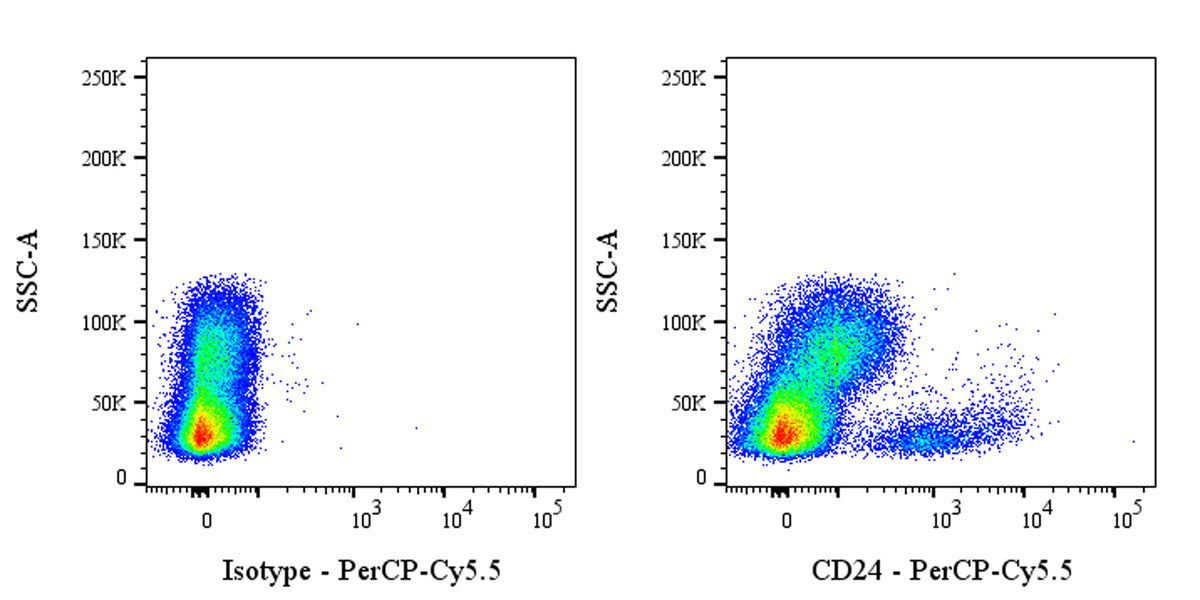
Flow cytometric analysis of human CD24 expression on human PBMC. Human PBMC were stained with either PerCP-Cy5.5 Mouse IgG2a, κ Isotype Control (left panel) or SDT PerCP-Cy5.5 Mouse Anti-Human CD24 Antibody (right panel) at 5 μl/test treated with True-Stain Monocyte Blocker™. Flow cytometry and data analysis were performed using BD FACSymphony™ A1 and FlowJo™ software.
PerCP-Cy5.5 Mouse Anti-Human CD24 Antibody (ML5)
PerCP-Cy5.5 Mouse Anti-Human CD24 Antibody (ML5)
Price:
Regular price
$210 USD
Regular price
Sale price
$210 USD
Unit price
per
For shipping services or bulk orders, you may request a quotation.
Secure checkout with

View full details
Product Details
Product Details
Product Specification
| Host | Mouse |
| Antigen | CD24 |
| Synonyms | Signal transducer CD24; Small cell lung carcinoma cluster 4 antigen; CD24A |
| Location | Cell membrane |
| Accession | P25063 |
| Clone Number | ML5 |
| Antibody Type | Mouse mAb |
| Isotype | IgG2a,k |
| Application | FCM |
| Reactivity | Hu |
| Positive Sample | Human PBMC |
| Purification | Protein G |
| Concentration | 0.2 mg/ml |
| Conjugation | PerCP-Cy5.5 |
| Physical Appearance | Liquid |
| Storage Buffer | PBS, 1% BSA, 0.3% Proclin 300 |
| Stability & Storage | 12 months from date of receipt / reconstitution, 2 to 8 °C as supplied |
Dilution
| application | dilution | species |
| FCM | 5μl per million cells in 100μl volume | Hu |
Background
CD24, also known as heat stable antigen (HSA), is a mucin-type glycosylphosphatidylinositol (GPI)-anchored glycoprotein primarily expressed on the surface of hematopoietic cells such as B lymphocytes, activated T lymphocytes, monocytes, and granulocytes, as well as certain epithelial cells. It plays a critical role in cell recognition, activation, signal transduction, proliferation, differentiation, and cell extension and movement. In the context of oncology, CD24 is highly expressed in a variety of malignant tumors, including breast, ovarian, bladder, prostate, non-small cell lung, and nasopharyngeal cancers. It has immunomodulatory functions and is involved in the interaction between tumor cells and the immune system, where it can inhibit macrophage-mediated phagocytosis of tumor cells, thereby promoting immune evasion of the tumor. Its engagement with Siglec-10 on macrophages serves as a "don't eat me" signal, which is a significant mechanism of tumor immune escape. Targeting the CD24-Siglec10 axis is an area of active research in cancer immunotherapy, as it holds potential for reprogramming the tumor immune microenvironment and enhancing anti-tumor immunity.
Picture
Picture
FC