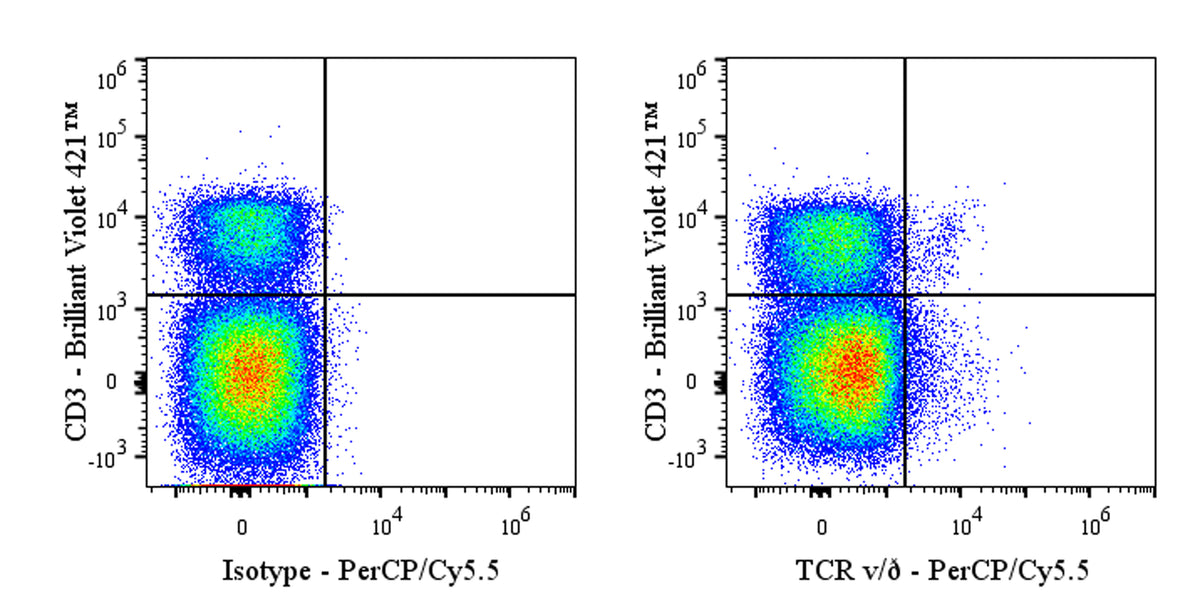
Flow cytometric analysis of Mouse TCR γ/δ expression on C57BL/6 mouse splenocytes. C57BL/6 mouse splenocytes were stained with Brilliant Violet 421™ Rat Anti-Mouse CD3 and either PerCP-Cy5.5 Armenian hamster IgG Isotype Control (left panel) or SDT PerCP-Cy5.5 Armenian hamster Anti-Mouse TCR γ/δ Antibody (right panel) at 5 μl/test treated with True-Stain Monocyte Blocker™. Flow cytometry and data analysis were performed using BD FACSymphony™ A1 and FlowJo™ software.
PerCP-Cy5.5 Armenian hamster Anti-Mouse TCR γ/δ Antibody (S-R525)
PerCP-Cy5.5 Armenian hamster Anti-Mouse TCR γ/δ Antibody (S-R525)
Price:
Regular price
$150 USD
Regular price
Sale price
$150 USD
Unit price
per
For shipping services or bulk orders, you may request a quotation.
Secure checkout with

View full details
Product Details
Product Details
Product Specification
| Host | Armenian hamster |
| Antigen | TCR γ/δ |
| Location | Cell membrane |
| Accession | 110066、110067 |
| Clone Number | S-R525 |
| Antibody Type | Recombinant mAb |
| Isotype | IgG |
| Application | FCM |
| Reactivity | Ms |
| Positive Sample | C57BL/6 mouse splenocytes |
| Purification | Protein G |
| Concentration | 0.2 mg/ml |
| Conjugation | PerCP-Cy5.5 |
| Physical Appearance | Liquid |
| Storage Buffer | PBS, 1% BSA, 0.3% Proclin 300 |
| Stability & Storage | 12 months from date of receipt / reconstitution, 2 to 8 °C as supplied |
Dilution
| application | dilution | species |
| FCM | 1μg per million cells in 100μl volume | Ms |
Background
TCR γ protein is a key component of the γδ T cell receptor (TCR), which is a heterodimer comprising TCRγ and TCRδ chains. Unlike the αβ TCR, which primarily recognizes peptide antigens presented by MHC molecules, the γδ TCR can identify a diverse range of antigens in an MHC-independent manner. This includes small phosphorylated non-peptide antigens, such as those produced by cellular pathogens and cancers. The γδ TCR is associated with three CD3 dimeric subunits—CD3εγ, CD3εδ, and CD3ζζ—forming an octameric γδ TCR–CD3 complex. This complex plays a crucial role in the immune response by triggering the phosphorylation of ITAMs within the cytoplasmic tails of CD3 subunits upon antigen engagement, initiating downstream signaling events. The γδ TCR–CD3 complex is an attractive target for cancer immunotherapy due to its unique properties and effector functions. TCR δ protein is a component of the γδ T cell receptor (TCR), forming a heterodimer with TCR γ chain. This γδ TCR is expressed on γδ T cells, which are a unique subset of T cells with both adaptive and innate immune characteristics. Unlike αβ TCRs that primarily recognize peptide antigens presented by MHC molecules, γδ TCRs can recognize a diverse range of antigens in an MHC-independent manner. TCR δ, along with TCR γ, undergoes somatic recombination of V, D, and J gene segments to generate diversity. The γδ TCR-CD3 complex, which includes TCR γ, TCR δ, and CD3 subunits, plays a crucial role in antigen recognition and T cell activation. Upon antigen binding, the complex triggers the phosphorylation of ITAMs in the CD3 subunits, initiating downstream signaling pathways that lead to T cell proliferation, differentiation, and effector functions. This makes the γδ TCR-CD3 complex an attractive target for cancer immunotherapy, as it can provide broad protective immune responses against various infections and tumors.
Picture
Picture
FC