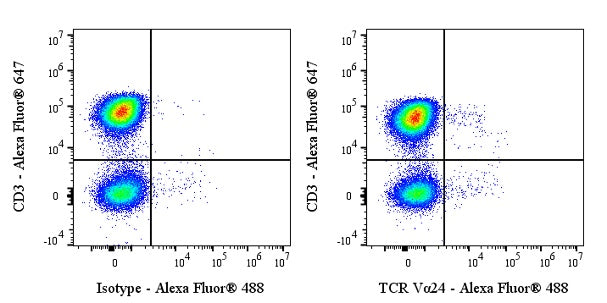
Flow cytometric analysis of human PBMC (human peripheral blood mononuclear cells) labeled Human TCR Vα24 antibody at 1/200 dilution (1 μg) / (right panel) compared with a Mouse IgG1, κ Isotype Control / (left panel). Goat Anti-Mouse IgG Alexa Fluor® 488 was used as the secondary antibody. Then cells were stained with CD3 - Alexa Fluor® 647 antibody separately. Total viable cells, as determined by Fixable Viability Dye 452 (S0D0021), were used for analysis. Flow cytometry and data analysis were performed using Agilent NovoCyte Quanteon and FlowJo™ software.
Mouse Anti-Human TCR Vα24 Antibody (S-4518)
Mouse Anti-Human TCR Vα24 Antibody (S-4518)
Price:
Regular price
$100 USD
Regular price
Sale price
$100 USD
Unit price
per
For shipping services or bulk orders, you may request a quotation.
Secure checkout with

View full details
Product Details
Product Details
Product Specification
| Host | Mouse |
| Antigen | TCR Vα24 |
| Synonyms | TCR Valpha24; TCRAV24S1; TCR Va24; TCRV alpha 24; TRAV24 |
| Location | Cell membrane |
| Accession | 28659 |
| Clone Number | S-4518 |
| Antibody Type | Mouse mAb |
| Isotype | IgG1,k |
| Application | FCM |
| Reactivity | Hu |
| Positive Sample | Human PBMC |
| Purification | Protein G |
| Concentration | 2 mg/ml |
| Conjugation | Unconjugated |
| Physical Appearance | Liquid |
| Storage Buffer | PBS pH7.4 |
| Stability & Storage | 12 months from date of receipt / reconstitution, 2 to 8 °C as supplied |
Dilution
| application | dilution | species |
| FCM | 1:200 | Hu |
Background
TCR Vα24 (T-cell receptor Vα24 chain) is a specific variable region gene segment of the human T-cell receptor alpha chain, most notably characterized by its rearrangement with the Jα18 gene segment to pair with a specific Vβ11 chain, forming a semi-invariant T-cell receptor primarily expressed on a special subset of T cells known as Natural Killer T (NKT) cells (specifically Type I or classical NKT cells); this unique Vα24-Jα18/Vβ11 TCR combination enables NKT cells to recognize lipid antigens (such as α-galactosylceramide, α-GalCer) presented by CD1d molecules, rather than the peptide-MHC complexes recognized by conventional T cells, thereby allowing NKT cells to rapidly release large amounts of cytokines (such as IFN-γ and IL-4) upon activation, playing a pivotal bridging role in connecting innate and adaptive immunity, regulating autoimmune diseases, modulating anti-tumor immune responses, and defending against infections.
Picture
Picture
FC