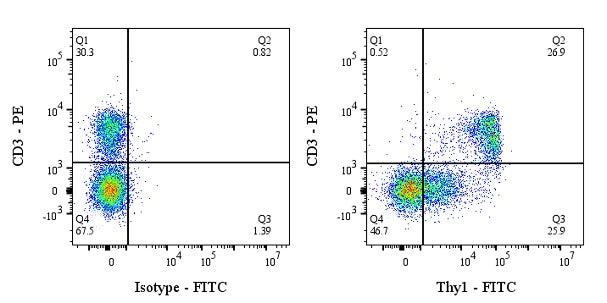
Flow cytometric analysis of Mouse Thy1(CD90) expression on fresh C57BL/6 mouse splenocytes. Fresh C57BL/6 mouse splenocytes were stained with PE Rat Anti- Mouse CD3 Antibody and either FITC Rat IgG2a Isotype Control (left panel) or SDT FITC Rat Anti- Mouse Thy1(CD90) Antibody (right panel) at 2 μl/test. Total viable cells, as determined by Fixable Viability Dye 452 (S0D0021), were used for analysis. Flow cytometry and data analysis were performed using Agilent NovoCyte Quanteon and FlowJo™ software.
FITC Rat Anti-Mouse Thy1 (CD90) Antibody (S-4038)
FITC Rat Anti-Mouse Thy1 (CD90) Antibody (S-4038)
Price:
Regular price
$60 USD
Regular price
Sale price
$60 USD
Unit price
per
For shipping services or bulk orders, you may request a quotation.
Secure checkout with

View full details
Product Details
Product Details
Product Specification
| Host | Rat |
| Antigen | Thy1 (CD90) |
| Synonyms | Thy-1 membrane glycoprotein; Thy-1 antigen; Thy-1 |
| Location | Cell membrane |
| Accession | P01831 |
| Clone Number | S-4038 |
| Antibody Type | Rat mAb |
| Isotype | IgG2a |
| Application | FCM |
| Reactivity | Ms |
| Positive Sample | Fresh C57BL/6 mouse splenocytes |
| Purification | Protein G |
| Concentration | 0.5 mg/ml |
| Conjugation | FITC |
| Physical Appearance | Liquid |
| Storage Buffer | PBS, 1% BSA, 0.3% Proclin 300 |
| Stability & Storage | 12 months from date of receipt / reconstitution, 2 to 8 °C as supplied |
Dilution
| application | dilution | species |
| FCM | 1μg per million cells in 100μl volume | Ms |
Background
Thy1 (also known as CD90) is a glycosylphosphatidylinositol (GPI)-anchored glycoprotein widely expressed on the surface of various cell types and belongs to the immunoglobulin superfamily; it was originally named after its discovery in mouse thymocytes. As a critical marker for stem cells and specific differentiated cells, Thy1 is highly expressed on hematopoietic stem cells, mesenchymal stem cells (MSCs), neurons, fibroblasts, and activated T cells, with its functions varying significantly depending on the cell type: in the nervous system, it participates in axon growth, synaptic plasticity, and neural repair; in the immune system, it regulates T cell activation, adhesion, and migration; and in stem cell research, it serves as a key surface antigen for identifying and isolating MSCs (typically characterized as CD90-positive). Although its precise downstream signaling mechanisms remain not fully understood due to the lack of a transmembrane domain, Thy1 is generally believed to mediate cell-cell and cell-matrix adhesion by interacting with extracellular matrix components or other membrane proteins, thereby influencing cell proliferation, differentiation, and tissue homeostasis, making it a vital target in regenerative medicine, neurobiology, and oncology.
Picture
Picture
FC