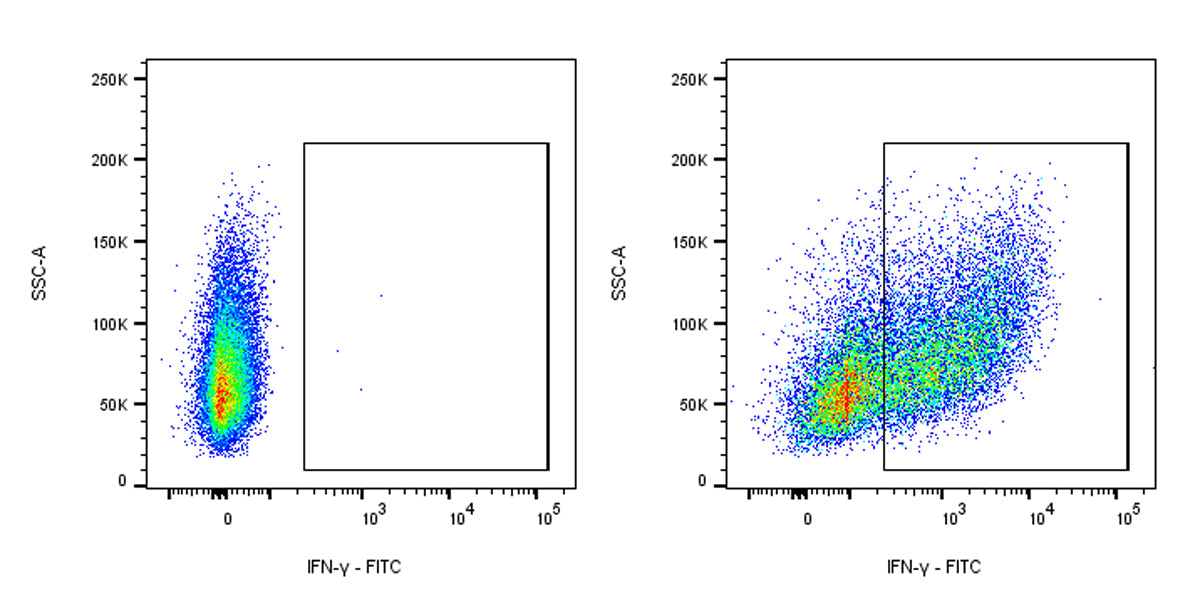
Flow cytometric analysis of IFNγ expression in C57BL/6 mouse splenocytes polarized with Th1 Polarization Kit, Mouse (UA090017). Th1 polarized C57BL/6 mouse splenocytes were harvested and restimulated for 5 hr with PMA and Ionomycin in the presence of Brefeldin A (Right Panel) or unstimulated (Left Panel).
The cells were harvested and fixed with 4% PFA and permeabilized with Intracellular Fixation & Permeabilization Buffer Set. The cells were then stained with SDT FITC Rat Anti-Mouse IFNγ Antibody at 1.25μl/test. Total viable cells, as determined by Fixable Viability Dye 452 (S0D0021), were used for analysis. Flow cytometry and data analysis were performed using BD FACSymphony™ A1 and FlowJo™ software.
FITC Rat Anti-Mouse IFNγ Antibody (XMG1.2)
FITC Rat Anti-Mouse IFNγ Antibody (XMG1.2)
Price:
Regular price
$70 USD
Regular price
Sale price
$70 USD
Unit price
per
For shipping services or bulk orders, you may request a quotation.
Secure checkout with

View full details
Product Details
Product Details
Product Specification
| Host | Rat |
| Antigen | IFNγ |
| Synonyms | Interferon gamma; IFN-gamma; Ifng |
| Location | Secreted |
| Accession | P01580 |
| Clone Number | XMG1.2 |
| Antibody Type | Rat mAb |
| Isotype | IgG1,k |
| Application | ICFCM |
| Reactivity | Ms |
| Positive Sample | Th1 polarized C57BL/6 mouse splenocytes |
| Purification | Protein G |
| Concentration | 0.2 mg/ml |
| Conjugation | FITC |
| Physical Appearance | Liquid |
| Storage Buffer | PBS, 1% BSA, 0.3% Proclin 300 |
| Stability & Storage | 12 months from date of receipt / reconstitution, 2 to 8 °C as supplied |
Dilution
| application | dilution | species |
| ICFCM | 1.25μl per million cells in 100μl volume | Ms |
Background
Interferon-gamma (IFNγ) is the signature cytokine of type II interferon, a 20–25 kDa glycoprotein homodimer that is synthesized and secreted primarily by activated T cells, NK cells and NKT cells; upon binding to its high-affinity receptor (IFNGR1/2) it triggers JAK1/JAK2-mediated phosphorylation of STAT1, launching a transcriptional program that up-regulates MHC class I and II, antigen-processing machinery, chemokines such as CXCL9/10/11, nitric-oxide and reactive-oxygen species, and hundreds of IFN-stimulated genes, thereby polarizing macrophages toward the microbicidal M1 phenotype, enhancing Th1 responses, orchestrating antiviral, antitumor and intracellular bacterial immunity, and exerting pro- or anti-inflammatory feedback depending on context; genetic or therapeutic blockade of IFNγ in mice and humans highlights its essential yet double-edged role in controlling infection, tumor surveillance, autoimmune diseases and immune-related adverse events.
Picture
Picture
FC