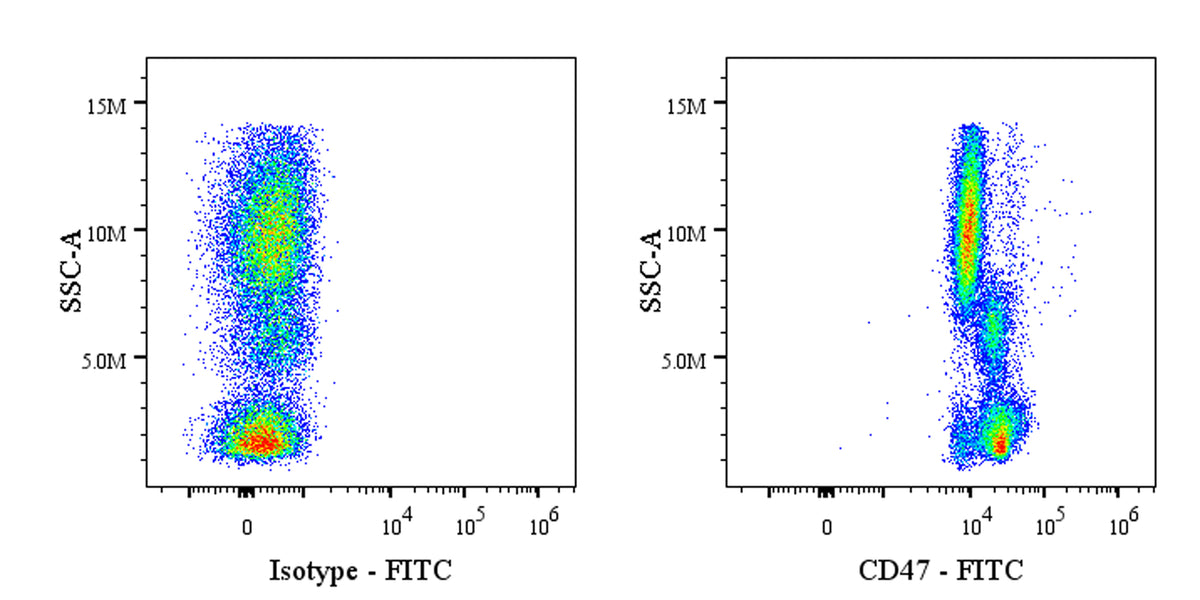
Flow cytometric analysis of human CD47 expression on human peripheral blood cells. Human peripheral blood cells were stained with either FITC Mouse IgG1 Isotype Control (left panel) or SDT FITC Mouse Anti-Human CD47 Antibody (right panel) at 5 μl/test. Flow cytometry and data analysis were performed using BD FACSymphony™ A1 and FlowJo™ software.
FITC Mouse Anti-Human CD47 Antibody (S-3383)
FITC Mouse Anti-Human CD47 Antibody (S-3383)
Price:
Regular price
$120 USD
Regular price
Sale price
$120 USD
Unit price
per
For shipping services or bulk orders, you may request a quotation.
Secure checkout with

View full details
Product Details
Product Details
Product Specification
| Host | Mouse |
| Antigen | CD47 |
| Synonyms | Leukocyte surface antigen CD47; Antigenic surface determinant protein OA3; Integrin-associated protein (IAP); Protein MER6; MER6 |
| Location | Cell membrane |
| Accession | Q08722 |
| Clone Number | S-3383 |
| Antibody Type | Mouse mAb |
| Isotype | IgG1 |
| Application | FCM |
| Reactivity | Hu |
| Positive Sample | Human Peripheral Blood cells |
| Purification | Protein G |
| Concentration | 0.2 mg/ml |
| Conjugation | FITC |
| Physical Appearance | Liquid |
| Storage Buffer | PBS, 1% BSA, 0.3% Proclin 300 |
| Stability & Storage | 12 months from date of receipt / reconstitution, 2 to 8 °C as supplied |
Dilution
| application | dilution | species |
| FCM | 5μl per million cells in 100μl volume | Hu |
Background
CD47 is a widely expressed transmembrane glycoprotein recognized for transmitting a "don't eat me" signal upon binding to signal regulatory protein alpha (SIRPα) on macrophages, thereby inhibiting phagocytosis and protecting healthy cells—especially red blood cells—from clearance. Initially identified as integrin-associated protein (IAP), it also interacts with other ligands such as thrombospondin-1 and various integrins, playing a broad role in regulating cell proliferation, migration, apoptosis, and immune homeostasis. However, many tumor cells exploit this mechanism by upregulating CD47 to evade immune surveillance, positioning CD47 as a promising target for cancer immunotherapy. Although CD47-targeting agents such as Magrolimab have shown antitumor activity in clinical trials, the widespread expression of CD47 on normal cells, particularly erythrocytes, results in significant on-target, off-tumor hematologic toxicities (e.g., anemia)—a major challenge hindering clinical translation. Current research is therefore focused on developing tumor-specific bispecific antibodies or combination strategies to mitigate this risk.
Picture
Picture
FC