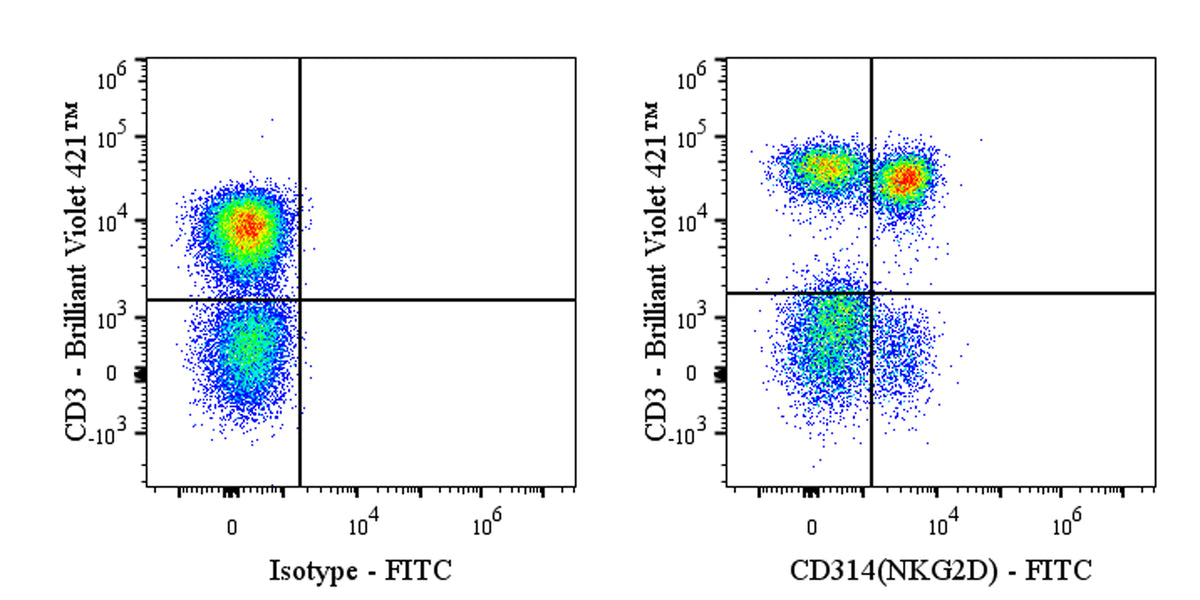
Flow cytometric analysis of human CD314 expression on Human PBMC (human peripheral blood mononuclear cells). Human PBMC were stained with Brilliant Violet 421™ Mouse Anti-Human CD3 Antibody and either FITC Mouse IgG1, k Isotype Control (left panel) or SDT FITC Mouse Anti-Human CD314 Antibody (right panel) at 5 μl/test. Flow cytometry and data analysis were performed using BD FACSymphony™ A1 and FlowJo™ software.
FITC Mouse Anti-Human CD314 (NKG2D) Antibody (S-4154)
FITC Mouse Anti-Human CD314 (NKG2D) Antibody (S-4154)
Price:
Regular price
$180 USD
Regular price
Sale price
$180 USD
Unit price
per
For shipping services or bulk orders, you may request a quotation.
Secure checkout with

View full details
Product Details
Product Details
Product Specification
| Host | Mouse |
| Antigen | CD314 (NKG2D) |
| Location | Cell membrane |
| Accession | P26718 |
| Clone Number | S-4154 |
| Antibody Type | Mouse mAb |
| Isotype | IgG1,k |
| Application | FCM |
| Reactivity | Hu |
| Positive Sample | Human PBMC |
| Purification | Protein G |
| Concentration | 0.2 mg/ml |
| Conjugation | FITC |
| Physical Appearance | Liquid |
| Storage Buffer | PBS, 1% BSA, 0.3% Proclin 300 |
| Stability & Storage | 12 months from date of receipt / reconstitution, 2 to 8 °C as supplied |
Dilution
| application | dilution | species |
| FCM | 5μl per million cells in 100μl volume | Hu |
Background
CD314, also known as NKG2D (Natural Killer Group 2D), is a type II transmembrane glycoprotein and a member of the C-type lectin-like receptor family that serves as an activating receptor expressed on the surface of natural killer (NK) cells, CD8+ T cells, γδ T cells, and NKT cells. It functions as a homodimeric receptor that recognizes stress-induced ligands, including MICA, MICB, and ULBP1-6 (UL16-binding proteins) in humans, which are upregulated on infected, transformed, or damaged cells due to cellular stress, DNA damage, or viral infection. Upon ligand engagement, NKG2D associates with the adaptor protein DAP10 (DNAX-activating protein of 10 kDa) through a charged transmembrane interaction, triggering phosphoinositide 3-kinase (PI3K)-dependent signaling pathways that promote cytotoxicity, cytokine production, and enhanced immune surveillance. Unlike many other NK cell receptors, NKG2D signaling is not inhibited by self-MHC class I molecules, making it a critical mechanism for distinguishing healthy cells from aberrant cells in the context of cancer immunosurveillance, viral defense, and autoimmune regulation. Dysregulation of the NKG2D-ligand axis has been implicated in various pathological conditions, including tumor immune evasion through ligand shedding or downregulation, as well as autoimmune diseases such as rheumatoid arthritis and type 1 diabetes, highlighting its significance as a therapeutic target in immuno-oncology and immunotherapy development.
Picture
Picture
FC