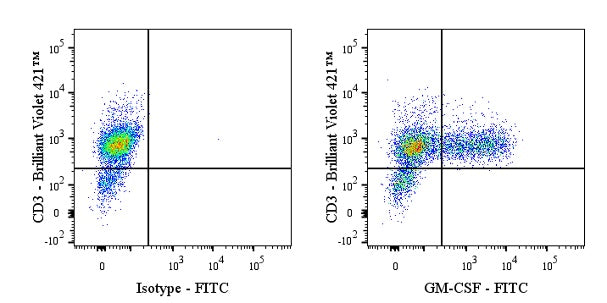
Flow cytometric analysis of GM-CSF expression in human PBMC polarized with Th1 Polarization Kit, Human (UA090016). Th1 polarized human PBMC were harvested and restimulated for 5 hr with PMA and Ionomycin in the presence of Brefeldin A.
The cells were harvested and fixed with 4% PFA and permeabilized with Intracellular Fixation & Permeabilization Buffer Set. The cells were then stained with Brilliant Violet 421™ Mouse Anti-Human CD3 and SDT FITC Human Anti-Human GM-CSF Antibody at 5μl/test. Total viable cells, as determined by Fixable Viability Dye 452 (S0D0021), were used for analysis. Flow cytometry and data analysis were performed using BD FACSymphony™ A1 and FlowJo™ software.
FITC Human Anti-Human GM-CSF Antibody (S-2816)
FITC Human Anti-Human GM-CSF Antibody (S-2816)
Price:
Regular price
$190 USD
Regular price
Sale price
$190 USD
Unit price
per
For shipping services or bulk orders, you may request a quotation.
Secure checkout with

View full details
Product Details
Product Details
Product Specification
| Host | Human |
| Antigen | GM-CSF |
| Synonyms | Granulocyte-macrophage colony-stimulating factor; Colony-stimulating factor (CSF); Molgramostin; Sargramostim; GMCSF; CSF2 |
| Location | Secreted |
| Accession | P04141 |
| Clone Number | S-2816 |
| Antibody Type | Recombinant mAb |
| Application | ICFCM |
| Reactivity | Hu |
| Positive Sample | Th1 Polarization Human PBMC |
| Purification | Protein A |
| Concentration | 0.2 mg/ml |
| Conjugation | FITC |
| Physical Appearance | Liquid |
| Storage Buffer | PBS, 1% BSA, 0.3% Proclin 300 |
| Stability & Storage | 12 months from date of receipt / reconstitution, 2 to 8 °C as supplied |
Dilution
| application | dilution | species |
| ICFCM | 5μl per million cells in 100μl volume | Hu |
Background
Granulocyte-macrophage colony-stimulating factor (GM-CSF), also known as CSF2, is a multifunctional glycoprotein cytokine that serves as a critical regulator of hematopoiesis and immune responses by binding to a specific heterodimeric receptor complex composed of an alpha chain (CD116) and a shared beta chain (CD131) on target cells. Primarily produced by activated macrophages, T cells, mast cells, endothelial cells, and fibroblasts in response to inflammatory stimuli, GM-CSF stimulates the proliferation, differentiation, survival, and functional activation of myeloid progenitor cells, driving their development into mature granulocytes (such as neutrophils, eosinophils, and basophils) and monocytes/macrophages while simultaneously enhancing the antimicrobial and antigen-presenting capabilities of these mature cells through mechanisms like increased phagocytosis, oxidative burst, and upregulation of MHC class II molecules. Beyond its physiological role in boosting host defense against infections and maintaining tissue homeostasis, GM-CSF plays a significant pathological role in chronic inflammatory and autoimmune diseases, such as rheumatoid arthritis and multiple sclerosis, where its overproduction contributes to sustained inflammation and tissue damage, making it a prominent therapeutic target for monoclonal antibodies aimed at blocking its signaling pathway, while recombinant forms of the protein (e.g., sargramostim) are clinically utilized to accelerate myeloid recovery following chemotherapy or bone marrow transplantation.
Picture
Picture
FC