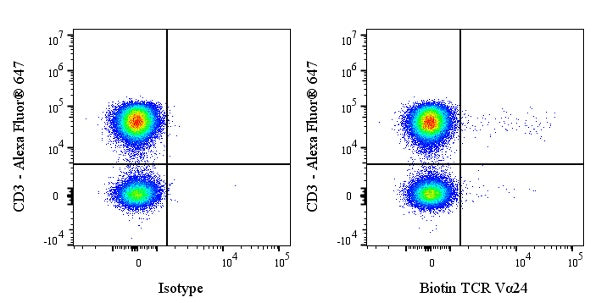
Flow cytometric analysis of human TCR Vα24 expression on human PBMC (human peripheral blood mononuclear cell). Human PBMC were stained with Alexa Fluor® 647 Mouse Anti-Human CD3 Antibody and either Biotin Mouse IgG1, κ Isotype Control (left panel) or SDT Biotin Mouse Anti-Human TCR Vα24 Antibody (right panel) at 5 μl/test followed by Sav-PE. Total viable cells, as determined by Fixable Viability Dye 452 (S0D0021), were used for analysis. Flow cytometry and data analysis were performed using BD FACSymphony™ A1 and FlowJo™ software.
Biotin Mouse Anti-Human TCR Vα24 Antibody (S-4518)
Biotin Mouse Anti-Human TCR Vα24 Antibody (S-4518)
Price:
Regular price
$150 USD
Regular price
Sale price
$150 USD
Unit price
per
For shipping services or bulk orders, you may request a quotation.
Secure checkout with

View full details
Product Details
Product Details
Product Specification
| Host | Mouse |
| Antigen | TCR Vα24 |
| Synonyms | TCR Valpha24; TCRAV24S1; TCR Va24; TCRV alpha 24; TRAV24 |
| Location | Cell membrane |
| Accession | 28659 |
| Clone Number | S-4518 |
| Antibody Type | Mouse mAb |
| Isotype | IgG1,k |
| Application | FCM |
| Reactivity | Hu |
| Positive Sample | Human PBMC |
| Purification | Protein G |
| Concentration | 0.2 mg/ml |
| Conjugation | Biotin |
| Physical Appearance | Liquid |
| Storage Buffer | PBS pH7.4, 0.03% Proclin 300 |
| Stability & Storage | 12 months from date of receipt / reconstitution, 2 to 8 °C as supplied |
Dilution
| application | dilution | species |
| FCM | 5μl per million cells in 100μl volume | Hu |
Background
TCR Vα24 (T-cell receptor Vα24 chain) is a specific variable region gene segment of the human T-cell receptor alpha chain, most notably characterized by its rearrangement with the Jα18 gene segment to pair with a specific Vβ11 chain, forming a semi-invariant T-cell receptor primarily expressed on a special subset of T cells known as Natural Killer T (NKT) cells (specifically Type I or classical NKT cells); this unique Vα24-Jα18/Vβ11 TCR combination enables NKT cells to recognize lipid antigens (such as α-galactosylceramide, α-GalCer) presented by CD1d molecules, rather than the peptide-MHC complexes recognized by conventional T cells, thereby allowing NKT cells to rapidly release large amounts of cytokines (such as IFN-γ and IL-4) upon activation, playing a pivotal bridging role in connecting innate and adaptive immunity, regulating autoimmune diseases, modulating anti-tumor immune responses, and defending against infections.
Picture
Picture
FC