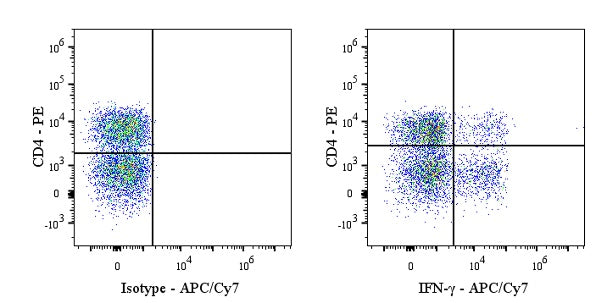
Flow cytometric analysis of IFN-γ expression in human PBMC polarized with Th1 Polarization Kit, Human (UA090016). Th1 polarized human PBMC were harvested and restimulated for 5 hr with PMA and Ionomycin in the presence of Brefeldin A.
The cells were harvested and fixed with 4% PFA and permeabilized with Intracellular Fixation & Permeabilization Buffer Set. The cells were then stained with PE Mouse Anti-Human CD4 and either APC-Cy7 Mouse IgG1, κ Isotype Control (left panel) or SDT APC-Cy7 Mouse Anti-Human IFN-γ Antibody (right panel) at 1.25μl/test treated with True-Stain Monocyte Blocker™. Total viable cells, as determined by Fixable Viability Dye 452 (S0D0021), were used for analysis. Flow cytometry and data analysis were performed using BD FACSymphony™ A1 and FlowJo™ software.
APC-Cy7 Mouse Anti-Human IFN-γ Antibody (S-3076)
APC-Cy7 Mouse Anti-Human IFN-γ Antibody (S-3076)

Product Details
Product Details
Product Specification
| Host | Mouse |
| Antigen | IFN-γ |
| Synonyms | Interferon gamma; IFN-gamma; Immune interferon; IFNG |
| Location | Secreted |
| Accession | P01579 |
| Clone Number | S-3076 |
| Antibody Type | Mouse mAb |
| Isotype | IgG1,k |
| Application | ICFCM |
| Reactivity | Hu |
| Positive Sample | Th1 Polarization Human PBMC |
| Purification | Protein G |
| Concentration | 0.2 mg/ml |
| Conjugation | APC-Cy7 |
| Physical Appearance | Liquid |
| Storage Buffer | PBS, 1% BSA, 0.3% Proclin 300 |
| Stability & Storage | 12 months from date of receipt / reconstitution, 2 to 8 °C as supplied |
Dilution
| application | dilution | species |
| ICFCM | 1.25μl per million cells in 100μl volume | Hu |
Background
Interferon gamma (IFN-γ) is a dimerized soluble cytokine and the only member of the type II class of interferons. It is primarily produced by CD4+ T helper 1 (Th1) cells, natural killer (NK) cells, and CD8+ cytotoxic T cells. The IFN-γ protein is encoded by the IFNG gene in humans and consists of approximately 160 amino acids, forming a noncovalently linked homodimer with a molecular weight of about 50 kDa. It plays a crucial role in regulating both innate and adaptive immunity by activating signaling pathways, such as the JAK-STAT pathway, in cells like macrophages and B cells. IFN-γ has antiviral, antibacterial, and antitumor properties and is involved in promoting inflammation and cell proliferation. However, its pleiotropic nature also means it can induce immunosuppressive effects, which limit its clinical use.
Picture
Picture
FC