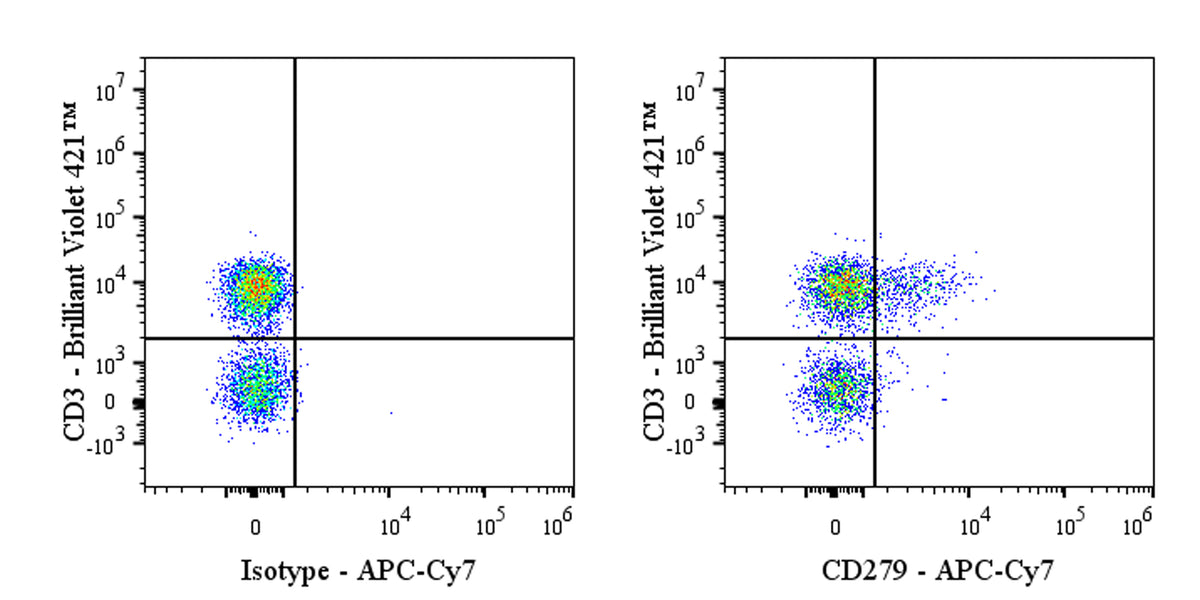
Flow cytometric analysis of human peripheral blood cells. Human Peripheral Blood cells were stained with Brilliant Violet 421™ Mouse Anti-Human CD3 and either APC-Cy7 Mouse IgG1, k Isotype Control (left panel) or SDT APC-Cy7 Mouse Anti-Human CD279 (PD-1) Antibody (right panel) at 1.25 μl/test treated with True-Stain Monocyte Blocker™. Flow cytometry and data analysis were performed using Agilent NovoCyte Quanteon and FlowJo™ software.
APC-Cy7 Mouse Anti-Human CD279 (PD-1) Antibody (EH12.2H7)
APC-Cy7 Mouse Anti-Human CD279 (PD-1) Antibody (EH12.2H7)
Price:
Regular price
$220 USD
Regular price
Sale price
$220 USD
Unit price
per
For shipping services or bulk orders, you may request a quotation.
Secure checkout with

View full details
Product Details
Product Details
Product Specification
| Host | Mouse |
| Antigen | CD279 (PD-1) |
| Synonyms | Programmed cell death protein 1; Protein PD-1; hPD-1; CD279; PD1; PDCD1 |
| Location | Cell membrane |
| Accession | Q15116 |
| Clone Number | EH12.2H7 |
| Antibody Type | Mouse mAb |
| Isotype | IgG1,k |
| Application | FCM |
| Reactivity | Hu |
| Positive Sample | Human Peripheral Blood cells |
| Purification | Protein G |
| Concentration | 0.2 mg/ml |
| Conjugation | APC-Cy7 |
| Physical Appearance | Liquid |
| Storage Buffer | PBS, 1% BSA, 0.3% Proclin 300 |
| Stability & Storage | 12 months from date of receipt / reconstitution, 2 to 8 °C as supplied |
Dilution
| application | dilution | species |
| FCM | 1.25μl per million cells in 100μl volume | Hu |
Background
Programmed cell death protein 1 (PD-1), also known as CD279, is a type I transmembrane protein belonging to the CD28 immunoglobulin superfamily. It is encoded by the Pdcd1 gene and consists of 288 amino acids, including an extracellular IgV-like domain, a transmembrane region, and a cytoplasmic tail. PD-1 is expressed on activated T cells, B cells, macrophages, dendritic cells, and natural killer cells. Its cytoplasmic domain contains two tyrosine residues that form an immunoreceptor tyrosine-based inhibitory motif (ITIM) and an immunoreceptor tyrosine-based switch motif (ITSM), which play key roles in inhibiting T cell receptor signaling. PD-1 interacts with its ligands PD-L1 and PD-L2 to negatively regulate immune responses, contributing to peripheral tolerance and preventing autoimmune diseases. However, this inhibitory function can also suppress anti-tumor immunity, making PD-1 a promising target for cancer immunotherapy.
Picture
Picture
FC