Standard curve
Example of Human Apolipoprotein E/APOE standard curve
in Assay Diluent A1.
Human Apolipoprotein E/APOE Culture Media Onestep ELISA Kit
Human Apolipoprotein E/APOE Culture Media Onestep ELISA Kit
Price:
Regular price
$500 USD
Regular price
Sale price
$500 USD
Unit price
per
For shipping services or bulk orders, you may request a quotation.
Secure checkout with

View full details
Product Details
Product Details
Product Specification
| Antigen | Apolipoprotein E/APOE |
| Immunogen | Recombinant Protein |
| Antibody Type | Recombinant mAb |
| Reactivity | Hu |
| Purification | Protein A |
| Stability & Storage | 12 months from date of receipt / reconstitution, 2 to 8'C as supplied. |
Kit
| Precision | Intra-assay: 3.5%; Inter-assay: 4.9% |
| Sample type | Cell culture supernatant |
| Assay type | Sandwich (quantitative) |
| Sensitivity | 0.038 ng/mL |
| Range | 0.156 ng/mL – 10 ng/mL |
| Recovery | Cell culture supernatant: 95% |
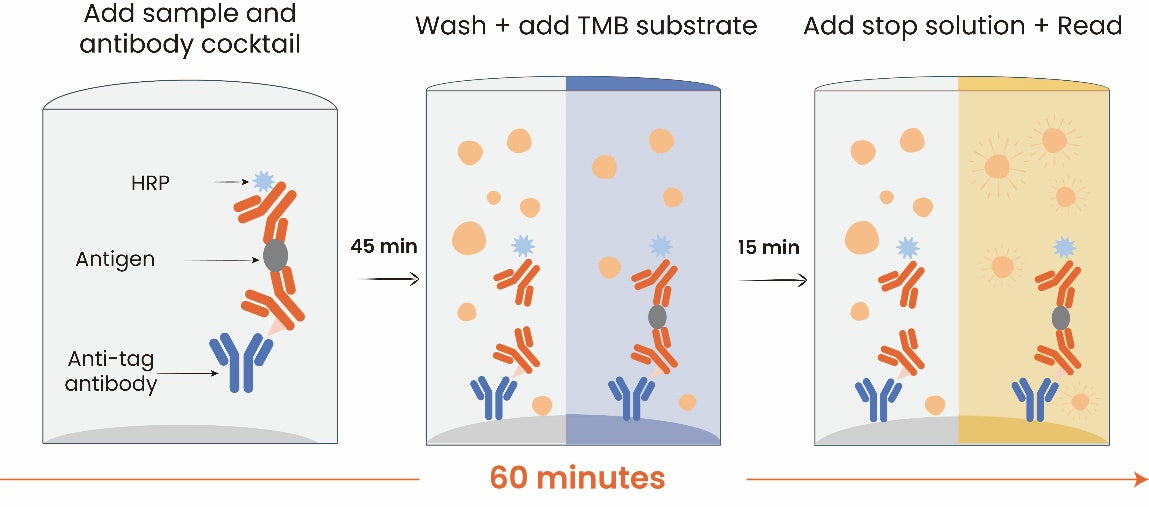
| Assay time | 60 minutes |
| Species reactivity | Hu |
Background
Human APOE (Apolipoprotein E) is a key protein involved in lipid metabolism, primarily produced in the liver and brain. It functions as a carrier for cholesterol and other fats, facilitating their transport through the bloodstream. APOE exists in three common isoforms—APOE2, APOE3, and APOE4—which differ by single amino acids. Among these, APOE4 is the strongest genetic risk factor for late-onset Alzheimer's disease, while APOE2 appears to offer some protective effects. The protein also plays a crucial role in neuronal repair and inflammation regulation within the central nervous system. Its interaction with cellular receptors allows cells to take up lipids for membrane maintenance and energy. Overall, APOE is essential for both cardiovascular and brain health, with its genetic variations significantly influencing disease susceptibility.
Picture
Picture
ELISA
To assess the linearity of the assay, sample was spiked with high concentrations of Human Apolipoprotein E/APOE in various matrices and diluted with the appropriate Calibrator Diluent to produce samples with values within the dynamic range of the assay.
Protocol Diagram