
Angiopoietin-1 His Tag Protein, Cynomolgus
Angiopoietin-1 His Tag Protein, Cynomolgus

Product Details
Product Details
Product Specification
| Species | Cynomolgus |
| Synonyms | AGP1; AGPT; Ang1; ANG-1; angiopoietin 1; ANGPT1; KIAA0003 |
| Accession | XP_005563980.1 |
| Amino Acid Sequence | Arg276-Phe497, with C-8*His |
| Expression System | HEK293 |
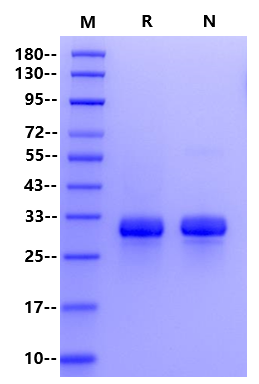
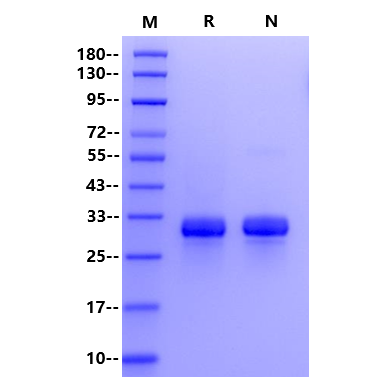
| Molecular Weight | 28-33kDa (Reducing) |
| Purity | >95% by SDS-PAGE |
| Endotoxin | <0.1EU/μg |
| Conjugation | Unconjugated |
| Tag | His Tag |
| Physical Appearance | Lyophilized Powder |
| Storage Buffer | PBS, pH7.4 |
| Reconstitution | Reconstitute at 0.1-1 mg/ml according to the size in ultrapure water after rapid centrifugation. |
| Stability & Storage | · 12 months from date of receipt, lyophilized powder stored at -20 to -80℃. · 3 months, -20 to -80℃ under sterile conditions after reconstitution. · 1 week, 2 to 8℃ under sterile conditions after reconstitution. · Please avoid repeated freeze-thaw cycles. |
Background
Angiopoietin-1 (Ang-1) is a secreted glycoprotein that plays a critical role in the development and maintenance of the vascular system. It contains a N-terminal coiled-coil region and a C-terminal fibrinogen-like domain separated by a short flexible region. Angiopoietin-1 binds and activates the receptor tyrosine kinase Tie-2, and its association into tetramers is important for full Tie-2 activation. Angiopoietin-1 ligation of Tie-2 on vascular endothelial cells (EC) induces the development and branching of blood vessels. In confluent EC (i.e. in homeostasis), multimeric Angiopoietin-1 enhances vascular integrity by promoting the in trans homotypic association of Tie-2 between EC or with the substratum. In addition, Angiopoietin-1 suppresses several VEGF-induced effects on the vasculature including endothelial permeability, stretch-induced release of Angiopoietin-2, and up-regulation of the leukocyte adhesion molecules VCAM-1, ICAM-1, and E-Selectin. Angiopoietin-1 also interacts with a variety of integrins and the extracellular matrix independently of Tie-2. These interactions support the adhesion, migration and stress resistance of EC, fibroblasts, and myocytes. Angiopoietin-1 can protect against pulmonary arterial hypertension, reduce the extent of fibrosis and remodeling in infarcted diabetic myocardium, and enhance tumor progression and metastasis.
Picture
Picture
SDS-PAGE