Unione® TR-FRET Human TSLP/TSLPR Binding Kit
Unione® TR-FRET Human TSLP/TSLPR Binding Kit

Product Details
Product Details
Product Specification
| Host | Human |
| Stability & Storage | -80℃ |
Background
[Background Introduction]
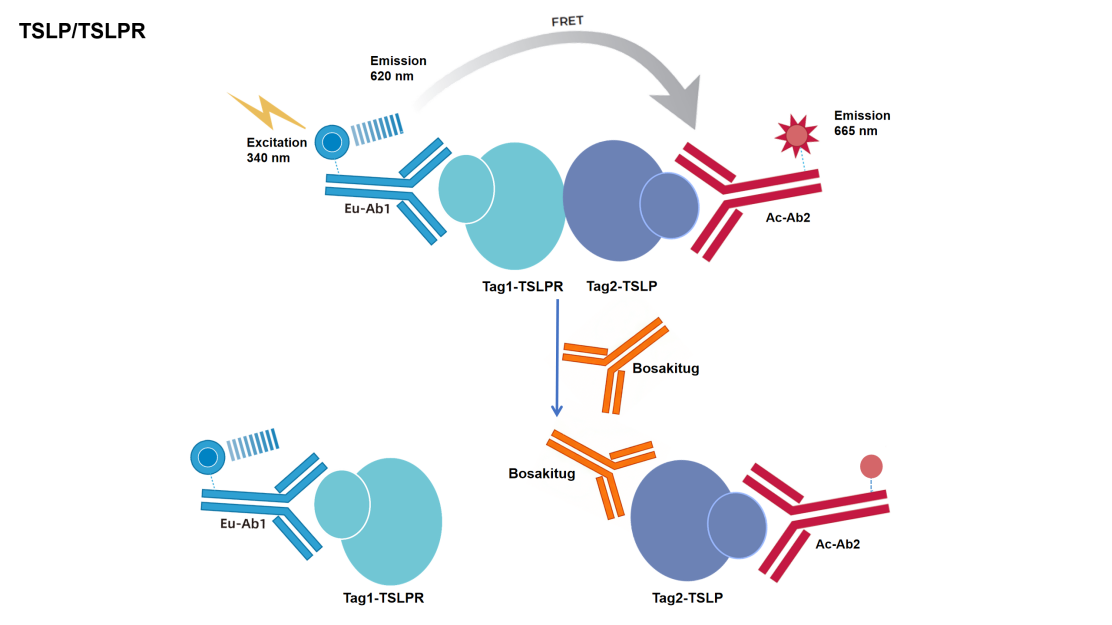
The kit employs homogeneous time-resolved fluorescence technology (TR-FRET) to measureTSLPand its interaction withTSLPR. This method enables simple and rapid high-throughput screening of inhibitors and antibody blockers.
Components
[Product Componentsand Storage Conditions]
Components |
Concentration |
100T |
500T |
2500T |
10000T |
Storage Temperature |
Tag1-TSLPRprotein |
100× |
5μL |
20μL |
100μL |
400μL |
-80℃ |
Tag2-TSLPprotein |
100× |
5μL |
20μL |
100μL |
400μL |
-80℃ |
Anti-Tag1 Eu antibody |
100× |
5μL |
25μL |
125μL |
500μL |
-80℃ |
Anti-Tag2 Ac antibody |
25× |
20μL |
100μL |
500μL |
2000μL |
-80℃ |
Detection buffer |
10× |
400μL |
2mL |
10mL |
40mL |
-80℃ |
Caution: After the first thaw, immediately aliquot and store at the recommended temperature. Avoid storing diluted samples or subjecting them to repeated freeze-thaw cycles.
Protocol
[Experimental Procedure and Operations]
1,Reagent Preparation
1.1Before use, thaw all reagents at room temperature (allow them to equilibrate at room temperature for at least 30 minutes). The reaction system in a 384-well plate is 20μL (the amount of reagents for the reaction system is shown in the table). Calculate the required volume before preparation and prepare accordingly; the following preparation is for reference only, using 500 reactions as an example.
Table 1.Reagent Preparation
Reagent Name |
Configuration |
Amount per Detection Well (μL) |
Detection buffer |
Take 2mL of 10× Detection Add 18 mL of deionized water to the buffer, diluteto1×, mixthoroughly and set asidefor use.- |
Tag1- |
TSLPRproteinTake 2 |
0μL of Tag1-TSLPRprotein stock solution,1×diluted with Detection bufferto2mL ,mix well and set asidefor use. |
4 |
Tag2-TSLPprotein |
take 20μL of Tag2-TSLPprotein stock solution, diluted 1×with Detection bufferto2mL ,Mix well and set aside. |
4 |
Mix |
Take25μL of Anti-Tag1 Eu antibody stock solution, add 1×Detection buffer 2.475mL,mix well and set aside; take100 μL of Anti-Tag2Acantibody stock solution, add 1×Detection buffer 2.4mL,mix well and set aside; Anti-Tag1 Eu antibody and Anti-Tag2Acantibody are each diluted and then mixed 1:1mix well and set aside. |
10 |
1.2sample to be testedgradient dilution
takingBosakitugas an example, the diluent is 1× Detection buffer,to reduce the influence of matrix effect interference, it is recommended to use a solution with the same matrix as the sample to be tested for dilution; andthe sample to be tested should be adjusted according to its actual concentration.
Table2.Positive drugBosakitugGradient dilution(adjusted according to the actual situation)
BosakitugFinal concentrationnM |
BosakitugConfiguration concentrationnM |
Preparation method |
|
① |
10.00 |
100.00 |
3μL 2μMBosakitug+57μL 1× Detection buffer |
② |
5.00 |
50.00 |
30μL ①+30μL 1× Detection buffer |
③ |
2.50 |
25.00 |
30μL ②+30μL 1× Detection buffer |
④ |
1.25 |
12.50 |
30μL ③+30μL 1× Detection buffer |
⑤ |
0.63 |
6.25 |
30μL ④+30μL 1× Detection buffer |
⑥ |
0.31 |
3.13 |
30μL ⑤+30μL 1× Detection buffer |
⑦ |
0.16 |
1.56 |
30μL ⑥+30μL 1× Detection buffer |
⑧ |
0.08 |
0.78 |
30μL ⑦+30μL 1× Detection buffer |
⑨ |
0.04 |
0.39 |
30μL ⑧+30μL 1× Detection buffer |
Blank |
0 |
0 |
30μL 1× Detection buffer |
2,Sample addition and controls
2.1 Sample addition order for experimental wells: 2 μL of the sample to be tested, 4 μLTag2-TSLPproteinworking solution, 4 μLTag1-TSLPRproteinworking solution, a mixed solution of 10 μL, added sequentially into the 384-well plate;
2.2maximum valuecontrol: 2 μL of 1× Detection buffer dilutedliquid,4 μLTag2-TSLPproteinworking solution, 4 μLTag1-TSLPRproteinworking solution, a mixed solution of 10 μL,added sequentially into the 384-well plate;
2.3 Quality control well (NC):10μL of 1× Detection buffer plus10μLMix.
After all samples have been added, centrifuge, cover with a plate seal, and incubate at room temperature1hour.
Maximum valueControl |
Sample |
NC |
|
Step one |
2 μL 1× DetectionBuffer |
2μL Gradient dilution of the sample to be tested |
10uL 1× DetectionBuffer |
4 μLTag2-TSLPproteinworking solution | |||
incubate for 10 min | |||
|
Step two |
4 μLTag1-TSLPRproteinworking solution |
||
10μLMix | |||
Step three |
seal the plate with a membrane, incubate at room temperature1h |
||
3,detection
Detect on an ELISA reader compatible with TR-FRET.Excitation light is 320/340 nm, detecting emission wavelengths at 620 nm and 665 nmemissionwavelengths.
[Result Calculation]
1)Calculate the signal value(Ratio): The fluorescence signal at 665 nm divided by the fluorescence signal at 620 nm, then multiplied by 10,000.
Ratio = (665/620)×10000
2)Calculated based on the signal valueNet signal:
Net signal= (Std-NC)/NC×100
3)Calculate CV (%):
CV (%) = Standard Deviation/Mean Ratio × 100%
[Data Example]
The following data cannot replace the data obtained in experiments; it is only for illustration, and the results maydepend on the plate readerinstrumentvaries.
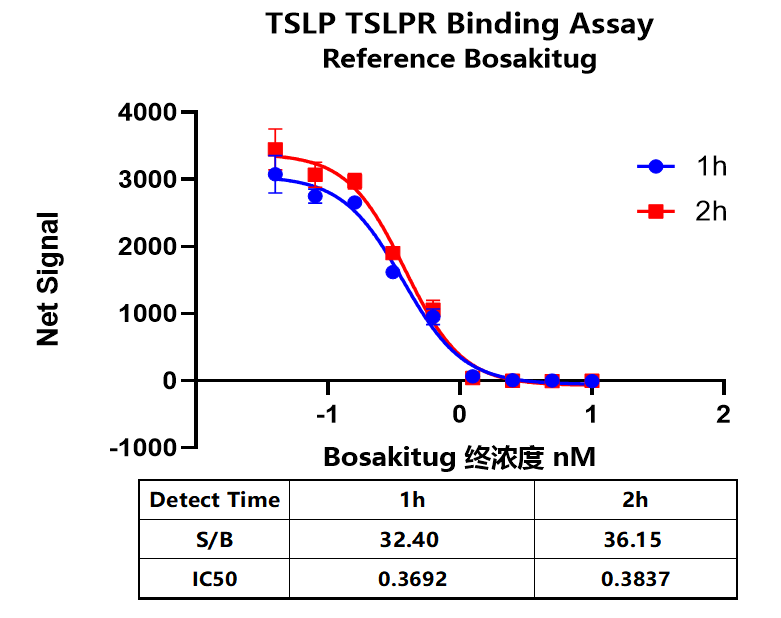
Note: Recommendedmicroplate (384-well plate, white, shallow wells)