WB result of Phospho-TAZ (ser89)/Phospho-YAP (Ser127) Recombinant Rabbit mAb
Blocking/Diluting buffer and concentration: 5% NFDM/TBST
Primary antibody: Phospho-TAZ (ser89)/Phospho-YAP (Ser127) Recombinant Rabbit mAb at 1/1000 dilution
Lane 1: PANC-1 whole cell lysate 20 µg
Secondary antibody: Goat Anti- rabbit IgG, (H+L), HRP conjugated at 1/10000 dilution
Predicted MW: 54 kDa
Observed MW: 54 kDa
This blot was developed with high sensitivity substrate
Phospho-TAZ (ser89)/Phospho-YAP (Ser127) Recombinant Rabbit mAb (S-1364-129)
Phospho-TAZ (ser89)/Phospho-YAP (Ser127) Recombinant Rabbit mAb (S-1364-129)
Price:
Regular price
$100 USD
Regular price
Sale price
$100 USD
Unit price
per
For shipping services or bulk orders, you may request a quotation.
Secure checkout with

View full details
Product Details
Product Details
Product Specification
| Host | Rabbit |
| Antigen | Phospho-TAZ (ser89)/Phospho-YAP (Ser127) |
| Synonyms | WW domain-containing transcription regulator protein 1; Transcriptional coactivator with PDZ-binding motifImported; TAZ s; WWTR1 |
| Immunogen | Synthetic Peptide |
| Location | Cell membrane, Cytoplasm, Nucleus |
| Accession | Q9GZV5、P46937 |
| Clone Number | S-1364-129 |
| Antibody Type | Recombinant mAb |
| Isotype | IgG |
| Application | WB, ICC |
| Reactivity | Hu, Rt |
| Positive Sample | PANC-1, HeLa (treated with 100 ng/ml Calyculin A for 30 minutes), C6 (treated with 100 ng/ml Calyculin A for 30 minutes) |
| Purification | Protein A |
| Concentration | 0.5 mg/ml |
| Conjugation | Unconjugated |
| Physical Appearance | Liquid |
| Storage Buffer | PBS, 40% Glycerol, 0.05% BSA, 0.03% Proclin 300 |
| Stability & Storage | 12 months from date of receipt / reconstitution, -20 °C as supplied |
Dilution
| application | dilution | species |
| WB | 1:1000 | Hu, Rt |
| ICC | 1:500 | Hu |
Background
Phospho-TAZ (Ser89) and Phospho-YAP (Ser127) are the inactivated forms of the transcriptional coactivators TAZ (also known as WWTR1) and YAP (Yes-associated protein), respectively, following phosphorylation at serine residue 89 and serine residue 127, representing the activation state of the Hippo signaling pathway. These two phosphorylation sites are located within the 14-3-3 protein binding regions of TAZ and YAP, respectively. When the upstream kinase cascade (such as MST1/2 and LATS1/2) is activated, LATS1/2 directly phosphorylates YAP at Ser127 and TAZ at Ser89. The phosphorylated YAP/TAZ then bind to 14-3-3 proteins in the cytoplasm, leading to cytoplasmic sequestration and ubiquitin-mediated degradation, thereby preventing their nuclear translocation and transcriptional regulatory functions. The Hippo signaling pathway regulates the phosphorylation status of TAZ and YAP, participating in the control of organ size, tissue homeostasis, cell proliferation, and apoptosis. In various tumors, reduced phosphorylation levels of TAZ/YAP (i.e., enhanced activation) are commonly observed. These phosphorylation sites are typically detected using specific antibodies via methods such as immunoblotting or immunohistochemistry, serving as key molecular markers for assessing Hippo signaling pathway activity and the nuclear translocation status of TAZ/YAP.
Picture
Picture
Western Blot
WB result of Phospho-TAZ (ser89)/Phospho-YAP (Ser127) Recombinant Rabbit mAb
Blocking/Diluting buffer and concentration: 5% NFDM/TBST
Primary antibody: Phospho-TAZ (ser89)/Phospho-YAP (Ser127) Recombinant Rabbit mAb at 1/1000 dilution
Lane 1: untreated HeLa whole cell lysate 20 µg
Lane 2: HeLa treated with 100 ng/ml Calyculin A for 30 minutes whole cell lysate 20 µg
Secondary antibody: Goat Anti- rabbit IgG, (H+L), HRP conjugated at 1/10000 dilution
Predicted MW: 54 kDa
Observed MW: 50- 56 kDa
This blot was developed with high sensitivity substrate
WB result of Phospho-TAZ (ser89)/Phospho-YAP (Ser127) Recombinant Rabbit mAb
Blocking/Diluting buffer and concentration: 5% NFDM/TBST
Primary antibody: Phospho-TAZ (ser89)/Phospho-YAP (Ser127) Recombinant Rabbit mAb at 1/1000 dilution
Lane 1: untreated C6 whole cell lysate 20 µg
Lane 2: C6 treated with 100 ng/ml Calyculin A for 30 minutes whole cell lysate 20 µg
Secondary antibody: Goat Anti- rabbit IgG, (H+L), HRP conjugated at 1/10000 dilution
Predicted MW: 54 kDa
Observed MW: 50- 56 kDa
This blot was developed with high sensitivity substrate
Immunocytochemistry
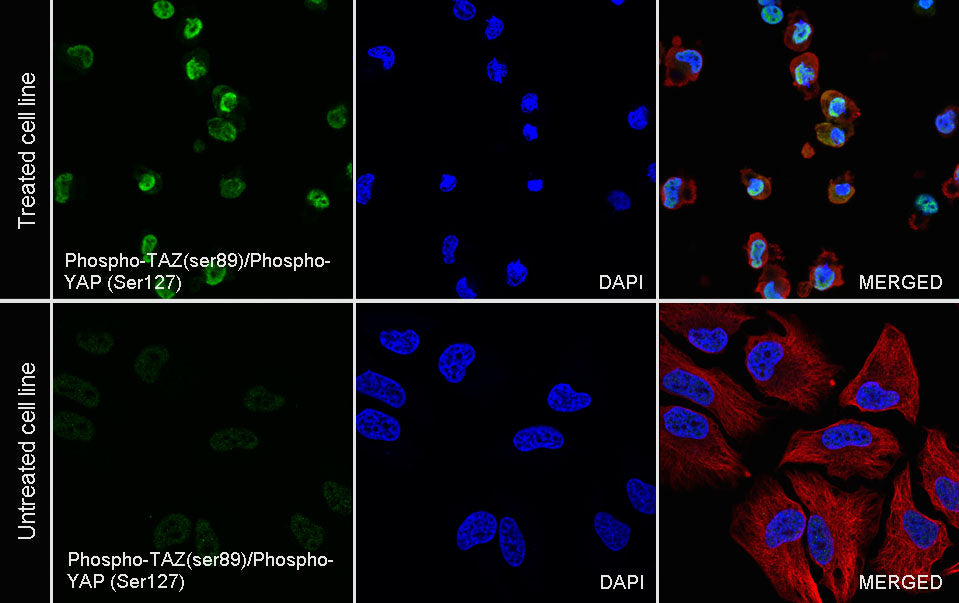
ICC analysis of HeLa cells treated with Calyculin A (100ng/ml,30min) (top panel) and untreated HeLa cells (below panel). Anti-Phospho-TAZ (ser89)/ Phospho-YAP (Ser127) antibody was used at 1/500 dilution (Green) and incubated overnight at 4°C. Goat polyclonal Antibody to Rabbit IgG - H&L (Alexa Fluor® 488) was used as secondary antibody at 1/1000 dilution. The cells were fixed with 4% PFA and permeabilized with 0.1% PBS-Triton X-100. Nuclei were counterstained with DAPI (Blue). Counterstain with tubulin (Red).