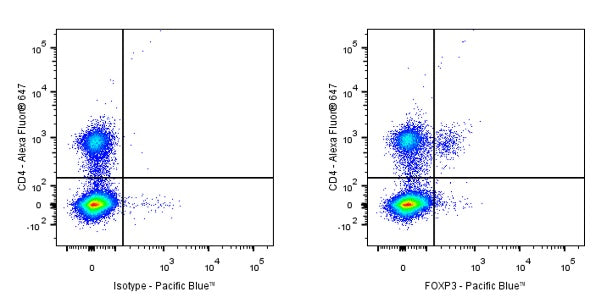
Flow cytometric analysis of FOXP3 expression in C57BL/6 mouse splenocytes. C57BL/6 mouse splenocytes were fixed and permeabilized with Foxp3 / Transcription Factor Staining Buffer Set. The cells were then stained with Alexa Fluor® 647 Rat Anti- Mouse CD4 Antibody and either Pacific Blue™ Rat IgG2b Isotype Control or SDT Pacific Blue™ Rat Anti-Mouse FOXP3 Antibody at 1.25 μl/test. Flow cytometry and data analysis were performed using BD FACSymphony™ A1 and FlowJo™ software.
Pacific Blue Rat Anti-Mouse FOXP3 Antibody (MF23)
Pacific Blue Rat Anti-Mouse FOXP3 Antibody (MF23)
Price:
Regular price
$210 USD
Regular price
Sale price
$210 USD
Unit price
per
For shipping services or bulk orders, you may request a quotation.
Secure checkout with

View full details
Product Details
Product Details
Product Specification
| Host | Rat |
| Antigen | FOXP3 |
| Synonyms | Forkhead box protein P3; Scurfin; Foxp3 |
| Location | Cytoplasm, Nucleus |
| Accession | Q99JB6 |
| Clone Number | MF23 |
| Antibody Type | Rat mAb |
| Isotype | IgG2b |
| Application | ICFCM |
| Reactivity | Ms |
| Purification | Protein G |
| Concentration | 0.2 mg/ml |
| Conjugation | Pacific Blue |
| Physical Appearance | Liquid |
| Storage Buffer | PBS, 1% BSA, 0.3% Proclin 300 |
| Stability & Storage | 12 months from date of receipt / reconstitution, 2 to 8 °C as supplied |
Dilution
| application | dilution | species |
| ICFCM | 1.25μl per million cells in 100μl volume | Ms |
Background
FOXP3 (Forkhead box protein P3) is a 47 kDa transcription factor that acts as the master immune‐suppression switch: it is expressed almost exclusively in CD4⁺ regulatory T (Treg) cells, where it binds to conserved forkhead DNA motifs to repress genes that drive effector T-cell proliferation (e.g., IL-2, IFN-γ) and simultaneously up-regulate genes for inhibitory cytokines (IL-10, TGF-β) and checkpoint molecules (CTLA-4, LAG-3); its N-terminal repressor domain recruits co-repressors such as EZH2 and HDACs, while the C-terminal winged-helix domain mediates DNA contact and homo-multimerization essential for chromatin looping at the IL-2 locus, and mutations in either segment—exemplified by the Δ2 splice variant or the human IPEX mutations p.A384T and p.R397W—abolish DNA binding or nuclear localization, unleashing fatal multi-organ autoimmunity; post-translational control further tunes Treg stability: TCR and IL-2 signals activate PI3K–AKT–mTOR cascades that phosphorylate FOXP3 at S418, enhancing its DNA affinity, whereas inflammatory cytokines like TNF-α and IL-6 trigger PIM1/CK2-mediated phosphorylation at S422 and ubiquitination by STUB1, leading to proteasomal degradation and conversion of Tregs into pro-inflammatory TH17 cells; in cancer, hypoxia-induced HIF-1α and oncogenic STAT3 similarly destabilize FOXP3, weakening intra-tumoral Treg suppressive function and paradoxically enabling immune evasion, whereas demethylating agents or low-dose IL-2 restore FOXP3 expression and are being tested clinically to curb graft-versus-host disease and autoimmunity, making FOXP3 both a biomarker of immune tolerance and a druggable node at the intersection of infection, autoimmunity, and cancer.
Picture
Picture
FC