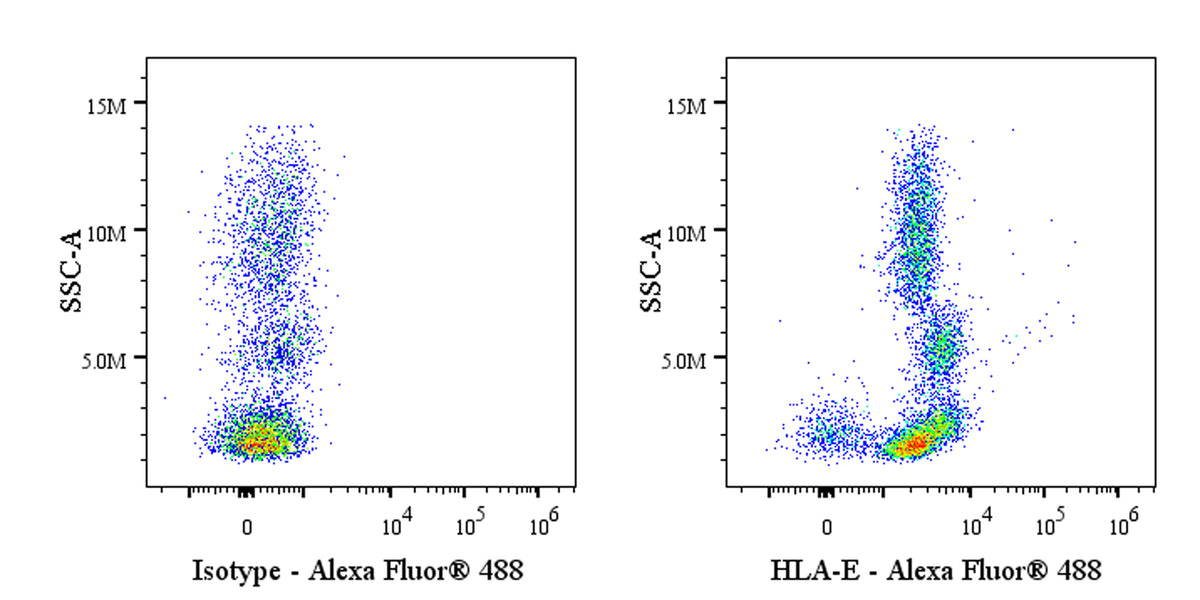
Flow cytometric analysis of human peripheral blood cells labelling human HLA-E antibody at 1/200 dilution (1 μg) / (right panel) compared with a Mouse IgG1, κ Isotype Control / (left panel). Goat Anti- Mouse IgG Alexa Fluor® 488 was used as the secondary antibody. Flow cytometry and data analysis were performed using Agilent NovoCyte Quanteon and FlowJo™ software.
Mouse Anti-Human HLA-E Antibody (3D12)
Mouse Anti-Human HLA-E Antibody (3D12)
Price:
Regular price
$100 USD
Regular price
Sale price
$100 USD
Unit price
per
For shipping services or bulk orders, you may request a quotation.
Secure checkout with

View full details
Product Details
Product Details
Product Specification
| Host | Mouse |
| Antigen | HLA-E |
| Synonyms | HLA class I histocompatibility antigen, alpha chain E; MHC class I antigen E; HLA-6.2; HLAE |
| Location | Cell membrane |
| Accession | P13747 |
| Clone Number | 3D12 |
| Antibody Type | Mouse mAb |
| Isotype | IgG1,k |
| Application | FCM |
| Reactivity | Hu |
| Positive Sample | Human peripheral blood cells |
| Purification | Protein G |
| Concentration | 2 mg/ml |
| Conjugation | Unconjugated |
| Physical Appearance | Liquid |
| Storage Buffer | PBS pH7.4 |
| Stability & Storage | 12 months from date of receipt / reconstitution, 2 to 8 °C as supplied |
Dilution
| application | dilution | species |
| FCM | 1:200 | Hu |
Background
HLA-E is a non-classical, oligomorphic class Ib major histocompatibility complex (MHC) molecule whose primary function centers on presenting highly conserved nonameric signal peptides (predominantly the VMAPRTLVL sequence, known as VL9) derived from the leader sequences of other classical HLA class I molecules (such as HLA-A, -B, -C, and -G) via a TAP-dependent processing pathway. These peptides form stable peptide-HLA-E-β2m trimers that are transported to the cell membrane, where they serve as key ligands for the CD94/NKG2 family of receptors expressed on NK cells and certain CD8⁺ T cells. Notably, HLA-E exhibits significantly higher affinity for the inhibitory receptor NKG2A than for the activating receptor NKG2C. This mechanism constitutes a real-time "sensing system" that monitors the overall expression levels of classical MHC-I molecules within the cell, enabling the immune system to recognize and eliminate "missing-self" cells—those that have downregulated classical MHC-I due to viral infection or malignant transformation. Unlike classical HLA molecules, HLA-E displays extremely low genetic polymorphism (predominantly represented by the E01:01 and E01:03 alleles), minimal surface expression levels, and a remarkably short half-life (approximately 12 minutes). Its cytoplasmic tail contains a unique lysine/tryptophan motif that drives clathrin-mediated rapid endocytosis via the adaptor protein AP-2, followed by endosomal peptide exchange and recycling through VCP-associated pathways. This unconventional intracellular trafficking mechanism enables HLA-E, under specific conditions (such as macrophages infected with mycobacteria or CMV-vectored vaccine strategies), to load suboptimal peptides derived from stress protein Hsp60 signal sequences or from pathogens including Mycobacterium, Salmonella, HIV, and SARS-CoV-2. These peptides are presented in an HLA-E-restricted manner to CD8⁺ T cells expressing TCRs featuring the unique TRAV17 gene segment, thereby eliciting adaptive immune responses. Given its dual role as both a central hub maintaining NK cell tolerance and a shared target exploited by viruses (such as HCMV and HIV) and tumors (which upregulate HLA-E to retain NK inhibitory signals and evade immunity), HLA-E has emerged as a critical target for developing "universal" T cell/NK cell immunotherapies and for designing novel CMV-vectored vaccines—exemplified by the clearance of SIV in rhesus macaques within the RhCMV/SIV model.
Picture
Picture
FC